

Funeral life insurance is designed to give a beneficiary money that may be used for a funeral, burial or cremation, and other bills that can arrive after a death. It can be a practical tool, but the label can be confusing. It is not a special government program, and the insurer usually does not pay a funeral home automatically. In most cases, it is simply a smaller life insurance policy whose death benefit goes to the beneficiary named by the owner.
Families often ask us whether life insurance can pay funeral expenses. The short answer is yes: a beneficiary generally may use policy proceeds for those costs. The more useful answer is that the policy must still be in force, the claim must be approved, and the beneficiary must understand what the coverage does and does not promise. A thoughtful plan also accounts for timing, other family obligations, and the possibility that actual costs will change.
This guide explains how funeral life insurance works, how it differs from prepaid funeral arrangements, what underwriting and waiting periods may apply, and how to estimate an appropriate amount without buying blindly. Our goal is not to make a difficult subject feel urgent. It is to help families turn a vague concern into a clear set of questions.
What funeral life insurance actually is
“Final expense insurance,” “burial insurance,” and “funeral insurance” are marketing descriptions rather than one uniform policy category. Many products sold under those names are whole life policies with a relatively modest death benefit. Premiums may be intended to remain level, the policy may build cash value, and coverage may last for life if required premiums are paid and the contract remains in force. Product details vary by company and state.
A family can also use proceeds from a larger term or permanent policy for funeral costs. There is no rule that requires a separate policy for each purpose. A household may have one amount intended to replace income, pay a mortgage, support children, and handle final expenses. Another household may keep a small permanent policy specifically for end-of-life costs after a larger term policy expires. The right structure depends on the need, budget, health, time horizon, and existing coverage.
The policy owner chooses a beneficiary. After the insured person dies, the beneficiary submits a claim and required documentation to the insurer. If the claim is approved, the insurer pays the death benefit according to the contract. The beneficiary, not the insurer, usually decides how to use the money unless a valid assignment or other arrangement changes that process.
Can life insurance pay for funeral expenses?
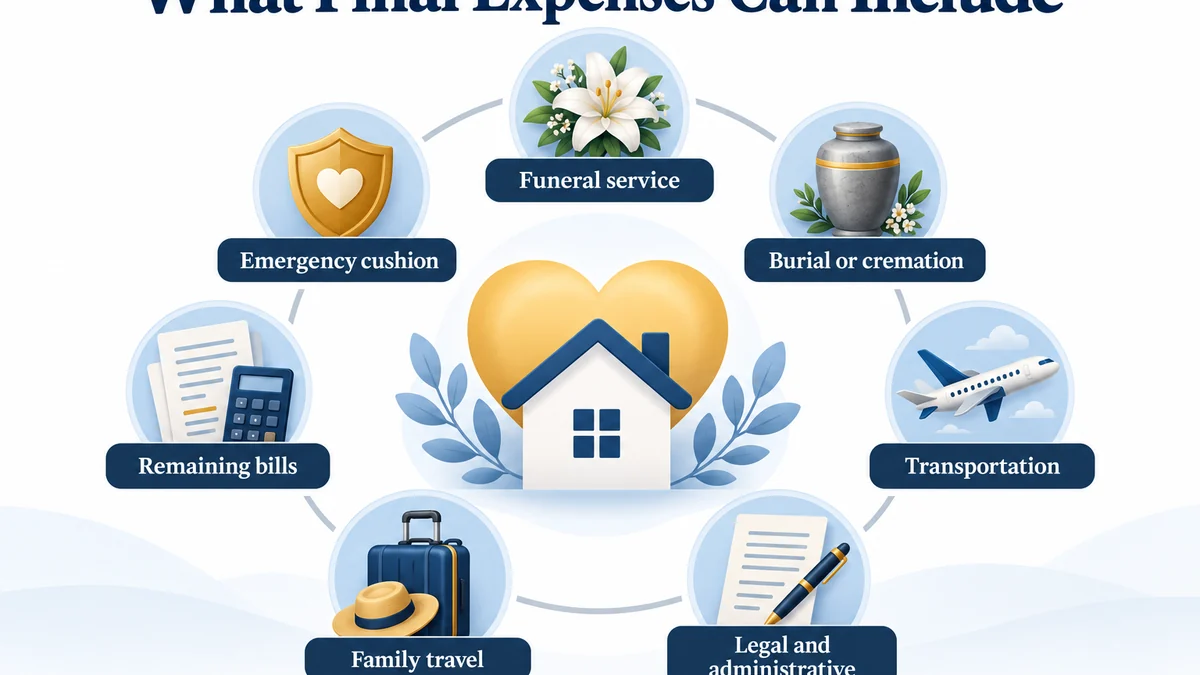
Yes. Life insurance proceeds can generally be used for a funeral service, burial, cremation, transportation, obituary, flowers, clergy or celebrant fees, death certificates, family travel, and other related needs. Proceeds may also help with remaining household bills, medical balances, legal or administrative costs, or a temporary cushion while the family organizes the estate.
That flexibility is useful because final expenses are rarely one invoice. Some costs come from the funeral provider, while others come from a cemetery, crematory, transportation company, county office, attorney, or travel provider. The Federal Trade Commission explains that a funeral bill may include a basic services fee, optional goods and services, and cash-advance items purchased from third parties. Its funeral costs and pricing checklist can help families organize the categories they want to compare.
There is an important distinction between “may be used” and “will arrive before every bill is due.” Claims require a death certificate and other information. The insurer may need additional review, especially if the death occurs during a contractual contestability period or if the application information raises a question. Families should not assume that every provider will wait for the claim or that the death benefit will be available immediately.
Funeral life insurance versus prepaid funeral arrangements
Funeral life insurance and a prepaid funeral contract solve different problems. A life insurance policy is an agreement with an insurer. It pays a death benefit to a beneficiary when the insured dies, subject to the contract. The proceeds may be used at any funeral home or for another purpose unless the benefit has been assigned or restricted through a separate legal arrangement.
A prepaid or preneed funeral contract is an agreement for specified goods and services, often with a funeral provider. Depending on the arrangement and state rules, funds may be placed in trust or connected to an insurance product. Prices may be guaranteed for some items but not others. Transferability, cancellation rights, refunds, portability, and what happens if the provider changes ownership all require careful review.
- Life insurance emphasizes flexible cash. The beneficiary can address the needs that exist at the time of death.
- Preplanning emphasizes decisions. It can document preferences and reduce the number of choices a family must make later.
- Prepaying emphasizes price and funding. It may secure certain services, but the contract determines what is guaranteed.
- The tools can coexist. A family may preplan without prepaying, or use insurance to supplement a limited preneed arrangement.
Before signing a preneed agreement, ask who owns the funds or policy, who receives any excess, what happens after a move, whether every promised item is guaranteed, and what cancellation or transfer charges apply. Those are contract and state-law questions, not details to infer from a brochure.
How to Estimate Your Funeral Life Insurance Needs
Start with the plan, not a round number. Write down the type of service you would prefer, whether burial or cremation is more likely, where family members live, and whether there are debts or household costs that might continue briefly. Then separate essential costs from preferences and optional items.
The FTC’s Funeral Rule guidance says consumers have the right to buy only the goods and services they want, obtain price information by telephone, receive a written General Price List when visiting a funeral home, and see casket and outer-burial-container price lists before viewing those products. Those rights make local comparison more useful than relying on a national “average” that may not match a family’s choices.
Request current itemized prices from several providers. Ask what the basic services fee includes, which services are optional, and which cemetery or crematory charges are separate. Include copies of death certificates, transportation, permits, family travel, a gathering or meal, an obituary, and any religious or cultural practices that matter. If you want a cushion, label it separately instead of hiding it inside the funeral estimate.
Next, subtract resources that are truly available for this purpose. That may include existing life insurance, a dedicated savings account, an employer benefit, a valid preneed contract, or benefits for an eligible veteran. Do not count an asset that another person needs for rent, food, medical care, or taxes. A resource is not “available” merely because it appears on a balance sheet.
Our life insurance needs calculator can help place final expenses within the larger protection picture. It is an educational starting point, not an underwriting quote or recommendation. If income replacement, debts, education, or caregiving needs are also important, a small funeral life insurance policy should not distract from them.
Funeral Life Insurance Policy Types Families Commonly Compare
Level-benefit whole life
A level-benefit whole life policy may provide the full stated natural-death benefit from the policy’s start, subject to all contract terms and exclusions. It generally requires enough underwriting for the insurer to decide that immediate full coverage is appropriate. Premiums may be level, and the policy may accumulate guaranteed cash value. “Level” does not mean every feature is identical among carriers, so review the schedule of benefits, premiums, exclusions, and nonforfeiture provisions.
Graded or modified-benefit whole life
A graded or modified policy may limit the natural-death benefit during an initial period. For example, the contract might return premiums plus stated interest or pay a percentage of the face amount if death from natural causes occurs early. Accidental-death treatment can differ. These policies may be available to applicants who do not qualify for immediate full coverage, but availability is not the same as suitability. The waiting-period language deserves a line-by-line review.
Guaranteed-issue coverage
Guaranteed-issue policies generally ask few or no health questions within stated age and benefit limits. They often use a graded benefit for early natural death, and the cost per dollar of coverage may be higher than medically underwritten alternatives. “Guaranteed issue” does not mean every claimant automatically receives the full face amount immediately, and it does not remove the duty to pay premiums.
Term life insurance
Term insurance can provide a larger death benefit for a defined period and may be cost-effective for temporary needs. It does not guarantee lifetime coverage. If funeral funding is the only remaining need after the term ends, the family may have to rely on savings, conversion rights, renewal, or new coverage at an older age. Term can still be the better fit when the principal need is income replacement or debt protection during working years.
Funeral Life Insurance Underwriting and Waiting Periods
Applications can range from full medical underwriting to a short set of health questions. The wording matters. A simplified application may ask about recent hospitalizations, serious diagnoses, nursing care, oxygen use, or pending tests. Applicants should answer accurately and completely. A fast application is not permission to guess or omit information.
Ask the agent to identify the exact benefit payable for death from natural causes in policy year one, policy year two, and after any graded period. Ask separately about accidental death. Review the suicide exclusion and contestability language. The insurer’s ability to investigate a claim during the contestability period is different from a graded death benefit, although both may affect an early claim.
- Is the full natural-death benefit effective on the issue date?
- If not, what is paid during each early policy year?
- How is accidental death defined and what exclusions apply?
- Are premiums guaranteed, and for how long are they payable?
- What happens after a missed payment, and how long is the grace period?
- Does the policy build cash value, and what happens if it is surrendered?
- Can the policy be reduced or adjusted if the budget changes?
A policy that is easier to obtain may carry meaningful tradeoffs. Compare the benefit timeline and total premium commitment, not just the first monthly payment. When better-underwritten coverage is available, it may provide more benefit for the premium. When it is not available, a graded policy may still solve part of the need if the limitations are understood.
How Beneficiaries and Claims Affect Funeral Life Insurance
A good funeral life insurance plan identifies a beneficiary who is likely to be available, capable of handling the claim, and aware of the policy. Naming “my estate” can cause proceeds to pass through estate administration, where timing and creditor treatment may differ from a direct beneficiary payment. Naming a minor directly can also create delays or require a court-supervised arrangement. Beneficiary choices have legal consequences, so complex situations may call for an attorney.
Keep the insurer’s name, policy number, agent contact, and basic claim instructions in a place the beneficiary can find. Do not hide the only copy in a safe deposit box that no one can access. Tell the beneficiary that coverage exists without posting sensitive information publicly. Review the designation after marriage, divorce, death, birth, adoption, or a significant change in relationships.
Some funeral homes accept an assignment of life insurance proceeds. An assignment can allow a provider to receive an agreed portion directly, with any remaining proceeds going to the beneficiary. That arrangement should be voluntary, written, limited to the amount owed, and reviewed before signing. Ask about assignment fees, what happens if the claim is delayed, and where any excess goes.
Public benefits may help, but eligibility is specific
Families sometimes assume Social Security will cover funeral costs. The Social Security Administration states that an eligible spouse might receive a one-time lump-sum death payment of $255; if there is no spouse, certain children may qualify. Eligibility conditions and a filing deadline apply. That payment can help, but it is not a substitute for estimating the actual need.
Eligible veterans and survivors may have additional resources. The U.S. Department of Veterans Affairs describes burial allowances and transportation benefits for qualifying circumstances, and benefits can depend on service connection, place of care, relationship, reimbursement from other sources, and other requirements. Current amounts and rules can change, so check the VA directly rather than relying on an old brochure.
VA national cemetery benefits may also include a gravesite, opening and closing, a government burial liner, a marker, and perpetual care for eligible people. Those benefits can reduce some costs, but they do not necessarily cover every service, travel expense, or family preference. Confirm eligibility and document availability before treating any benefit as guaranteed.
Common mistakes with funeral life insurance
Buying from emotion instead of a written estimate
A television advertisement may make a round benefit sound universally appropriate. It is better to list the anticipated costs, available resources, and other protection needs. The result may be smaller or larger than the advertised amount. The purpose of the exercise is clarity, not matching a slogan.
Assuming no health questions means no waiting period
Guaranteed-issue coverage frequently limits early natural-death benefits. An applicant who expects immediate full coverage can be badly disappointed. Read the benefit schedule and ask for an explanation in plain language.
Ignoring total premiums and affordability
A permanent policy may require premiums for many years. Calculate the annual amount and consider whether it remains manageable if income changes. Cancelling after years of payments can leave the family without the intended benefit, and surrender value may be less than total premiums paid.
Treating cash value as a free extra
Cash value belongs to the policy design and affects cost. Loans, withdrawals, and surrender can reduce benefits or cause coverage to end. Any access strategy should be reviewed against the contract and possible tax consequences. A policy purchased mainly for final expenses should not be weakened casually.
Failing to review the beneficiary
A deceased beneficiary, outdated former spouse, or minor without an appropriate arrangement can complicate a claim. Review the primary and contingent beneficiaries periodically and keep contact information current.
A fair way to compare two policies
Compare policies with the same proposed insured, benefit amount, payment schedule, and underwriting class. Place the guaranteed values and contractual benefits side by side. A lower monthly premium may reflect a smaller benefit, a longer graded period, different underwriting, or a different payment duration.
- Benefit timing: What is payable for natural and accidental death in each early year?
- Premium guarantee: Can the required premium change?
- Payment period: Are premiums due for life or for a limited period?
- Cash values: What guaranteed value is available upon surrender?
- Riders: Which are included, optional, or unavailable?
- Insurer: What are the company’s financial-strength ratings and claims process?
- Replacement impact: Would a new policy restart waiting, contestability, or surrender periods?
Financial-strength ratings are opinions, not guarantees, but they can be part of due diligence because claims depend on the insurer’s claims-paying ability. Review ratings from more than one recognized agency when practical, and understand that ratings can change.
When You May Not Need Funeral Life Insurance
Not every family needs a separate funeral life insurance policy. A household with sufficient liquid savings, clear beneficiary arrangements, and broader coverage may already have the need addressed. Self-funding can avoid insurance costs, but the funds must remain available and easy for the right person to access.
Existing employer insurance can help, yet employment-based coverage may end or shrink after retirement. A group certificate should be reviewed for portability, conversion, reduction schedules, and beneficiary rules. Do not count it as lifetime coverage without confirming those terms.
An existing individual policy may already be sufficient. Before replacing it, compare guarantees, health changes, contestability, suicide provisions, surrender charges, tax implications, and the risk that new coverage is not issued as expected. Never cancel the old policy until the new policy is in force and has been reviewed. Replacement decisions deserve carrier-, state-, tax-, and legal-specific guidance when applicable.
A hypothetical planning example
The following is a hypothetical example, not a real customer or promised outcome. Maria is 67, owns a small term policy that will expire in several years, and has modest savings. She wants cremation, a family memorial, travel help for two adult children, and a cushion for final household bills. Instead of starting with a policy amount, she requests local prices, lists the non-funeral costs, and identifies which savings must remain available for her spouse.
Maria compares keeping part of the need in savings with purchasing permanent coverage. She qualifies for one policy with an immediate level benefit and another with a graded natural-death benefit. The graded policy is easier to obtain but provides less protection during the early years. She reviews affordability, the beneficiary designation, and how the plan would work if she moved.
The valuable result is not a particular product. It is that Maria’s family knows her preferences, where the documents are, who will file the claim, and which expenses are expected. Insurance is one part of an organized plan rather than a substitute for communication.
Questions to ask before accepting funeral life insurance
- What type of life insurance is this?
- Is the full natural-death benefit available immediately?
- What is paid during any graded or modified period?
- Are premiums guaranteed, and how long must they be paid?
- What happens if a payment is late?
- What exclusions and contestability provisions apply?
- Does the policy build cash value, and what are the surrender terms?
- How do loans or withdrawals affect the death benefit?
- Who should be the primary and contingent beneficiaries?
- How is a claim filed, and what documents are normally required?
- Can the benefit be assigned to a funeral provider, and what fees apply?
- Would existing savings or coverage address the need more efficiently?
- What changes if I move to another state?
- Am I replacing another policy, and what protections would restart?
Ask for the policy illustration or buyer’s guide when applicable, and keep the delivered contract. Use any free-look period to confirm that the policy matches what was explained. If the wording differs from the conversation, the contract controls.
Build a Funeral Life Insurance Plan Your Family Can Use
Funeral life insurance can create a defined pool of money at death, but the best plan combines appropriate coverage with current beneficiaries, realistic cost information, accessible records, and family communication. We can help explain life insurance options, policy tradeoffs, underwriting, and the questions to take to investment, tax, and legal professionals. We do not provide individualized investment, tax, or legal advice.
About Jay A. Cohen, The Ocala Insurance Guy
Jay A. Cohen is a licensed health and life insurance agent based in Ocala, Florida. He is licensed to serve clients in Florida, Virginia, Illinois, Utah, and California. We listen first, explain coverage choices and tradeoffs in plain language, and help families prepare practical questions without pressure.
If you are planning for funeral expenses or reviewing final expense insurance, you can explore our life insurance information, learn more about Jay A. Cohen and The Ocala Insurance Guy, or use The Ocala Insurance Guy Contact Form to request an educational review.
This article provides general educational information and is not individualized insurance, investment, legal or tax advice. Policy provisions, availability and requirements vary by insurer and state. Consult qualified professionals before replacing, surrendering, borrowing from or materially changing a life insurance policy.