

“Can we still get life insurance if we have diabetes?” It is a fair question, and a diagnosis does not automatically make the answer no. Life insurance for diabetics may be available for people with type 1 or type 2 diabetes. The choices and price depend on the full health picture: the diagnosis, treatment, recent laboratory results, complications, and the coverage requested.
Here is where people can get frustrated: a friend has diabetes and was approved, so why is another application taking longer or costing more? The diagnosis is only the starting point. Think of it as the title on a folder. An underwriter still needs to read what is inside.
Life insurance underwriting is the insurer’s process for assessing risk and deciding what coverage and price it can offer. The National Association of Insurance Commissioners explains how underwriting fits into insurance. Each carrier has its own guidelines, which is why the same health history can lead to different offers.
We will walk through what insurers commonly ask, how A1C fits into the picture, and what “no exam” really means. The goal is to help you prepare and compare choices, without promising an approval or telling you how to manage your medical care.
Can People With Diabetes Get Life Insurance?
Yes, many can. The more useful question is: what form of life insurance for diabetics may be available for this person, at this time, from which carrier, and at what cost? An applicant whose diabetes is stable, monitored, and free of major complications may have more choices than someone whose condition was recently diagnosed, whose treatment is changing, or whose records show significant complications. That does not mean the second person has no options. It may mean a different product, a smaller amount, a higher premium, a postponement, or a graded-benefit design.
Life insurance decisions are individualized. Type 1 and type 2 diabetes are not interchangeable, and neither label tells an underwriter everything. Age at diagnosis, duration, control over time, other health conditions, and follow-up care can all matter. Gestational diabetes or prediabetes may also prompt questions, even if the applicant does not currently use diabetes medication.
It is also important to separate “possible” from “guaranteed.” An agent can help organize information and identify carriers that may be more receptive to a particular history, but the insurer makes the underwriting decision. No responsible explanation of life insurance for diabetics should promise a rating, approval, or premium before underwriting is complete.
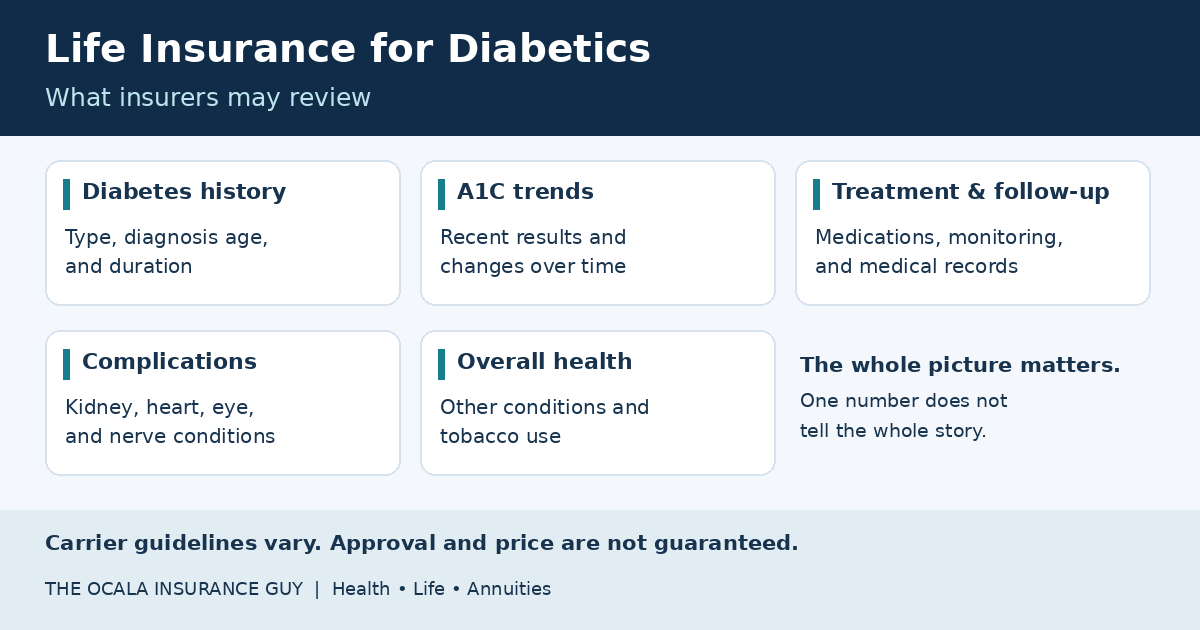
What Underwriters Review for Life Insurance for Diabetics
An application usually begins with basic facts: age, occupation, residence, tobacco or nicotine use, requested benefit, beneficiary, and the reason for coverage. For an applicant with diabetes, the insurer may request more detail through application questions, a telephone interview, medical records, prescription-history data, laboratory results, or an examination. That additional record helps the carrier evaluate life insurance for diabetics in context.
Type of diabetes and age at diagnosis
Underwriters usually want to know whether the applicant has type 1, type 2, gestational diabetes, or another documented condition. They may ask when it was diagnosed because duration affects the context. At the same current age, someone diagnosed earlier has lived with the condition longer, while a recent diagnosis may not yet have a long record showing stability. Neither fact alone decides the application.
A1C results and trends
The Centers for Disease Control and Prevention describes the A1C test as a measure of average blood sugar over roughly the previous three months. That longer view is one reason it often appears in underwriting records. An underwriter may consider the recent value, earlier values, and whether the trend appears stable, improving, or worsening.
An A1C result is not a universal life-insurance cutoff. The CDC notes that treatment goals are individualized, even though 7% or less is a common medical goal for many people with diabetes. Insurers also use different underwriting manuals and may weigh the rest of the record differently. The same A1C can lead to different underwriting decisions at different carriers.
Context matters for another reason: the CDC says A1C results can be affected by conditions such as severe anemia, kidney failure, liver disease, certain blood disorders, some medicines, blood loss or transfusion, and pregnancy. Applicants should not diagnose or reinterpret a test for an insurer. They should make sure the application and medical records accurately describe any relevant context.
Treatment and follow-up
The insurer may ask about diet and activity changes, oral medication, injectable medication, insulin, glucose monitoring, or continuous glucose monitoring. Treatment intensity by itself does not tell the whole story. What matters is how the treatment fits the diagnosis and whether records show appropriate follow-up. The American Diabetes Association explains that monitoring plans differ by person and treatment.
Regular care can make your health history easier to document. Long gaps in visits, missed laboratory work, or conflicting medication information may create questions even when the applicant feels well. If there is a reasonable explanation—such as a move, a change of physician, or a temporary insurance gap—it should be stated accurately rather than hidden.
Complications and related health factors
Underwriters may review kidney function, cardiovascular history, eye disease, nerve problems, circulation, episodes of severe low blood sugar, and hospitalizations. They may also consider blood pressure, cholesterol, weight trends, sleep apnea, tobacco use, driving history, and family medical history. The ADA’s overview of health checks for people with diabetes illustrates why care extends beyond glucose alone.
This broader review is why comparing one applicant’s outcome with a friend’s can be misleading. Two people can report the same recent A1C and receive different results because their ages, diagnoses, histories, complications, tobacco use, and requested coverage differ.
Why A1C Matters in Life Insurance for Diabetics
People often ask for an exact A1C that will qualify them for a preferred or standard rate. There is no honest universal answer. A carrier may use ranges internally, but it can also consider duration of diabetes, age, complications, treatment, other laboratory results, and overall mortality risk. Guidelines change, and a carrier may request more evidence before deciding.
For life insurance for diabetics, a pattern often tells more than one isolated result. A recent improvement may be encouraging, but an underwriter may want enough time to see whether it is sustained. A single unexpected result may prompt a repeat test or medical clarification. Trying to time an application around one unusually favorable reading can backfire if the full record tells a different story.
The best approach to life insurance for diabetics is straightforward: provide accurate dates, physicians, medications, and test history. If an applicant has made meaningful changes, describe what changed and when. If a physician has documented a target or an explanation for a result, let the medical record speak for itself.
Underwriting Paths for Life Insurance for Diabetics
“No exam” does not always mean “no underwriting.” The label describes one part of the process, not necessarily the amount of information an insurer uses.
Traditional underwriting
Traditional underwriting may include a medical interview, an examination, blood or urine testing, and records from treating clinicians. The NAIC notes that traditional life underwriting can involve extensive medical information and fluid samples. This route can take longer, but it may give the carrier a fuller record on which to evaluate an applicant whose diabetes is well managed.
Accelerated underwriting
Accelerated underwriting may waive a traditional exam for eligible applicants while using application data, external records, and predictive models. The NAIC’s accelerated-underwriting overview, updated April 7, 2026, explains that insurers may use prescription histories, motor-vehicle records, and other external data. An applicant seeking life insurance for diabetics can still be referred to traditional underwriting when the information requires a closer look.
Simplified issue
Simplified-issue policies generally ask fewer health questions and may not require an exam. They can be useful when speed or convenience matters, but coverage amounts may be lower and premiums may be higher than a comparable fully underwritten policy. “Simplified” is not the same as automatic approval; the application still must be answered truthfully.
Guaranteed issue
Guaranteed-issue policies generally do not ask medical questions, but they commonly have smaller death benefits, higher cost per dollar of coverage, age restrictions, and a graded benefit for non-accidental death during an initial period. Policy language varies by insurer and state. This may be a fallback for some applicants, not automatically the best first choice.
Term and Permanent Life Insurance for Diabetics
Underwriting answers whether and on what terms coverage may be offered. Policy selection answers a different question: what kind of coverage fits the need and budget?
Term life insurance provides coverage for a stated period, such as 10, 20, or 30 years, if premiums are paid and the policy remains in force. It is often considered for income replacement, a mortgage period, education funding, or another need with a time horizon. The initial premium may be lower than permanent coverage for the same death benefit, but renewal or conversion provisions require careful review.
Permanent life insurance is designed to remain in force for life if required premiums are paid and policy requirements are met. Depending on the design, it may build cash value. It usually costs more than term coverage for the same initial death benefit, and charges, guarantees, interest or crediting methods, surrender terms, and loan provisions differ substantially.
A diabetes diagnosis does not determine which policy type a person “should” buy. The decision should begin with the purpose of coverage, how long the need may last, the amount required, and a premium the household can maintain. Our life insurance overview explains the major categories, while our guide to life insurance cost reviews factors that can affect premiums.
Applying for Life Insurance for Diabetics: What to Gather
Preparation cannot guarantee approval, but it can reduce avoidable confusion. Before applying for life insurance for diabetics, gather the names and contact information of physicians, the approximate date of diagnosis, current medications and doses, recent laboratory results, and the dates of specialist visits or hospitalizations. A simple timeline can make the file easier to understand when several providers are involved.
How much protection do you actually need? Start with the income your household depends on, debts you would want paid, and future obligations, then consider existing insurance and resources. Our Life Insurance Needs Calculator can help organize that starting estimate. It does not determine eligibility or replace an individual review, but it gives the conversation a useful starting point.
Also be ready to explain the purpose and amount of coverage. A request should make financial sense in relation to income, debts, dependents, business obligations, or estate needs. Insurers often ask about other coverage already in force or pending.
Answer application questions completely. Do not stop a prescribed medicine, change treatment, or alter eating habits merely to influence an insurance test. Medical decisions belong with the treating clinician. Misstatements or omissions can delay underwriting, change an offer, or create serious problems later.
If records contain an error, work with the provider to correct or clarify it through the provider’s normal process. An agent cannot rewrite a medical record. The useful role is to help the applicant identify what the carrier needs and present accurate information in an organized way.
Should You Apply for Life Insurance for Diabetics Now or Wait?
There is no universal rule for timing life insurance for diabetics. Waiting may make sense when a physician has just changed medication, a follow-up test is already scheduled, records are incomplete, or a temporary condition has not resolved. A short, purposeful delay can allow a clearer record to develop.
Waiting also carries tradeoffs. Age increases, health can change, and a family may remain underinsured during the delay. Nobody knows in advance whether a future application will be better. The decision should weigh the current protection need against the realistic reason for waiting.
Sometimes the practical approach is to evaluate what is available now and revisit coverage later. Any future replacement deserves careful review because a new contestability period, new surrender schedule, new underwriting, and new costs may apply. Do not cancel existing coverage until new coverage is approved, delivered, accepted, and in force, and any replacement implications have been reviewed.
A Hypothetical Example: Same Diagnosis, Different Context
The following example is hypothetical and does not represent a real customer or predict an underwriting result.
Alex and Morgan are both 47 and both report type 2 diabetes. Alex was diagnosed eight years ago, sees a physician regularly, has consistent laboratory follow-up, does not use tobacco, and has no documented complications. Morgan was diagnosed two years ago, recently changed treatment, has a pending kidney evaluation, and has not yet completed the follow-up ordered by a specialist.
The diagnosis label is the same, but the underwriting information is not. An insurer may be able to evaluate Alex’s history from a stable record. Morgan’s application may require additional records or may be postponed until the pending evaluation is complete. Another insurer might handle either file differently.
The lesson is not that one person is “better.” It is that life insurance for diabetics is evaluated from the documented whole, and unresolved medical questions can make a current risk harder to assess. A careful agent should explain possible paths without promising the carrier’s answer.
How to Compare Life Insurance for Diabetics Offers Fairly
If more than one life insurance for diabetics offer is available, compare more than the monthly premium. Confirm the death benefit, policy type, duration of any level term, renewal schedule, conversion rights, guarantees, exclusions, riders, and whether the illustrated premium is sufficient under the assumptions shown.
For permanent policies, ask which values and premiums are guaranteed and which are not. Review charges, surrender periods, loan provisions, and what could cause the policy to lapse. An attractive illustration is not a forecast or guarantee. The insurer’s claims-paying ability and the contract language matter.
For simplified or guaranteed-issue coverage, examine any graded death-benefit period. Ask what is paid for non-accidental death during that period and how premiums are treated. Also compare the total coverage amount with the actual family need. A policy that is easy to obtain can still be too small or too expensive for the intended job.
Finally, ask whether the premium fits the household budget. The most favorable rating is not helpful if the premium cannot be maintained. Life insurance for diabetics should be designed around protection that is both meaningful and realistically affordable.
Questions to Ask About Life Insurance for Diabetics
- What underwriting class was offered, and is the premium guaranteed for the stated period?
- Is this fully underwritten, accelerated, simplified issue, or guaranteed issue?
- Does the policy have a graded death benefit or waiting period?
- What happens to the premium after the initial level term?
- Can term coverage be converted, by what deadline, and to which policies?
- Which riders are included, which cost extra, and what conditions apply?
- For permanent coverage, which values are guaranteed and which are illustrated?
- What charges, surrender terms, loan interest, and lapse risks apply?
- Are there alternative offers from carriers whose underwriting may fit this history differently?
- What must happen before existing coverage should be changed or canceled?
Protect the Life Insurance for Diabetics You Already Have
If a person already owns an individual policy and later develops diabetes, the insurer generally does not re-underwrite the policy simply because health changes, provided the contract remains in force. Premium requirements and policy terms still apply. Existing life insurance for diabetics can be especially valuable when new coverage would cost more or be harder to obtain.
Review beneficiary designations, ownership, premium notices, term conversion deadlines, and any permanent-policy performance. Do not assume that an older policy is automatically inadequate, and do not assume a new policy is automatically better. Replacement can restart contestability and surrender periods and may have tax or financial consequences.
If work coverage is part of the plan, confirm what happens after leaving the employer and whether conversion or portability is available. Group coverage can be useful, but it may not follow the employee indefinitely or provide enough protection by itself.
Common Mistakes to Avoid
Assuming one carrier represents the whole market. Underwriting practices differ. A decline or expensive offer from one company does not prove that every company will respond identically.
Choosing “no exam” without comparing the tradeoffs. Convenience can be valuable, but the policy may have lower limits, higher cost, or different benefit provisions. A well-documented applicant may benefit from fuller underwriting.
Focusing only on A1C. A1C matters, but life insurance underwriting can include complications, other health conditions, tobacco use, driving, occupation, finances, and the requested coverage.
Leaving out information. Accurate disclosure protects the integrity of the application. If a question is unclear, ask for clarification instead of guessing.
Canceling existing coverage too soon. Keep current coverage until any new policy is fully approved and in force and the consequences of replacement have been reviewed.
Buying an unaffordable amount. A sustainable policy can be more useful than a larger policy that lapses. Coverage should fit the purpose and the household budget.
Our Practical Approach to Life Insurance for Diabetics
We begin with the protection need, not the medical label. Then we organize the health history, identify unanswered questions, and consider underwriting paths that may fit. We explain what the carrier is asking and help the applicant compare offers, but we do not diagnose, set medical targets, or promise an outcome.
About Jay A. Cohen, The Ocala Insurance Guy
Jay A. Cohen is a licensed health and life insurance agent based in Ocala, Florida, licensed in Florida, Virginia, Illinois, Utah, and California. Through The Ocala Insurance Guy, we help individuals, families, and business owners understand their insurance options and make informed decisions about protecting what matters to them.
Our approach starts with listening. What are you trying to protect? Who depends on you? What concerns you about applying, and what premium would fit comfortably into your budget? Those answers help us understand the need before we discuss products.
Then we work through the choices together. We explain how the coverage works, what it costs, what is guaranteed, and which limitations deserve a closer look. If a term or policy provision is confusing, we slow down and explain it. The goal is for you to understand both the benefits and the tradeoffs, rather than feel you have to take our word for it.
When diabetes is part of the conversation, we help you understand the information an insurer may request and compare the coverage that may be available. We leave medical decisions with your treating clinician. Our role is to help you make an insurance decision you understand and feel comfortable maintaining. There are no bad products. There are only bad solutions—the coverage needs to fit the person and the purpose.
If you are considering life insurance for diabetics, start with a clear purpose, accurate records, and a premium you can sustain. You can explore our life insurance information, learn more about Jay A. Cohen and our educational approach, or use The Ocala Insurance Guy Contact Form to request an educational review. We can help you understand the questions an insurer may ask and the policy choices that may be available without pressure or promises.
This article provides general educational information and is not individualized insurance, investment, legal or tax advice. Policy provisions, availability and requirements vary by insurer and state. Consult qualified professionals before replacing, surrendering, borrowing from or materially changing a life insurance policy.