

Who should manage the life insurance money we leave behind? And what if the people we want to protect are too young to manage it themselves? Those are the questions behind life insurance trust planning. A trust can give someone instructions for managing the proceeds, deciding when money is distributed, and helping beneficiaries over time. You do not need an enormous estate to ask those questions. You do need a clear reason for using a trust and professional guidance on how it should work.
We start with the family goal. Perhaps you want money held for a child, support for a family member with special needs, or a plan for estate expenses. Then we look at how the policy, beneficiary form, trust document, and premium payments fit together. We can explain the insurance. Your estate-planning attorney handles the legal design, and your tax adviser checks the tax consequences. Simply putting the word “trust” on a form does not settle those questions or guarantee a tax result.
What does a life insurance trust actually do?
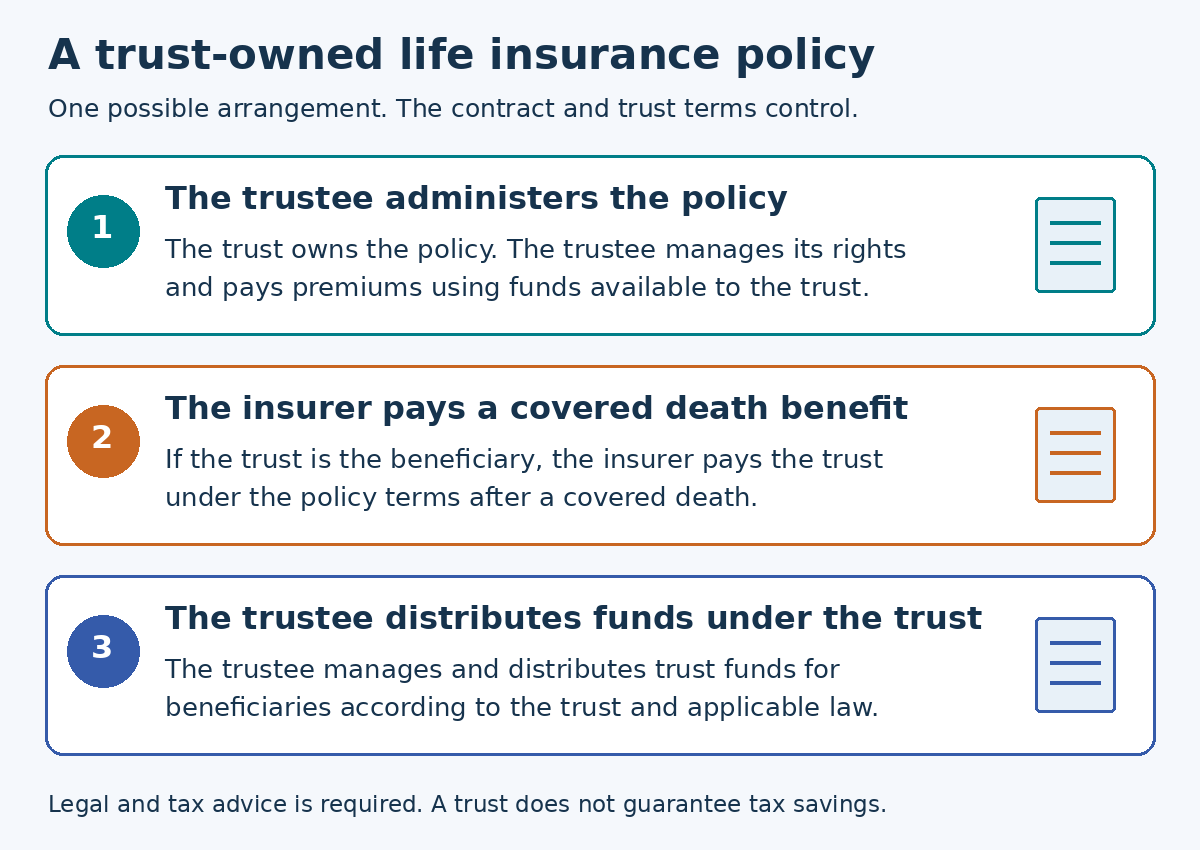
A trust is a legal arrangement in which a trustee holds or administers property under written instructions for one or more beneficiaries. In life insurance planning, a trust may be involved in two different ways. A trust can be named as the beneficiary of a policy, meaning it receives the death benefit after a covered death. A trust may also own the policy, meaning the trustee generally controls the contractual rights that belong to the policy owner.
Those two roles are not interchangeable. Policy ownership can include the authority to change beneficiaries, assign or surrender the contract, and access values when the contract permits it. The National Association of Insurance Commissioners’ consumer guidance explains that a policy owner generally controls beneficiary changes and that a trust may be considered when a beneficiary is a minor. The exact rights depend on the policy, trust language, insurer procedures, and applicable law.
A revocable living trust and an irrevocable life insurance trust are also different tools. A revocable trust is generally amendable during the creator’s lifetime and may serve broad estate-administration goals. An irrevocable life insurance trust, often called an ILIT, is designed so the creator gives up important control. That loss of control is not a technicality. It is central to why an ILIT may be considered in estate-tax planning, and it is also why no one should create or fund one without qualified legal advice.
What would we want the trust to accomplish?
Before discussing documents, we ask what you want the money to accomplish. A life insurance trust should solve a real problem for your family. Common objectives include managing proceeds for young beneficiaries, controlling the timing of distributions, coordinating money for a family member who may need long-term support, creating liquidity for estate obligations, and separating policy control from the insured person’s estate.
Providing for minor children
Insurance companies generally do not hand a large death-benefit check directly to a young child. Naming a properly drafted trust as beneficiary can allow a trustee to manage money under stated rules for the child’s health, education, maintenance, or other needs. The trust can describe when the child receives control and whether distributions occur all at once or over time. This may offer more direction than simply naming an adult informally and hoping that person uses the money as intended.
A trust is not the only option. State custodial arrangements, an adult beneficiary, or other estate-planning structures may be considered. Each option creates different control, administrative, tax, and legal consequences. Parents should coordinate the beneficiary form with guardianship and estate documents rather than assuming the will overrides the insurance contract. The Florida Bar notes that when a policy is payable to an individual, a will generally does not direct those proceeds; its consumer guidance on wills and life insurance recommends coordinated professional advice.
Setting distribution instructions
When someone receives the death benefit outright, they generally decide what to do with it after the insurer pays. A trust can instead instruct a trustee to hold, invest, and distribute funds according to defined standards. That structure may be useful when a beneficiary is financially inexperienced, has creditor or relationship concerns, or would benefit from staged access.
Control must be balanced with flexibility. A rule written today may operate decades later. A trust that is too restrictive can make it hard to respond to medical needs, education expenses, inflation, disability, or changes in family circumstances. A capable attorney can discuss discretionary standards, successor trustees, removal provisions, and how state law affects administration. Insurance cannot repair a poorly designed trust document.
Coordinating care for a beneficiary with special needs
A direct inheritance or insurance payment can affect eligibility for certain means-tested public benefits. A properly designed special-needs trust may sometimes help manage assets for a beneficiary while addressing benefit-program rules. This is a specialized legal area. The beneficiary’s age, existing benefits, source of funds, state law, trustee powers, and distribution practices all matter. Families should involve an attorney who works regularly with special-needs planning before changing a beneficiary designation.
Who owns the policy, and who makes the decisions?
Life insurance involves several roles that may be held by the same person or by different people. The insured is the person whose life is covered. The owner controls the policy rights. The beneficiary is the person or entity designated to receive the death benefit. When a trust is involved, the trustee administers trust property and follows the trust agreement. The trust itself is a legal relationship, while the trustee is the person or institution acting for it.
In one arrangement, an individual owns the policy and names a revocable trust as beneficiary. In another, an irrevocable life insurance trust owns the policy and is also the beneficiary. Those arrangements can produce different control and estate-tax consequences. The trustee may need to apply for a new policy, accept gifts, send beneficiary withdrawal notices when required by counsel, pay premiums, keep records, review policy performance, and submit the claim after death.
Who would you trust with the job, and would that person actually want it? Being a close friend or relative does not automatically make someone a good trustee. The job can involve deadlines, accounting, communication with beneficiaries, premium administration, insurance reviews, tax filings, and difficult distribution decisions. Families may compare a trusted individual, co-trustees, and a professional or corporate trustee. Fees, continuity, judgment, availability, and conflicts of interest deserve attention.
Does a trust change how life insurance is taxed?
Federal income tax and federal estate tax are different systems. The IRS states that death benefits received by a beneficiary are generally not included in gross income, although interest and certain transferred-policy situations can create exceptions. That general income-tax rule does not determine whether proceeds are included in the insured person’s gross estate for estate-tax purposes.
Federal estate-tax analysis looks in part at who owns and controls the policy. Treasury regulations describe “incidents of ownership” broadly. They can include powers to change a beneficiary, surrender or cancel a policy, assign it, pledge it for a loan, or obtain a policy loan. The regulation also addresses powers held through a trust. Readers who want the technical source can review Treasury Regulation section 20.2042-1.
An ILIT is often discussed because, when properly established and administered, ownership outside the insured’s control may help keep policy proceeds out of the insured’s gross estate for federal estate-tax purposes. That sentence contains important conditions. The insured cannot casually retain policy powers, borrow at will, change beneficiaries, or treat trust property as personal property. Trust terms, premium gifts, trustee actions, and state law must support the intended structure.
Estate-tax exposure also depends on current law and the size and composition of the estate. Exemptions and tax rules can change. State estate or inheritance taxes may differ from federal rules. A household that is not currently exposed may still value trust control for minors or distribution management, but it should not be told that an ILIT is necessary solely because it owns life insurance. Tax-sensitive recommendations require current calculations by qualified advisers.
The Three-Year Rule When an Existing Policy Is Transferred
Timing deserves special attention when an insured person already owns a policy and considers transferring it to an irrevocable trust. Under federal law, certain life-insurance transfers made within three years of death may be pulled back into the insured’s gross estate. The current IRS Instructions for Form 706 specifically identify certain transfers involving a policy on the decedent’s life within three years of death.
This does not mean a family should race to transfer a policy. A transfer can create gift-tax reporting questions, transfer-for-value concerns, contractual requirements, valuation issues, or unintended changes to control and access. A new trust’s purchase of a newly issued policy may be analyzed differently from the transfer of an existing policy. Health, insurability, contestability, suicide provisions, replacement rules, and premium affordability also belong in the conversation.
Never cancel an existing policy merely because a new trust-owned policy is being considered. Keep the existing coverage in force until the new policy is issued, accepted, paid, and reviewed, and until the appropriate professionals agree on the implementation sequence. A gap in coverage can be permanent if health changes prevent replacement.
Who pays the premiums, and how?
Who is going to pay the premiums? The trust needs a funding plan as well as a policy. In a common arrangement, the person who created the trust makes cash gifts to it, and the trustee uses those funds to pay premiums. Depending on the design, beneficiaries may receive temporary withdrawal rights intended to help gifts qualify for the federal gift-tax annual exclusion. These notices are often called Crummey notices, after the court case associated with the technique.
This process requires real administration. The trustee must receive the funds, follow the trust and attorney’s instructions, provide notices when required, allow the stated withdrawal period, retain evidence, and then pay the premium on time. Automatically moving money from the insured’s personal account to the insurer can undermine the paper trail and may conflict with the intended ownership structure. The attorney and tax adviser should establish the procedure, not the insurance agent.
Premium affordability remains an insurance issue as well. The trustee should understand whether premiums are guaranteed, flexible, or dependent on nonguaranteed policy performance. For permanent insurance, lower-than-illustrated crediting, dividends, or investment results may require higher future funding. Loans or withdrawals can reduce values and death benefits and increase lapse risk. A trust-owned policy still needs regular in-force reviews.
Revocable Trust Versus Irrevocable Life Insurance Trust
A revocable living trust can provide management continuity and instructions for beneficiaries, but the creator generally retains the power to amend or revoke it. That retained control usually means the trust’s property remains part of the creator’s estate for federal estate-tax purposes. Naming a revocable trust as policy beneficiary may help coordinate distributions, yet it does not automatically remove proceeds from the taxable estate.
An irrevocable life insurance trust is designed around a more permanent transfer of control. The creator generally cannot reclaim the policy or rewrite the agreement whenever preferences change. That can support certain estate-planning goals, but it also reduces flexibility. Divorce, family conflict, a beneficiary’s changed needs, trustee problems, or a policy that no longer fits can be harder to address. Some modifications may be possible under trust terms or state law, but they should never be assumed.
The Florida Bar’s consumer explanation of revocable trusts emphasizes that beneficiary-designated assets such as life insurance require coordinated titling and beneficiary decisions. A trust and a will are complementary tools, not substitutes for careful beneficiary forms and policy administration.
Which policy would support the trust’s purpose?
Putting a policy in a trust does not make it the right policy for your family. The policy must match the coverage period, funding capacity, health profile, and purpose. Term insurance may provide substantial temporary coverage at a lower initial premium, which can fit needs tied to working years or a defined obligation. It may expire before a long-term estate need arises, and renewal costs may increase sharply.
Permanent insurance is designed for lifetime coverage if required premiums and policy conditions are met. Whole life, universal life, indexed universal life, and variable universal life operate differently. Guarantees, flexibility, charges, crediting methods, investment risk, loan provisions, and lapse exposure vary. A trustee should understand which elements are guaranteed and which are assumptions.
For universal life designs, a favorable illustration is not a forecast. The trustee should review guaranteed and nonguaranteed columns, premium duration, mortality charges, administrative expenses, credited interest assumptions, and the effect of lower performance. With indexed universal life, cash value is not invested directly in a market index. Caps, participation rates, spreads, and other limits can change within contract terms. A 0% index-crediting floor does not stop policy values from declining because policy charges continue.
Policy loans and withdrawals can reduce available cash value and death benefits. Loan interest accrues, and a heavily borrowed policy can lapse if it is not managed. A lapse with gain can create tax consequences. A trust intended to preserve a death benefit should not be illustrated as though easy lifetime access by the insured remains available. That may conflict with both the trust design and the estate-planning objective.
Questions to Ask Before Using a Life Insurance Trust
- What problem are we solving? Identify whether the main concern is a minor beneficiary, distribution control, special-needs planning, estate liquidity, business succession, or estate-tax exposure.
- Should the trust own the policy or only receive the benefit? Ask the attorney to explain the control and tax differences.
- Is a revocable or irrevocable structure appropriate? Understand what can be changed later and what control must be surrendered.
- Who should serve as trustee? Evaluate capability, availability, independence, succession, costs, and potential conflicts.
- How will premiums reach the trustee? Get a written administrative process for gifts, notices, waiting periods, records, and payments.
- Does transferring an existing policy create a three-year-rule concern? Ask counsel to analyze timing, valuation, gift reporting, and transfer-for-value issues.
- How long must the coverage last? Match term or permanent coverage to the actual need.
- Which values are guaranteed? Review the ledger under conservative assumptions rather than relying only on a current illustration.
- What happens if funding stops? Ask for reduced-funding and stress-tested scenarios.
- How will the policy be monitored? Establish who obtains in-force ledgers and how often advisers meet.
- How do state laws affect the plan? Trust, creditor, probate, insurance, and tax rules vary.
- What other documents must change? Coordinate the will, powers of attorney, beneficiary forms, business agreements, and guardianship planning.
Common Mistakes to Avoid
One common mistake is using a generic online trust form without advice about Florida law, taxes, trustees, beneficiaries, or policy administration. Another is naming a trust that does not yet exist or describing it inconsistently on the insurer’s beneficiary form. A third is transferring ownership while continuing to exercise policy control as if nothing changed.
Families also run into trouble when premium notices are ignored, gifts arrive late, policies are not reviewed, or trustees do not understand nonguaranteed performance. An ILIT is not “set it and forget it.” The trustee should keep the trust agreement, policy, annual statements, premium records, correspondence, notices, tax filings, and adviser contact information organized.
Another mistake is focusing only on possible estate-tax savings. The policy still needs an insurable purpose, affordable funding, an appropriate death benefit, and a financially strong insurer. Guarantees depend on the insurer’s claims-paying ability. Trust expenses and professional fees matter. A smaller or simpler estate may be better served by a straightforward beneficiary plan, while a complex family may value trust control even without a current federal estate-tax concern.
A Practical Review Process
Start by listing the people who depend on you and what you want the insurance money to accomplish. Estimate the resources needed for income replacement, debts, education, caregiving, final expenses, and other obligations. Our Life Insurance Needs Calculator can help organize those inputs, but it is an educational starting point rather than a legal or tax recommendation.
Next, inventory current policies. Record the insured, owner, beneficiary, contingent beneficiary, death benefit, premium, cash value, surrender charge, loan balance, conversion rights, guarantees, and policy purpose. Request current in-force illustrations for permanent policies. Then bring that information to the estate-planning attorney and tax professional so they can compare trust and non-trust approaches.
After the legal design is clear, compare insurance proposals on the same assumptions. Use the same death-benefit objective, premium schedule, underwriting class, time horizon, and policy purpose. Ask what is guaranteed, what can change, and what happens under less favorable conditions. The least expensive illustrated premium is not necessarily the most dependable plan.
Finally, document responsibilities. The attorney drafts the trust and advises on legal structure. The tax professional addresses reporting and tax treatment. The trustee follows the agreement and administers the policy. The insurance professional explains contract options, coordinates underwriting, and helps monitor coverage. Everyone should know who is doing what. Otherwise, a critical step can be missed because each person assumes someone else handled it.
Review the Plan as Life Changes
A life insurance trust may operate for decades, while families and laws change. Review the arrangement after births, deaths, marriages, divorces, business changes, moves to another state, major changes in wealth, trustee changes, or changes in a beneficiary’s health or financial circumstances. Review it when estate-tax laws change and whenever the policy requires additional funding.
The policy deserves an annual review even when the trust document remains appropriate. Confirm premiums were paid, beneficiaries and trustee contact information are current, loans have not appeared unexpectedly, and projected values remain adequate. For flexible-premium or nonguaranteed contracts, ask for an in-force ledger using both current and conservative assumptions.
How We Can Help You Prepare for the Conversation
A life insurance trust can provide useful control and coordination, but it is a legal structure rather than an insurance feature. The right sequence is to clarify the family goal, obtain legal and tax guidance, select appropriate ownership and beneficiaries, and then evaluate insurance that can support the plan over time.
We can help you inventory existing policies, explain insurance terminology, compare policy guarantees and nonguaranteed assumptions, and prepare practical questions for your estate-planning attorney and tax professional. We do not draft trusts or provide individualized legal, tax, or investment advice.
About Jay A. Cohen, The Ocala Insurance Guy
Jay A. Cohen is a licensed health and life insurance agent based in Ocala, Florida. He is licensed in Florida, Virginia, Illinois, Utah, and California.
Our approach is educational: we listen to understand your needs, goals, and budget, then explain your options in plain language. We walk through the benefits, costs, and limitations, welcome your questions, and help you make an informed decision without pressure to buy a particular product.
To explore permanent coverage and available policy options, visit the Jay A. Cohen life-insurance information page. You can also learn more about Jay’s educational approach and insurance experience.
For help reviewing the insurance side of your plan, use The Ocala Insurance Guy Contact Form. We can help you organize policy information and prepare questions for your attorney and tax adviser.
This article provides general educational information and is not individualized insurance, investment, legal or tax advice. Policy provisions, availability and requirements vary by insurer and state. Consult qualified professionals before replacing, surrendering, borrowing from or materially changing a life insurance policy.