

You’re still working, you like your health plan, and your 65th birthday is getting closer. Do you need Medicare now? Can you keep the coverage from work? And if you have both, which insurance is supposed to pay the bill? Medicare and group health insurance can work together, but the answer depends on the kind of coverage you have, the employer’s size, and your enrollment situation.
Let’s start with who pays first. For someone eligible for Medicare because of age, coverage based on current employment generally pays first when the employer has 20 or more employees. With fewer than 20, Medicare generally pays first. Retiree coverage follows a different path. Multi-employer arrangements can have exceptions, so the plan’s actual coordination rules need checking.
That answers the payment-order question. It does not settle every enrollment question. We suggest separating three decisions: who pays first, when you need to enroll, and what arrangement fits your household. Mixing those together is where a perfectly reasonable conversation can take a wrong turn.
Find your question: Who pays first? · Can Part B wait? · Prescription coverage · HSA contributions · Leaving work · Compare the choices
Medicare and group health insurance: who pays first?
When two health plans cover you, one processes the claim first. That is the primary payer. The secondary payer considers eligible remaining costs under its own rules. Having two cards does not mean every bill disappears or that you can choose which insurer goes first.
The following comparison focuses on Medicare eligibility at age 65 or older. Medicare’s official How Medicare Works with Other Insurance booklet explains the general payment order and multi-employer exceptions.
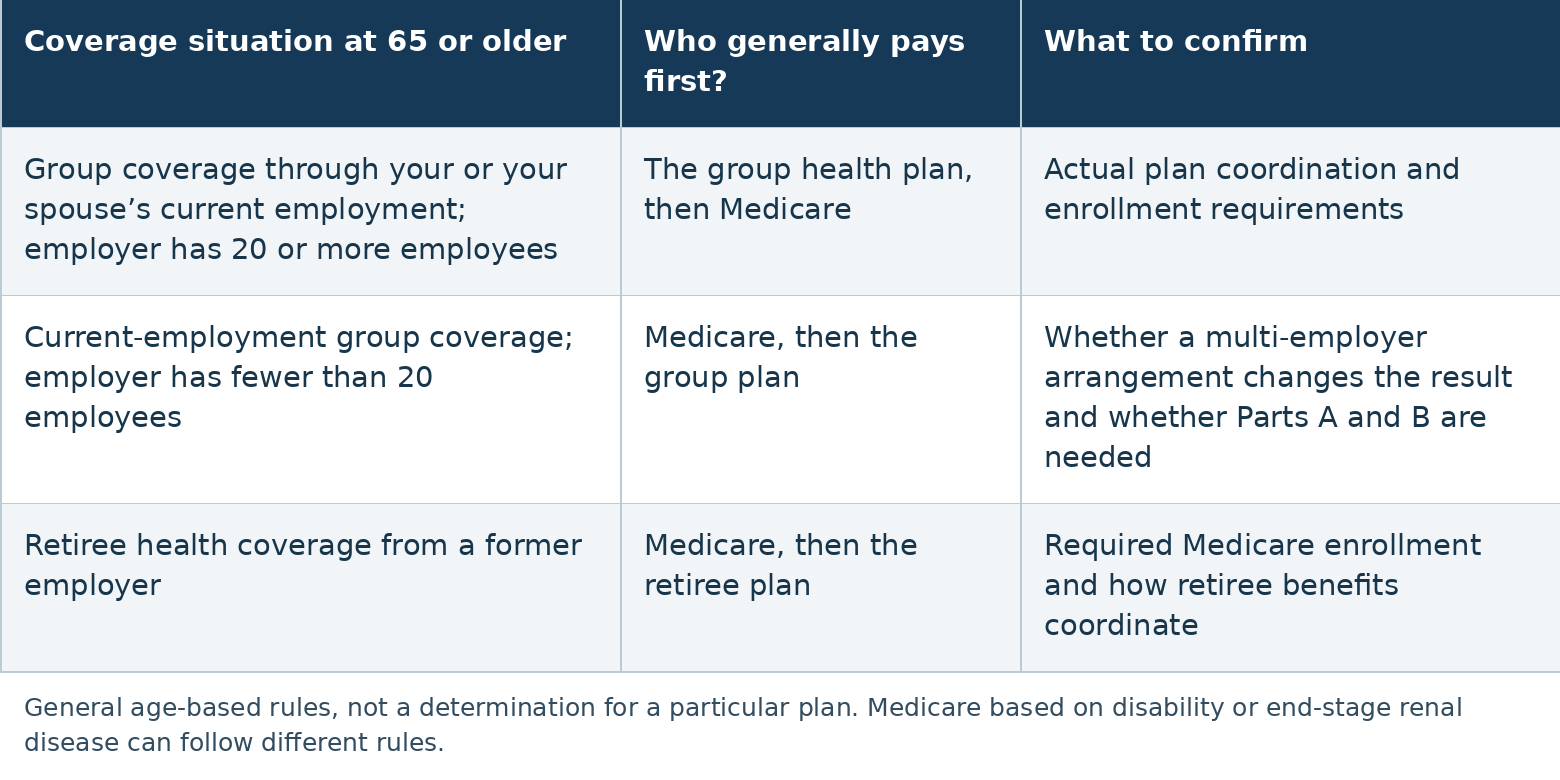
We would bring this comparison to a benefits discussion as a question sheet. Find the coverage situation that seems to fit, then have the plan administrator verify it. Do not decide the employer’s legal size by counting the people in your immediate office. Ask how the employer and plan are classified for Medicare coordination purposes.
Start with the source of your coverage
“Insurance from work” can mean coverage through a job you still have, a spouse’s current job, a former employer’s retiree plan, or COBRA continuation coverage. Those descriptions sound similar around the kitchen counter. They can lead to different Medicare decisions.
Write down the employer, whose employment supports the coverage, whether that person is still working there, and the plan’s formal name. Then gather the benefits summary and insurance cards. If you have only an old enrollment email, request current materials. A familiar insurer’s name does not tell us whether the underlying coverage arrangement has changed.
This is especially useful for people working for themselves. Being self-employed does not, by itself, establish that a personally purchased policy is qualifying current-employment group coverage. Medicare’s working-past-65 guidance specifically tells self-employed people to verify the coverage’s status. Our Florida self-employed health insurance guide explains the earlier question of how solo owners obtain coverage.
Can you delay Part B while you keep working?
With qualifying group coverage from your or your spouse’s current job, you can often wait to enroll in Part B without a late enrollment penalty. Part B is Medicare’s medical insurance, covering services such as eligible doctor and outpatient care. But being allowed to enroll later and having the coverage you need today are separate matters.
That distinction matters at a small employer. Medicare.gov warns that a plan from an employer with fewer than 20 employees might not pay for services if you lack both Part A and Part B. Do not read “I can enroll later” as “the group plan will cover everything until then.” Check the official Medicare enrollment guidance for your circumstances.
A useful written question is: “If Medicare is primary for me, how would this plan calculate a claim if I had not enrolled in Parts A and B?” Ask for the relevant plan provision rather than a general reassurance that you are insured. We want an answer about payment, not simply an answer about whether your name is on the membership list.
If the employer plan pays first and you are considering delaying Part B, make a note of what would change that decision: retirement, a job change, loss of coverage, or another change in the plan. The point is to have a reason for waiting and a clear trigger to review it.
What changes if coverage comes through your spouse?
Coverage based on a spouse’s current employment can be relevant even when you have already retired. The important facts are the working spouse’s employment and the plan providing your coverage. Your own retirement date is not the only date to write down.
Consider this hypothetical situation: one spouse is 66 and retired, while the other continues working and carries the household’s medical coverage. Their first task is to confirm the employer plan’s rules for the Medicare-eligible spouse. Their second is to ask what happens when the working spouse eventually leaves. The couple should not assume both people will make the same enrollment choices on the same day.
We suggest drawing a separate line for each person on a simple worksheet. Include current coverage, Medicare status, doctors, prescriptions, and the next expected change. A household may share a budget while needing two different coverage arrangements. That is a planning detail worth seeing before anyone cancels a policy.
COBRA and retiree coverage need their own review
COBRA lets eligible people temporarily continue an employer plan after certain events, including employment ending. It does not extend the current-employment Part B enrollment window. Medicare’s COBRA guidance warns that someone eligible for Medicare but not enrolled may receive only limited payment from COBRA and face substantial remaining costs.
The familiar card can be misleading. You may still see the same insurer and visit the same doctors while the employment status behind the coverage has changed. Put the last day of employment, the last day of active-employment coverage, and any COBRA start date on separate lines. Ask how the change affects both billing and Medicare enrollment.
Retiree medical benefits also need a separate check. Medicare generally pays first for age-based Medicare with retiree coverage, and the retiree plan may require Medicare enrollment to pay properly. Medicare’s payer-order resource describes this distinction. Do not assume a generous retirement package replaces the need to understand Parts A and B.
Prescription coverage has a separate test
When comparing Medicare and group health insurance, ask specifically about prescription coverage. “Creditable” drug coverage means the plan is expected to pay, on average, at least as much as Medicare Part D, the prescription drug benefit. It does not mean your premium feels reasonable or that your pharmacy currently accepts the card.
Keep the plan’s annual creditable-coverage notice. Medicare.gov explains that going 63 days or more without Part D or other creditable drug coverage can lead to a Part D late enrollment penalty when you enroll later. The creditable prescription drug coverage guidance also warns that joining Medicare drug coverage can affect employer or union benefits for you or your dependents. Verify the consequences before adding a plan.
For the practical comparison, list each regular medication, its dose, and the pharmacy you prefer. Ask for the actual costs and restrictions under each arrangement. A drug plan’s overall description is not a substitute for checking the prescriptions you use. Also distinguish the drug-coverage notice from the documents proving current-employment coverage for Part B; they answer different questions.
Have an HSA? Check before enrolling in any part of Medicare
A health savings account, or HSA, is a tax-favored account available to eligible people with qualifying coverage. If you contribute to one, Medicare enrollment needs an extra timing check. The IRS’s Publication 969 says your HSA contribution limit becomes zero beginning with the first month of Medicare enrollment, including months covered retroactively. Employer contributions count in that review too.
Premium-free Part A, Medicare’s hospital insurance, can be retroactive when someone enrolls after 65. The official Medicare & You handbook explains the lookback of up to six months, never earlier than initial eligibility, and why the date to stop contributions depends on the enrollment circumstances. “Part A has no premium” does not mean enrolling has no HSA consequences.
Before choosing an enrollment date, we suggest checking with your payroll department, the HSA custodian, and a qualified tax professional. Bring the expected application date, any Social Security application plans, your Medicare effective dates if already assigned, and contribution records. Ask for the permitted contribution amount for the year and whether corrections are needed. Guessing from the month you expect to retire can miss an important detail.

Build the transition before employer coverage ends
For eligible people leaving current-employment group coverage, the Part B Special Enrollment Period generally lasts eight months after employment or that coverage ends, whichever happens first. But having eight months to enroll does not mean you have eight months of health coverage. Waiting to its end can leave an uninsured interval. Coordinate the effective date you need with the application process.
Medicare’s Part A and Part B sign-up instructions explain the available application paths. Someone who already has Part A and needs Part B after job-based coverage may need employer-completed form CMS-L564 or other acceptable proof. Start gathering documents while the employer can still easily confirm your coverage history.
On your transition worksheet, record five things: when work ends, when active coverage ends, the requested Medicare start date, the date of any additional coverage, and the confirmation received for each. Keep your applications and confirmations together so they are easy to find. “Submitted” and “effective” are different entries; a pending application should not be treated as a completed coverage change.
Also check any appointments, procedures, or recurring treatments near the transition. Ask which coverage will apply on the service date and what the receiving provider needs. This is not about predicting medical needs perfectly. It is about noticing the services already on your calendar before the insurance arrangement changes.
Medigap and fall enrollment follow different calendars
Medigap is private insurance that helps with certain costs left by Original Medicare. The federal six-month Medigap Open Enrollment Period generally starts the first month you are 65 or older and enrolled in Part B. Medicare’s Medigap timing guide explains that this period can run while you still have employer coverage. Additional rights may exist under state law or particular circumstances; do not assume the window simply restarts at retirement.
The annual October 15–December 7 Medicare Open Enrollment Period concerns Medicare Advantage—the private-plan alternative to Original Medicare—and drug-plan choices. It is not a replacement for your Part A and Part B enrollment rules or a general annual Medigap guarantee. The official plan-enrollment calendar separates these events. A television ad about fall enrollment does not tell you the right deadline for leaving your employer plan.
Compare the household’s costs and access
Once the enrollment and payment rules are clear, we can make a useful comparison of Medicare and group health insurance. Start with a full year of premiums for the actual coverage combination under consideration. Then compare deductibles, copayments, coinsurance, prescriptions, and the financial exposure for a year with more care. A lower monthly premium answers only one part of the cost question.
A deductible is an amount you pay before certain benefits begin. A copayment is a fixed charge for a covered service; coinsurance is a percentage. Put the figures beside the services you actually expect to use rather than comparing labels alone. For broader background, our health insurance information page explains the value of reviewing coverage and access together.
Now look beyond your own card. If one person leaves family coverage, request the remaining household premium and available coverage options for the others. Include dental and vision benefits where relevant. A personal premium reduction may look different after another family member’s replacement coverage is included.
Check the doctors, facilities, prescriptions, and locations important to you. When an employer HMO (health maintenance organization) or PPO (preferred provider organization) pays first, Medicare.gov warns that out-of-network care can sometimes leave both plans declining payment. Two plans are not permission to ignore a network. Ask about planned travel or time in another state using the specific proposed coverage, rather than relying on a broad promise of flexibility.
Our practical suggestion is to create two columns: “keep the current arrangement” and “make the proposed change.” Write the verified benefits and costs under each. Write down any questions you still need answered. Current plan documents and a clear worksheet are more useful than a comparison built from assumptions.
A lower premium is only the start of the comparison
Here is a hypothetical budgeting example, using invented figures rather than real plan prices. One proposed arrangement costs $250 a month in combined premiums; another costs $400. The first starts $1,800 ahead over a full year: a $150 monthly difference multiplied by 12. That is useful arithmetic, but it does not tell us which arrangement provides better value.
Suppose the lower-premium arrangement would involve higher costs for the person’s regular prescriptions or a doctor they strongly prefer. Those differences belong beside the $1,800, not in a footnote. Conversely, paying more each month needs a reason too. When comparing Medicare and group health insurance, explain what the extra premium buys and whether that benefit matters to this household.
We would make one comparison for the care you reasonably expect and another for a more demanding year. Keep the assumptions visible. The exercise helps you see what you can budget comfortably and which risks you are prepared to carry; it does not predict next year’s medical bills.
If a bill arrives, check the explanation before guessing
A confusing bill is a reason to check the records. Gather the provider’s bill and each insurer’s explanation of benefits, often shortened to EOB. Identify the service date, which insurer processed it first, and the reason given for any unpaid amount. Avoid concluding from the balance alone that the entire problem is a lack of coverage.
Ask the billing office and plan administrator to verify the insurance information and payment order recorded for that service date. If retirement or a job change happened recently, include that date in your explanation. A card that is correct today may not describe the arrangement on the day care was provided. For Medicare and group health insurance, the timing can matter as much as the plan names.
If the issue is a coverage denial rather than billing order, request the written reason and the plan’s instructions for responding. Keep any stated response deadline on your calendar while the question is being investigated. Correcting a record, requesting a coverage review, and replacing insurance are different actions. Understand the problem before deciding which one is needed.
The questions to take into your benefits discussion
- Is this coverage based on my or my spouse’s current employment?
- For my Medicare eligibility, which plan pays first, and where is that stated?
- Does the plan require me to have Part A, Part B, or both to pay correctly?
- Is the prescription coverage creditable for Part D, and can we obtain the current notice?
- What would enrolling in other coverage change for my spouse or dependents?
- What are the exact employment, coverage, application, and effective dates?
- Do HSA contributions or Medigap rights need attention before we act?
If two answers conflict, ask for the plan provision and compare it with the official Medicare guidance for your situation. Keep the names, dates, and written explanations with your records. We would rather resolve a confusing answer during planning than discover the disagreement after a medical bill arrives.
Medicare and group health insurance can fit together well when each part has a clear role. Start with your actual coverage, verify payment order and enrollment timing, and compare the household’s options before making changes. Employers can also explore our group benefits resources when reviewing their overall benefits program.
About Jay A. Cohen, The Ocala Insurance Guy
Jay A. Cohen is a licensed health and life insurance agent based in Ocala, Florida, and is licensed in Florida, Virginia, Illinois, Utah, and California.
Our approach is educational: we listen to understand your needs, goals, and budget, then explain your options in plain language. We walk through the benefits, costs, and limitations, welcome your questions, and help you make an informed decision without pressure to buy a particular product.
To explore permanent coverage and available policy options, visit the Jay A. Cohen life-insurance information page. You can also learn more about Jay’s educational approach and insurance experience.
To share your questions and what matters most to you, use The Ocala Insurance Guy Contact Form.
Educational information only; not individualized medical, legal, tax, or insurance advice. Medicare eligibility, enrollment rights, payment order, and benefits depend on your circumstances and applicable rules. Plan documents and official determinations control; no coverage, claim payment, savings, or enrollment outcome is guaranteed. Hypothetical examples do not describe actual clients. The Ocala Insurance Guy is not affiliated with or endorsed by Medicare or any government agency. Confirm decisions with the relevant plan administrator, Medicare or Social Security, and qualified advisers before changing coverage.