

Mortgage life insurance can help a family keep or pay down a home after an insured homeowner dies, but the phrase is used for more than one kind of coverage. Some people mean an individual term life policy sized partly around a mortgage. Others mean a lender-connected policy whose benefit decreases with the loan balance. Those approaches can look similar in an advertisement while giving families very different control.
Homeownership creates both an asset and a monthly obligation. If one person’s income, caregiving, or household work disappears, the surviving family may need more than the exact mortgage balance. They may need time to decide whether to stay, sell, refinance, return to work, or change schools. That is why we prefer to start with the family’s choices rather than a product label.
This mortgage life insurance guide answers a question found in Jay’s AnswerThePublic research: “what life insurance do I need for mortgage?” We will compare personal life insurance, lender-connected mortgage protection, and private mortgage insurance; explain costs, underwriting, portability, and benefit design; and show how to build a useful estimate without assuming that paying off the loan is always the only goal.
What mortgage life insurance is designed to do
At its simplest, life insurance pays a death benefit when the insured dies while coverage is in force, subject to the contract. A beneficiary can use an individual policy’s proceeds to make monthly mortgage payments, retire the balance, cover property taxes and insurance, handle repairs, or meet other family needs. The mortgage does not have to be listed as the only purpose.
A product marketed specifically as mortgage protection may instead be a form of decreasing term or credit life insurance. The coverage may be tied to a particular loan, and the benefit may decline as the scheduled balance falls. In some designs, the lender receives the benefit directly. In others, a named beneficiary receives it. The certificate and policy—not the envelope, phone script, or online advertisement—determine how it works.
The National Association of Insurance Commissioners explains that term life insurance can be suitable when coverage is needed for a limited period or a specific obligation such as a mortgage. Its life insurance overview also distinguishes level term from decreasing term and permanent coverage. That does not make one form automatically best; it gives consumers a useful vocabulary for comparison.
Mortgage life insurance is not PMI
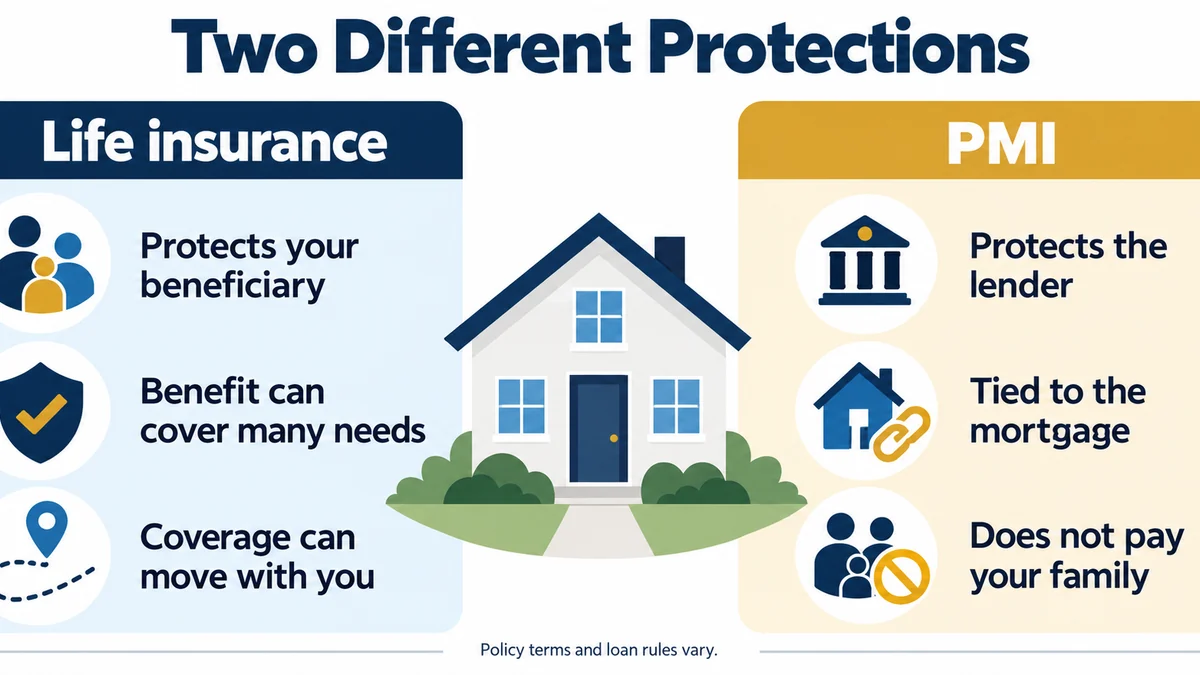
Private mortgage insurance, commonly called PMI, is easy to confuse with mortgage life insurance. PMI is generally connected to a conventional mortgage when the down payment or equity is below a required level. The Consumer Financial Protection Bureau states that PMI protects the lender—not the borrower if the borrower stops making payments. It can help someone qualify for a loan, but it does not create a death benefit for the family.
Homeowners insurance is different again. It generally protects the property against covered losses and provides other forms of property and liability protection. It does not pay off the mortgage simply because an owner dies. Disability coverage, unemployment protection, and life insurance address different risks and use different definitions.
- Individual life insurance: normally pays the named beneficiary, who can decide how to use the proceeds.
- Mortgage or credit life insurance: may be tied to a loan and may pay the creditor or reduce with the balance.
- PMI: protects the mortgage lender from loss if payments are not made.
- Homeowners insurance: protects against covered property and liability risks, not the loss of a person’s income.
Before accepting any “mortgage protection,” ask what event triggers payment, who receives the money, whether the benefit decreases, whether the coverage follows you after a refinance or move, and whether the premium changes.
Level term life insurance as mortgage life insurance
When level term coverage is used as mortgage life insurance, it provides a stated death benefit for a defined term when required premiums are paid. A homeowner might select a term that roughly matches the remaining mortgage years, but the benefit usually does not decrease merely because the loan balance declines. If the insured dies during the term and the claim is approved, the beneficiary generally receives the full policy benefit.
That flexibility can matter. Imagine a household with a $250,000 mortgage and a $300,000 level term policy. If the balance has fallen to $190,000 when the insured dies, the beneficiary could pay off the mortgage and use the remainder for taxes, maintenance, childcare, income replacement, or another priority. The beneficiary could also choose to keep making payments rather than immediately send the entire balance to the lender.
Level term coverage is also generally portable. A move or refinance does not necessarily end the policy because the contract is connected to the insured person rather than one loan. The beneficiary can usually be changed, subject to ownership rights and any irrevocable designation. Premiums may be guaranteed for the selected level period, after which renewal costs can rise sharply or coverage can end.
Decreasing mortgage protection and credit life
Decreasing term coverage starts with a stated amount and reduces over time according to a schedule. The design may broadly track a declining loan balance. Premiums can remain level even while the benefit falls. That can be simple, but a consumer should compare the total cost with the amount of protection available in each year.
Credit life insurance is often offered in connection with a debt. The creditor may be the beneficiary up to the outstanding balance. If the borrower dies, the benefit reduces or pays the covered debt according to the certificate. Family members may receive no cash beyond that obligation unless the contract names a secondary beneficiary and provides an excess benefit.
Under federal credit-disclosure rules and state insurance rules, optional credit insurance is not the same as a lender’s requirement to protect collateral. Consumers should confirm whether coverage is optional, how the premium is calculated, whether it is financed into the loan, and how cancellation affects the loan. A financed single premium can create interest cost and may not be fully refundable after early payoff.
How much mortgage life insurance coverage might you need?
For mortgage life insurance planning, the loan balance is a starting point, not a complete needs analysis. First decide what the family should be able to do. Is the goal to eliminate the mortgage immediately, provide several years of payments, preserve the option to stay in the home, or give the family enough time to sell thoughtfully? Each goal produces a different number.
List the current principal balance, monthly payment, remaining term, interest rate, property taxes, homeowners insurance, association fees, utilities, and realistic maintenance. A debt-free house still costs money to own. If the surviving spouse or partner would have less income, property taxes and repairs may be as important as the principal balance.
Then list other protection needs: income replacement, childcare, education, final expenses, emergency savings, debts, and support for dependents. Subtract resources that would actually remain available, such as existing individual coverage and dedicated liquid assets. Do not count retirement funds or a home’s equity twice, and do not assume an asset should be liquidated if the plan is intended to preserve it.
Our life insurance needs calculator can help organize these categories. It is educational, not an underwriting quote or individualized recommendation. A calculation should be revisited after a refinance, major renovation, move, new child, income change, or substantial payoff.
Should the death benefit equal the mortgage balance?
Equaling the balance can be reasonable when paying off the loan is the only goal and other family needs are already funded. It can be too little when the household relies heavily on the insured’s income or unpaid work. It can be more than necessary when the family has significant liquid assets, another policy, or plans to sell regardless.
A survivor may not want to pay the mortgage off immediately. A low fixed rate, emergency needs, taxes, or advice from qualified financial and tax professionals may affect that choice. Individual life insurance preserves that decision for the beneficiary. A lender-directed benefit may not.
Coverage should also reflect ownership. If both spouses contribute income or household services, insuring only the person named first on the mortgage may leave a large gap. An owner who does not earn wages can still provide childcare, transportation, home management, and care that would be expensive to replace.
Mortgage life insurance underwriting, pricing, and eligibility
Individual term life insurance commonly uses health and lifestyle underwriting. Age, health history, medications, tobacco or nicotine use, driving history, occupation, avocations, benefit amount, and policy term can affect eligibility and cost. Some applications use accelerated or simplified underwriting; others require medical records, an exam, or laboratory work.
Lender-connected mortgage life insurance may offer simplified questions or guaranteed acceptance within limits. Easier enrollment can be helpful for someone who cannot qualify for fully underwritten coverage, but it may come with higher cost, a decreasing benefit, graded natural-death coverage, or exclusions. “No medical exam” does not mean “no underwriting,” and “guaranteed acceptance” does not mean the full benefit is payable for every cause from day one.
Compare the premium over the period you expect to keep the policy, not just the initial monthly amount. Ask whether the premium is guaranteed, whether the benefit changes, and what happens at the end of the term. A quote is not coverage until the insurer approves the application, the policy is issued, delivery requirements are met, and the premium is paid according to the contract.
What happens to mortgage life insurance after a refinance, move, or early payoff?
An individual policy used for mortgage life insurance normally remains in force after a refinance or move if premiums continue and no contract provision says otherwise. The insured may review the amount and beneficiary, but the lender change itself generally does not cancel the coverage.
A loan-specific policy may end when the original debt is refinanced, assumed, transferred, or paid off. A new loan can require new enrollment and new eligibility. If health has changed, replacement coverage may be more expensive or unavailable. Ask about portability before relying on the policy for a long-term family need.
If a single premium was added to the loan, early payoff may create a refund calculation. Confirm who must request the refund, the formula used, and whether the refund reduces principal or is paid directly. Those are contract- and state-specific details.
Mortgage life insurance, beneficiary control, and the lender’s role
With personal life insurance, the owner generally names primary and contingent beneficiaries. The lender does not automatically receive the proceeds merely because the insured has a mortgage. A beneficiary can decide whether to pay off the loan, continue payments, sell the property, or use part of the benefit for another need.
A policy can sometimes be assigned as collateral. Under a collateral assignment, the lender may receive the amount owed, and remaining proceeds may go to the beneficiary. Assignment language, lender requirements, and release procedures should be reviewed carefully. Do not name a lender or sign an assignment without understanding how it changes control.
Beneficiary designations should be reviewed after marriage, divorce, death, birth, adoption, or ownership changes. Naming a minor directly can create a need for court involvement or a custodial arrangement. Trusts and estate designations can change timing and legal consequences. Those situations warrant legal guidance.
What mortgage life insurance does not cover
A life policy does not generally pay because someone loses a job, becomes disabled, or falls behind on payments unless a separate rider or product specifically provides that benefit. Disability income insurance, mortgage disability coverage, unemployment products, emergency savings, and loan-servicing options solve different problems.
If a homeowner is struggling with payments, waiting for an insurance solution is inappropriate. The CFPB advises borrowers to contact the mortgage servicer promptly and notes that a HUD-approved housing counselor can provide assistance. Life insurance planning does not replace loss-mitigation help.
Life insurance also does not guarantee that a family can afford every future housing cost. Taxes, insurance, association dues, utilities, repairs, and accessibility changes can continue after the mortgage is gone. A useful plan considers the home as part of the household budget rather than one isolated balance.
Permanent life insurance as an alternative
Permanent life insurance may be considered when the need extends beyond the mortgage term, such as final expenses, legacy goals, lifelong dependent support, or estate liquidity. It generally costs more than term coverage for the same initial death benefit and can involve cash value, policy charges, surrender considerations, and more complex funding.
Using permanent coverage solely because a mortgage exists can be unnecessary. Using term automatically can also be shortsighted when a lifetime need is present. The product should match the duration and nature of the problem. Consumers comparing permanent designs should review guaranteed and nonguaranteed values, funding assumptions, access provisions, lapse risk, and insurer claims-paying ability.
A combination can be appropriate: larger term coverage during mortgage and working years, plus smaller permanent coverage for a lasting need. The tradeoff is managing multiple policies and ensuring each remains affordable and current.
A hypothetical family comparison
This is a hypothetical example, not a real customer or promised outcome. Daniel and Priya have a 24-year mortgage, two children, and both contribute to household income. A mailed offer proposes decreasing mortgage protection equal to the scheduled loan balance. They also obtain quotes for separate level term policies.
They first decide what should happen if either dies. They want the survivor to have the option to pay off the loan, take time away from work, and preserve education savings. That goal is larger than the mortgage alone. They compare separate policies because their ages, health, income, and coverage needs differ.
The decreasing offer is simple, but the benefit falls and the creditor receives payment first. The level term options require more underwriting but preserve a fixed death benefit and beneficiary control. They also confirm how each policy would behave after a refinance. Their final decision depends on actual offers, budget, and priorities—not the hypothetical numbers in this example.
Questions to ask before buying mortgage life insurance
- Is this individual life insurance, decreasing term, credit life, disability coverage, or another product?
- Who owns the policy and who receives the benefit?
- Does the death benefit stay level or decrease?
- Are premiums level, and for how long?
- What health questions, waiting periods, exclusions, and contestability provisions apply?
- Does the policy follow me after a refinance, payoff, or move?
- Can I change the beneficiary?
- Is any premium added to the loan, and will I pay interest on it?
- What refund is available after cancellation or early payoff?
- How does the total cost compare with level term life insurance?
- Does the benefit address taxes, maintenance, income loss, and other family needs?
- What happens when the term ends?
- Would replacing existing coverage restart exclusions or contestability?
- What financial-strength information is available for the insurer?
Request the policy, certificate, buyer’s guide, and written illustration when applicable. Use any free-look period to read the delivered contract. If a sales explanation conflicts with the policy, the contract controls.
Review the plan as the home and family change
Mortgage life insurance planning should not end at the closing table. Review coverage after refinancing, a major principal reduction, renovation, income change, marriage, divorce, a new dependent, or a move. Confirm beneficiaries and contact information, and keep policy details where the right person can find them.
Do not cancel existing coverage until a replacement policy is issued, accepted, and in force. New underwriting can produce a different result than expected. Replacement can also restart contestability and suicide-exclusion periods and may create surrender or tax consequences for permanent policies.
Our role is to help families understand insurance choices and prepare informed questions for investment, tax, legal, and mortgage professionals. We do not provide individualized investment, tax, legal, or mortgage advice.
Protect the home without limiting the family’s choices
A mortgage is often a family’s largest debt, but mortgage life insurance planning should consider more than that single balance. The strongest plan considers who receives the benefit, how long coverage lasts, whether it moves with the insured, what happens after refinancing, and whether the amount supports the household as well as the loan.
About Jay A. Cohen, The Ocala Insurance Guy
Jay A. Cohen is a licensed health and life insurance agent based in Ocala, Florida, and the agent behind The Ocala Insurance Guy. He is licensed in Florida, Virginia, Illinois, Utah, and California. We help families understand mortgage life insurance, level term, permanent coverage, and existing policies in clear language, with an emphasis on listening first and helping people make informed insurance decisions.
For additional guidance, review our life insurance information, learn more about Jay A. Cohen and The Ocala Insurance Guy, or use our Contact Form to request an insurance review.
This article provides general educational information and is not individualized insurance, investment, legal or tax advice. Policy provisions, availability and requirements vary by insurer and state. Consult qualified professionals before replacing, surrendering, borrowing from or materially changing a life insurance policy.