

Audio Overview
Life insurance helps protect the people who count on you financially. In this episode, we’ll talk about what your health plan helps pay for, what happens to the bills at home if you die, and how to spot a gap in the coverage you already have.
Listen to the episode
Show notes
If you already have health insurance, do you still need life insurance? Health insurance helps with covered medical costs when you need care. Life insurance generally pays a death benefit to the people or organizations you name if you die while the policy is in force and the claim is covered.
Here’s where we’d start. If you landed in the hospital, what would you owe for the care? If your family lost your income, how long could they keep up with the bills? Your answers give us a place to start with the coverage you already have.
Maybe you have a medical plan at work and a small life insurance policy through the same employer. Great. Pull up both benefit summaries and see what each one would pay and when. Once we know what you’ve got, we can talk about whether there’s a gap worth spending money on.
Have a question about your coverage after listening? Use our Contact Form and we’ll help you sort through it.
Life insurance versus health insurance: two different jobs
Health insurance helps pay for covered care under a plan’s rules. Life insurance generally pays a death benefit to the named beneficiary when a covered death occurs. The two policies pay for different reasons and serve different needs.
An insurance card tells you where to start when you need care. Now picture the bills that would still show up at home if someone died. The mortgage, the groceries and the after-school care still need paying. That’s the part of the conversation we’d have with the life policy in front of us.
Here’s a hypothetical situation: a parent needs surgery, recovers and returns to work. Their health plan may help with covered treatment, subject to its terms. A standard life policy doesn’t pay a death benefit merely because surgery occurred. The household should also consider how it would cover bills during time away from work.
Now suppose the parent dies and the life policy pays a death benefit. The family could use that money for rent, groceries or another month of childcare. That’s where life insurance versus health insurance gets real. Who would be left paying those bills, and what money would they have to work with?
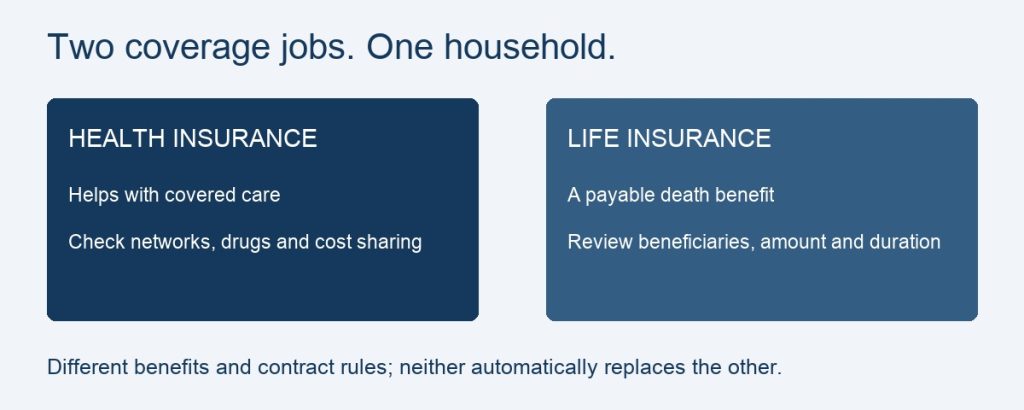
What would your household need help paying?
Grab a piece of paper and make two lists. On one, put the doctors you see, the prescriptions you fill and the medical bills you might have to pay yourself. On the other, put what someone would have to cover if you died. Start with housing, childcare, income and final expenses. That’s a practical way to work through life insurance versus health insurance at your own kitchen table.
A hypothetical single adult with no dependents may place particular emphasis on usable health coverage and a manageable reserve. A parent supporting children may also need enough life insurance to help cover years of household expenses. Dependents, debts, existing assets and the value of unpaid work can change the conversation.
Our life insurance needs calculator can help organize protection needs and existing resources. It doesn’t quote a policy or compare health plans. Use its estimate as a starting point, then discuss the assumptions. In life insurance versus health insurance planning, each side needs its own suitable tool.
An out-of-pocket maximum can limit certain covered spending during a plan year. It isn’t a ceiling on every dollar connected with healthcare. Premiums, noncovered services and some out-of-network spending can fall outside it. HealthCare.gov explains the protection against high medical costs; your plan documents supply the applicable details.
Start with your own routine. Is your doctor in the network? How much would you pay to fill the prescription you take every month? A lower premium can look good on the enrollment screen. The picture can change when you add up what it costs to keep getting the care you count on.
Start by comparing prices for coverage that does the same job. Match health plans against doctors, drugs and expected use. Match life proposals against benefit amount, duration and contract conditions. Putting two unrelated premiums next to each other won’t tell you whether either policy solves the problem you need it to solve.
Further reading · HealthCare.gov explains the protection against high medical costs · NAIC life insurance overview
Jay A. Cohen, The Ocala Insurance Guy, is a licensed life and health insurance agent serving Florida, Virginia, Illinois, Utah, and California. For help with the insurance questions raised in this episode, use our Contact Form. This episode is for general education.