

A fulfilling retirement takes planning. During a bear market, an existing cash-value life policy may offer another way to cover expenses while leaving investments in place.
The Rule of 110 gives you a quick way to begin a conversation about investment risk: subtract your age from 110, and the result is a suggested percentage of a portfolio to hold in stocks. At age 65, that would be 45% stocks. The arithmetic is simple. Paying bills after a market decline is much less simple.
The Rule of 110 and life insurance address different questions. The rule is a rough starting point for allocating investments. An existing permanent life insurance policy with accessible cash value may, in some circumstances, provide another way to cover a temporary cash need without immediately selling investments that have declined. It does not prevent a bear market, guarantee a recovery, or make a policy loan free.
This article explains what the formula can and cannot tell you, then walks through a realistic retirement-income decision. The goal is to use the rule as a useful starting point while keeping the family’s actual expenses, investment accounts, and insurance contract in view.
How Does the Rule of 110 Work?
For the Rule of 110, the formula is 110 minus your age = a suggested stock percentage. The remainder of the investment portfolio would generally go into bonds, cash, or other holdings chosen for the person’s goals and risk tolerance. For illustration:
| Age | Calculation | Suggested stocks | Remainder of portfolio |
|---|---|---|---|
| 40 | 110 − 40 | 70% | 30% |
| 55 | 110 − 55 | 55% | 45% |
| 65 | 110 − 65 | 45% | 55% |
| 75 | 110 − 75 | 35% | 65% |
This is a rule of thumb, not a requirement, an investment recommendation, or a guarantee that the suggested mix will meet anyone’s needs. It does not say which stocks or bonds to buy, how much cash to keep for emergencies, or which account to draw from when bills are due. The SEC’s Investor.gov guide to asset allocation emphasizes time horizon, risk tolerance, and diversification rather than endorsing one age-based formula.
Someone might ask why the number is 110. Older rules of thumb have used 100 minus age, while some conversations use a higher starting number to reflect a longer investment horizon. None is a measurement of an individual’s finances. The exact starting number matters less than the question the calculation raises: How much market risk can this household carry while meeting its real expenses?
The formula is about investments, not an insurance allocation
At age 65, “45% stocks” does not mean 55% must be put into life insurance. The other 55% refers to the non-stock portion of a hypothetical investment portfolio. A life insurance policy is a separate contract that may provide a death benefit and, depending on the type, build cash value. Insurance premiums, cash value, death benefits, and policy loans should not be casually counted as interchangeable with the bond or cash percentage in a portfolio.
The Rule of 110 and life insurance can be discussed in the same retirement plan because each may address a different problem. The portfolio allocation influences long-term investment risk. A suitable existing policy may add a possible source of liquidity for short-term needs. Keeping those roles separate prevents the impression that a life policy is a substitute for diversified investments.
What the Rule Gets Right—and What It Cannot Know
The Rule of 110 encourages people to revisit their exposure to market volatility as retirement approaches. A household making withdrawals has less flexibility than a household still adding money to its accounts. Reviewing the allocation before a crisis is usually more useful than making a rushed decision in the middle of one. Investor.gov’s retirement allocation discussion similarly notes that investors often hold more bonds and cash equivalents as they move toward retirement.
But age alone cannot reveal whether Social Security and a pension cover essential bills, whether a spouse depends on a death benefit, or how much cash is available for unexpected repairs. It also cannot reveal the tax rules of a traditional IRA, a Roth account, and a taxable brokerage account. Two people who are both 65 could reasonably have different investment mixes.
Risk tolerance and risk capacity are also different. A retiree might feel comfortable seeing prices fluctuate but lack enough liquid money to pay bills without selling. Another might have several years of predictable income but feel unable to sleep through even a modest decline. Either situation deserves a conversation more detailed than subtracting an age from 110.
The non-stock side of the formula is not risk-free. Bonds can lose value when interest rates change, particularly longer-duration holdings. Cash can lose purchasing power when living costs rise. Diversification can reduce reliance on any single holding, but it cannot remove all losses. A balanced portfolio still needs a withdrawal plan.
The Bear Market Problem: Income Is Due Before a Recovery
Suppose a recently retired couple follows a roughly balanced investment strategy. Stocks decline, while groceries, gasoline, and utilities become more expensive. They must cover the bills this month, regardless of what the market does next year. Selling investments can produce the money; it also reduces the number of shares available if those holdings later recover. Holding everything and leaving bills unpaid is not an option.
The Rule of 110 cannot solve the order-of-returns problem when a household is drawing income. Poor returns early in retirement, combined with withdrawals, can leave less capital available for later growth. That is one reason to plan for liquidity before a downturn. Our article on retirement sequence risk explains this issue in greater detail.
It would be a mistake to say that every sale during a bear market is harmful. Some assets may be appropriate to sell, the household may have planned withdrawals, and waiting for a recovery could make things worse if prices fall further. The Rule of 110 suggests an allocation; it cannot choose which account pays this week’s bills.
A household example: compare the sources, not just the balances
Consider Denise and Michael, a hypothetical couple aged 65 and 67. The Rule of 110 suggests 45% stocks for Denise and 43% for Michael if either applies the formula to an individual portfolio. Their actual joint investment mix would require a separate review. Social Security covers much of their essential spending, but a sudden home repair and several months of higher everyday costs create a $6,000 shortfall.
They have three broad choices to examine. They can use cash reserves and decide how much emergency money to keep. They can sell selected investments, considering account type, current prices, and taxes. They also own a permanent life policy purchased years ago, and they can ask whether a policy loan or partial withdrawal is available and appropriate. They should compare these choices with the insurer and appropriate investment and tax professionals. The $6,000 amount is illustrative, not a recommendation to borrow that amount.
If they use cash, they avoid a policy loan and an investment sale today but have a smaller cushion for the next emergency. If they sell investments, they raise cash without loan interest but no longer own the shares sold. If they access policy value, they may preserve some investments for a possible recovery while taking on policy costs and potentially reducing protection for a spouse. The best choice depends on the actual numbers, not on a slogan about always avoiding a sale.
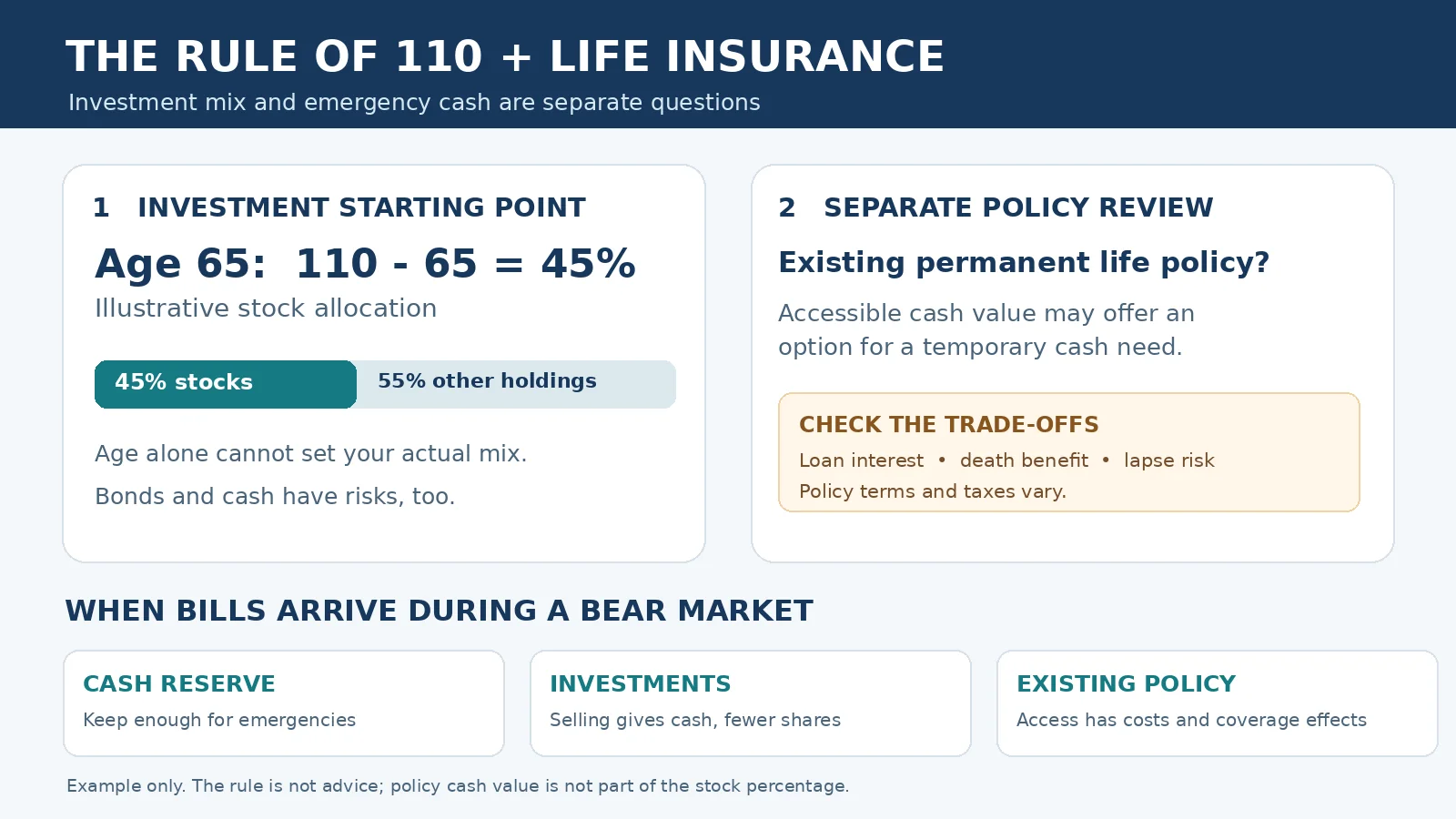
This is the practical connection between the Rule of 110 and life insurance: the rule opens an investment-risk conversation; a suitable policy may expand the cash-flow options during a difficult market. Neither determines the answer by itself.
What Type of Life Insurance Could Help?
Term life insurance generally provides coverage for a set period and does not build cash value to borrow against. Some permanent life insurance policies, including whole life and universal life, can build cash value. Indexed universal life (IUL) is a type of universal life with an interest-crediting method tied to an external index. The NAIC’s life insurance overview explains the differences among policy types.
The potential source of cash is the value in an existing policy. Buying a new policy after a bear market begins is not an instant liquidity strategy. New coverage requires underwriting, premiums, and time to build value. Early surrender charges and policy expenses may limit what is accessible. A policy should first make sense for its insurance purpose and remain comfortably affordable.
Cash value on a statement is not always the same as the amount that can be borrowed or withdrawn. Existing loans, surrender charges, and the contract’s own provisions can reduce accessible value. Ask the insurer for current figures rather than estimating from a chart or sales illustration. A household should also know why it bought the coverage and what death benefit the beneficiary still needs.
A policy loan is a loan against the contract
A policy loan may provide funds without requiring the owner to sell an investment at that moment. It carries interest, and the applicable rate and treatment of borrowed value vary by contract. An unpaid balance generally reduces the death benefit that beneficiaries would receive. As a balance and interest grow, the policy may need more premiums to stay in force. If it lapses or is surrendered with a substantial outstanding loan, tax consequences can arise. FINRA’s discussion of policy exchanges and outstanding loans flags the risk of lost protection and tax effects.
“No required monthly payment” does not mean no ongoing cost. Ask whether interest will be billed or added to the balance, whether the rate can change, and what the policy would look like after one, three, and five years if the loan is not repaid. A loan that helps bridge a short-term expense should not quietly become an indefinite method for funding a permanent budget gap.
A withdrawal reduces the value in the policy
A partial withdrawal removes value from the contract and may affect the death benefit, future premium needs, and taxes. Surrender charges or other restrictions may apply. Unlike a loan, the amount withdrawn is no longer in the policy, although the precise effect depends on the contract. Request a written explanation of the transaction rather than assuming every policy handles a withdrawal in the same way.
A loan is not automatically superior to a withdrawal, and neither is automatically superior to using savings or selling an investment. Compare the amount received, the insurance protection left afterward, ongoing costs, and the likely need for funds later. If the purpose of the policy is to protect a surviving spouse, that protection remains a central part of the decision.
Does IUL Shield Retirement Money From a Bear Market?
An IUL policy may have an index-crediting floor that limits a negative index credit for a specified period. That feature does not guarantee that the policy’s total cash value cannot decline. Insurance costs, administrative charges, loans, and withdrawals still affect the policy. Caps and participation terms can also limit positive credits. An IUL owner does not directly own the stocks in the referenced index.
The distinction matters here. The Rule of 110 is about how much of an investment portfolio might be in stocks. An IUL is an insurance contract with its own charges, benefits, and crediting rules. It should not be presented as a risk-free replacement for the stock side of the formula or as a way to guarantee bear-market protection.
If a household already owns IUL and is considering a loan, request a current in-force illustration with the proposed transaction. Review both guaranteed and non-guaranteed values and ask how lower crediting, rising charges, or a longer loan period could affect the policy. The NAIC explains the role of life insurance illustrations; projections are not promises.
The same discipline applies to whole life and traditional universal life. Whole life may include non-guaranteed dividends; universal life depends on credited interest and ongoing costs. Policy details matter more than the product label. The relevant question is whether this policy, with this proposed transaction, can continue serving the household’s insurance purpose.
Taxes Can Change the Comparison
Investment accounts and life insurance contracts do not share one tax rule. Selling a holding in a taxable account differs from taking a distribution from a traditional retirement account. A Roth distribution has its own rules. Life-policy withdrawals and loans depend on basis, contract structure, whether the policy is a modified endowment contract (MEC), and whether coverage remains in force. Do not assume that borrowing from a policy always creates “tax-free retirement income.”
The IRS explains that gain on surrender can be taxable. A policy that lapses with a large unpaid loan can create an unexpected tax issue; MEC rules may cause a loan or withdrawal to be treated differently. Ask a qualified tax professional to compare the specific investment accounts and insurance policy before choosing a source. A tax advantage that looks attractive in isolation can be outweighed by loan interest, loss of coverage, or the wrong transaction timing.
In a Rule of 110 conversation, tax treatment should be part of the analysis, not the entire sales pitch. The Rule of 110 says nothing about account taxes. A person can follow its suggested stock percentage yet still need a separate plan for which account to tap first, how much to withdraw, and what that means for later years.
A Practical Review Before Using the Policy
If you are considering insurance alongside a Rule of 110 discussion, ask these questions in order:
- What essential expense must be paid, and is the cash shortage temporary or likely to continue?
- How much cash reserve should remain for another emergency?
- What investment accounts and holdings could supply money, and what would selling them change?
- What permanent life policy exists, what death benefit is still needed, and how much cash value is accessible today?
- What interest, charges, surrender provisions, and loan or withdrawal limits apply?
- What do updated in-force illustrations show with and without the proposed transaction, under guaranteed and current assumptions?
- Is the policy a MEC, and what would loan, withdrawal, lapse, or surrender mean for taxes?
- When will the household revisit the decision, and what happens if markets do not recover on schedule?
Do not treat a policy illustration as a forecast that the market will recover. Stress-test the decision: what if expenses stay elevated for two years, the portfolio falls further, or the policy earns less than a current illustration assumes? If Denise and Michael needed another $6,000 next year, would the original loan still be manageable? Would a surviving spouse have enough death benefit if the insured died before repayment?
Set a review point. Request a current statement and illustration now, review the household budget after several months, and reassess before taking another policy loan. If the cash shortfall is permanent, address spending and income rather than assuming repeated borrowing will sustain the plan. The existence of accessible policy value should create flexibility, not an excuse to postpone an uncomfortable budget decision.
When This Combination May Not Fit
The Rule of 110 can be a poor fit as a literal allocation for someone whose goals, income sources, or risk capacity call for a different mix. An insurance loan can also be a poor fit if the policy has little accessible value, high loan costs, substantial existing debt, a large surrender charge, or an essential death benefit that would be weakened. It may make little sense to borrow to preserve investments if the household cannot afford the premiums or a plausible repayment plan.
Someone with only term coverage cannot borrow cash value from that policy. Someone without a permanent policy should not buy one solely because markets are down and bills are due. A household with ample cash reserves may have no reason to complicate its insurance coverage for a modest temporary expense. These are ordinary outcomes of an honest review, not failures to follow the rule.
It is also possible to choose a combination: use some cash, adjust discretionary spending, and sell an appropriate holding while keeping the policy intact. A diversified set of options is valuable precisely because it lets the household evaluate trade-offs rather than force every need into a single product.
Frequently Asked Questions
Does the Rule of 110 include my life insurance cash value?
The formula is a simplified suggestion for the stock percentage of an investment portfolio. It does not tell you how to value a life policy or where to count it in a portfolio allocation. A policy’s cash value may matter in a broader household balance-sheet and liquidity review, but do not relabel it as a stock, bond, or cash holding without a careful analysis of its limits and costs.
Does borrowing from a life policy prevent losses in stocks?
No. The stocks still rise or fall. A policy loan may let a household pay a temporary bill without selling certain shares now, allowing those shares to participate if prices later recover. They may also decline further. The loan accrues interest and may reduce the death benefit, so compare the two paths using actual account and policy information.
Can I use this approach with term insurance?
Generally no. Term insurance does not build the cash value needed for a policy loan or withdrawal. Term coverage may still be an important source of protection for a family, but it does not provide this particular liquidity option.
Is the Rule of 110 a good retirement plan by itself?
It is a starting question, not a complete plan. A workable retirement strategy also needs a budget, cash reserves, account and tax review, investment diversification, withdrawal decisions, and insurance protection appropriate to the household. If a bear market arrives, the cash-flow plan becomes just as important as the target stock percentage.
The Rule of 110 can help start an honest discussion about investment risk. Existing life insurance cash value may help some families handle a temporary bear-market cash need, but only after its charges, loan or withdrawal terms, remaining death benefit, and tax implications are understood. Contact Jay A. Cohen to review an existing policy’s insurance features, and coordinate investment and tax questions with qualified professionals.
This article is general educational information, not individualized investment, insurance, tax, or legal advice. Examples are hypothetical. Policy terms, available values, costs, and tax outcomes vary. Review the actual policy and a current in-force illustration before making a change.