

The grocery bill rises. Filling the gas tank costs more. Utilities take a larger bite out of a fixed monthly income. At the same time, a retiree’s investments are down. The bills cannot wait for the market to recover.
For households with an existing permanent policy, life insurance cash value may offer another source of money to consider. A policy loan or withdrawal could cover part of a temporary shortfall and reduce the need to sell investments after a decline. Whether that is a good choice depends on the actual policy, the amount needed, the cost of access, and the protection the family still needs. The market might not recover, and using policy value is never free of trade-offs.
Why Selling Investments During a Decline Can Be Difficult
Selling shares provides cash for immediate expenses. It also means those shares cannot participate if prices later rebound. The timing of losses and withdrawals matters in retirement, often called sequence-of-returns risk. Selling after a decline can be necessary and sometimes sensible; there is no rule that every investment sale in a bear market is a mistake.
The question is whether another available source could meet essential needs at a lower overall cost. Cash savings, predictable income, spending changes, and policy value each have different consequences. An Investor.gov discussion of market volatility notes that people who need to withdraw money soon may have less time to wait for a rebound. The best answer depends on the household’s circumstances.
A market decline and higher prices create two separate pressures
Investment values can fall at the same moment household expenses rise. Imagine that groceries, fuel, and electricity require an additional $350 a month. The family must find $4,200 over a year if those costs persist. That number is an illustration, not a forecast for any household. It is useful because it turns a vague worry into a cash-flow problem that can be evaluated.
The market side of the problem is different. If the family sells part of a diversified portfolio after prices fall, it converts a paper decline on those particular holdings into a realized transaction. Shares sold are no longer available to participate in a later recovery. Yet keeping those shares also exposes the family to a further decline. Neither choice eliminates risk, and nobody knows the next market move.
Before looking at life insurance cash value, separate what must be paid now from what can wait. An insurance premium, medication, or utility bill may have a firm deadline. Travel and discretionary purchases may not. Ask how many months the shortfall could last, what cash reserves are available, and whether the household can preserve a reasonable emergency cushion. Those answers determine how much money is actually needed and whether the need is temporary or structural.
Which Policies Build Life Insurance Cash Value?
Term life insurance does not build cash value and cannot normally be borrowed against. Some permanent policies, including whole life and universal life, can build cash value and permit loans or withdrawals under their contracts. Indexed universal life (IUL) is a form of universal life whose interest-crediting formula refers to an external index; owning an IUL policy is not the same as owning an index fund. The NAIC’s life insurance overview explains these basic distinctions.
This idea works only if the household already has a suitable policy with accessible value. Buying a new policy after a market decline is not an immediate source of retirement cash. Early values and surrender charges can make near-term access unattractive, and new premiums need to fit the budget. The policy’s original purpose—providing a death benefit—still matters.
Cash value is not the same as money available today
A statement may show accumulated value, cash surrender value, outstanding loans, and a death benefit. Those numbers do not necessarily describe the same dollars. A surrender charge can lower the amount available if the policy is canceled. Existing loans can reduce what can be borrowed or withdrawn. Policy provisions may also set minimum values that must remain to support the coverage. Ask the insurer for the amount available after relevant restrictions and charges, rather than assuming the largest number on the statement is available to spend.
Whole life, universal life, and IUL can behave differently. Whole life may have contractual guarantees and non-guaranteed dividends, depending on the policy. Universal life can allow flexible premiums, but ongoing insurance and administrative charges still need to be covered. IUL interest credits depend on its contract formula and crediting period. The label on the policy does not tell you whether accessing its life insurance cash value through a loan is affordable. The actual contract and current illustration do.
If coverage protects a spouse, adult dependent, business obligation, or estate plan, identify how much death benefit is still needed. A policy may look like a convenient source of cash while serving a purpose that would be expensive or impossible to replace later. Changes in health or age can make new coverage harder to obtain. This is one reason to review the insurance need before treating the policy as a retirement account.
A Retirement Household Facing Higher Bills
Consider Elena and David, a hypothetical retired couple. Social Security and a small pension cover much of their usual spending. They also have a diversified investment portfolio, some cash savings, and a permanent life policy bought years ago to protect the surviving spouse.
Now groceries, gasoline, and utilities cost more, while the market value of their investments has fallen. They need money for necessities, not a vacation they can simply cancel. Before choosing a source, they compare their options:
| Option | Potential benefit | Cost or question to check |
|---|---|---|
| Use cash savings | Pay bills without selling investments or borrowing. | How much reserve remains for another emergency? |
| Reduce flexible spending | Free money for essential bills. | Which costs can really be cut, and for how long? |
| Sell some investments | Get cash directly, without a policy loan. | Which holdings are sold, at what price, and under what account and tax rules? |
| Use value from their existing policy | A loan or withdrawal may cover a temporary gap while leaving more shares invested for a possible recovery. | Accessible value, interest, charges, taxes, reduced death benefit, and lapse risk. |
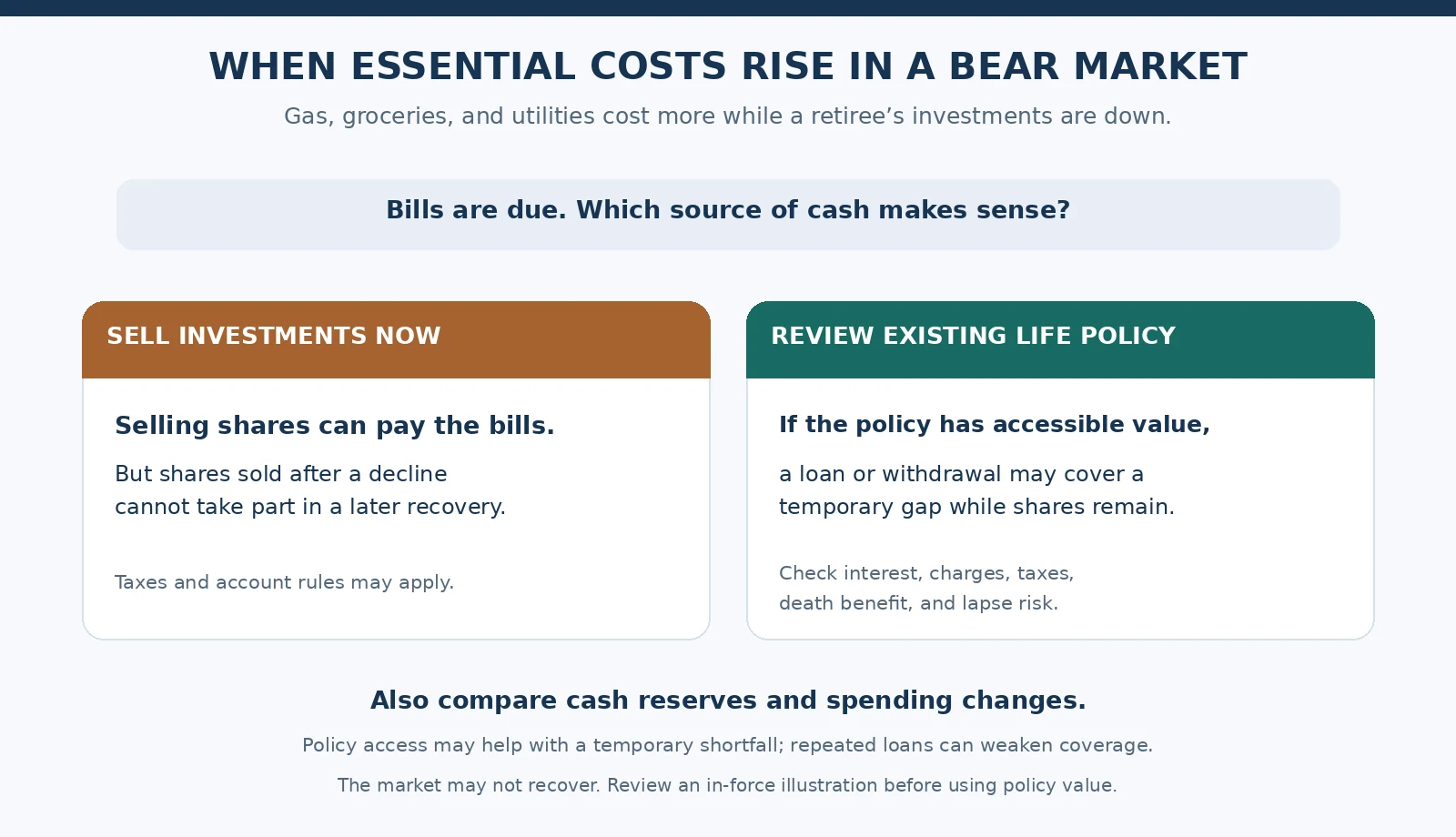
Suppose Elena and David have a short-term shortfall and their insurer confirms that the policy has enough accessible value. A modest loan or withdrawal might be preferable to selling investments that have recently fallen, provided the policy can remain healthy and the total costs make sense. If the investments later recover, the shares they did not sell could benefit. Neither that recovery nor a cheaper outcome is guaranteed.
If higher living costs leave them short every month for the foreseeable future, repeated policy loans are a different problem. Interest can accumulate, available value can shrink, and the policy may become difficult to maintain. They need a lasting adjustment to income or spending, not an open-ended borrowing plan.
Walk through the decision using actual bills
Suppose the couple needs $3,000 over the next three months for essential bills. They have cash savings, but using all of that money would leave little room for a home repair. Some investments have fallen in value, while other holdings may be closer to their original purchase prices. Their policy has cash value, but the insurer must confirm what is accessible and what interest or charges would apply. The $3,000 figure is only a teaching example; it does not imply that borrowing against life insurance cash value is suitable or cheaper.
They can first compare using part of their cash reserve with selling a limited amount of investments. A financial professional can help identify which account and holdings would actually be sold, the tax treatment, and the effect on the overall investment mix. They then ask the insurer for a loan and withdrawal illustration for the same amount. This produces a comparison of consequences, not merely a comparison of which account can send money fastest.
If they use life insurance cash value through a policy loan, the policy’s death benefit may be reduced by the unpaid balance, and interest continues until repayment or settlement. If they sell investments instead, they may avoid insurance costs but give up any future gains on those particular shares. If they use cash savings, they avoid those two costs now but have a smaller emergency reserve. A mixed approach may be reasonable. The decision should account for the family’s risk tolerance, coverage need, and ability to repay or replace the funds.
Write down the trigger for revisiting the decision. For example: review the budget in three months, reassess the policy after the next statement, and stop using policy value if the shortage becomes a regular monthly pattern. A plan with a review date is easier to manage than a series of loans made whenever a bill arrives.
Policy Loan Versus Cash Withdrawal
A policy loan uses eligible policy value as collateral under the insurer’s terms. Loan interest accrues. An outstanding loan generally reduces the death benefit available to beneficiaries and can increase the chance of lapse if it grows while charges continue.
A withdrawal takes value from the policy. It can reduce the death benefit and may trigger surrender charges or tax consequences depending on the contract and amount withdrawn. Unlike a loan, the amount withdrawn does not remain in the policy. Both choices can change how long the coverage lasts or how much additional premium is needed.
The policyholder should request a current in-force illustration showing the proposed transaction under both current and guaranteed assumptions. FINRA notes that loans or withdrawals can make coverage harder to keep in force and may have tax consequences. A projection is not a promise.
What changes after a policy loan?
Loan rules vary by contract. The insurer may charge a fixed or variable rate; the way interest is credited on borrowed value can also differ. Read the policy’s loan provision and ask for the current rate in writing. Find out when interest is due, whether it can be added to the balance, and how the loan affects credited value and the amount beneficiaries would receive. A loan against life insurance cash value that looks manageable at the outset can become harder to control if interest compounds while premiums and other charges continue.
You can often repay a policy loan, but repayment may be optional under the contract. “No required monthly payment” does not mean “no cost.” If the loan and interest remain outstanding, they generally reduce the proceeds payable at death. If the policy lapses or is surrendered with a large balance, tax consequences may arise. Ask for illustrations with and without a proposed repayment plan, and revisit them if premiums, loan rates, or policy values change.
What changes after a partial withdrawal?
A withdrawal of life insurance cash value permanently removes some policy value. Its effect on the death benefit, future premiums, surrender charges, and possible taxes depends on the contract. The insurer may describe several ways to take value, and those choices can have different consequences. Request a written explanation of the specific transaction before signing a form. An apparently small reduction in value today could affect coverage years later if the policy was already relying on non-guaranteed credits to pay its charges.
There is no universal rule that a loan is always better than a withdrawal. A loan introduces interest and an outstanding balance; a withdrawal reduces value directly and may have its own charges or tax treatment. The right comparison when accessing life insurance cash value is the after-transaction policy, the remaining insurance protection, and the household’s need for the money. Life insurance cash value should be evaluated in the context of the whole policy, not marketed as a separate savings account.
Is Accessing a Policy Better for Taxes?
There is no universal answer. Tax treatment depends on the contract’s basis, its status as a modified endowment contract (MEC), whether the policy remains in force, and the details of a loan or withdrawal. A policy loan should not be marketed simply as “tax-free retirement income.” Gains on surrender can be taxable; MEC loans can be treated differently; and lapse with a large outstanding loan can create a tax problem. The IRS explains taxable gain on policy surrender and special rules for MEC loans.
Investment-account tax rules also differ. A traditional retirement account, Roth account, and taxable brokerage account cannot be compared as if they were identical. Have a qualified tax professional review the specific accounts and policy before choosing a source of cash.
For example, selling an investment in a taxable brokerage account can have a different tax result from taking money out of a traditional IRA. Roth withdrawal treatment depends on its own rules and the particular distribution. Life insurance cash value has its own policy basis and MEC questions. Tax treatment may matter, but it should not overshadow loan interest, surrender charges, coverage needs, or the chance that an underfunded policy will lapse. A strategy that appears attractive for taxes can still weaken the household’s overall position.
Does an IUL Floor Protect the Policy’s Cash Value?
An IUL index-crediting floor may prevent a negative index credit for a particular period under the contract. It does not mean the policy’s total value cannot fall. Insurance costs, other charges, loans, and withdrawals can reduce value even in a period with a zero index credit. Caps, participation rates, spreads, and other terms can limit or change future crediting. NAIC guidance on illustrations distinguishes guaranteed from nonguaranteed values.
For the household deciding how to pay bills, the central issue is not whether IUL “beats” the stock market. It is whether their existing policy has accessible value and whether using it remains suitable after its full costs and effects are considered.
Stress-test the decision before relying on a rebound
When deciding whether to use life insurance cash value, ask what happens if investment values stay low longer than expected, household costs remain high, or the policy earns less than a current illustration projects. The family should understand how long the policy can stay in force under less favorable assumptions, how much premium may be needed, and what happens to the death benefit if a loan remains unpaid. The NAIC’s illustration guidance explains why guaranteed and non-guaranteed figures must be distinguished.
Also ask what happens if circumstances improve. Would the couple repay the loan from future income, leave it outstanding with a smaller death benefit, or take another action after professional review? Recovery in investments could make a temporary policy loan look attractive in hindsight, but it is not a repayment plan by itself. The market may recover slowly, fall further, or recover after the household needs additional cash.
Finally, consider the person who would depend on the death benefit. If the insured died before a loan was repaid, could the survivor meet expenses with the reduced proceeds? An insurance strategy that helps pay current bills should still be measured against the reason the family bought coverage in the first place.
A Practical Review Before Taking Policy Money
Before borrowing or withdrawing life insurance cash value, ask:
- How much policy value is accessible today, after any restrictions or surrender charges?
- What loan interest rate and policy charges apply now, and how could they change?
- How would the transaction affect the death benefit and future premium needs?
- What do current and guaranteed in-force illustrations show if markets or policy crediting disappoint?
- Is the policy a MEC? Could a withdrawal, loan, lapse, or surrender create taxable income?
- Is the cash shortfall temporary? What is the plan if higher prices persist?
- How do cash reserves, reduced spending, and other available sources compare?
Life insurance cash value can sometimes add cash-flow flexibility during a bear market. It does not prevent losses in a separate investment portfolio, ensure recovery, or replace an emergency reserve. The strongest decision starts with the family’s actual bills and the terms of the policy they already own.
Questions Retirees Commonly Ask
Should I use life insurance cash value before my emergency fund?
There is no preset order that works for everyone. Cash reserves can pay a bill without loan interest, but draining them entirely may leave the household vulnerable to another expense. A policy loan may preserve some reserve while creating interest and reducing the death benefit. Compare the actual dollars needed, the desired emergency cushion, and the policy illustration. A combination of sources may be more practical than relying on just one.
Can I borrow from a newly purchased life policy right away?
A new cash-value policy is generally a poor answer to an immediate cash shortage. Accessible value may be limited early on, premiums require additional cash, and surrender charges or policy terms can make short-term access unattractive. This article concerns an existing policy that has accumulated value over time. A new insurance purchase should be evaluated for its insurance purpose and long-term affordability, not presented as instant money for household bills.
What if I cannot afford to repay a policy loan?
Ask the insurer to illustrate the policy with the balance outstanding and interest accumulating. Some policies allow the loan to remain, but it can reduce the death benefit and may threaten coverage if the balance grows. If the household cannot afford future premiums either, that deserves prompt attention. Do not assume a market rebound or a future inheritance will solve the loan. Review the contract, current statement, and possible tax effects before deciding whether to borrow.
Is this a replacement for retirement planning?
No. Life insurance cash value can be one potential source of liquidity for some households, but it cannot set an investment allocation, make a permanent budget deficit disappear, or guarantee a retirement income stream. A coordinated review considers spending, cash reserves, account types, investment risk, taxes, and insurance protection together. The specific policy must support any proposed use.
If you have an existing policy with life insurance cash value and want to understand how it fits into your retirement planning, contact Jay A. Cohen to review the insurance side of the picture. Coordinate investment and tax decisions with qualified professionals. For more background on how withdrawals during downturns affect a portfolio, see the article on retirement sequence risk.
This article is general educational information, not individualized insurance, investment, legal, or tax advice. Policy terms, available values, charges, crediting methods, and tax outcomes vary. Review actual policy documents and a current in-force illustration before making a change.