

Can you cancel a life insurance policy? Usually, yes, if you are the policy owner and have the authority to make that decision. But before you sign anything, ask what happens next. Will anyone lose protection they still need? Will you receive money, owe taxes, or give up a benefit you cannot easily get back?
Maybe the premium has become uncomfortable. Maybe the mortgage is paid off, the children are independent, or a new policy looks better. Those are reasonable reasons to take another look. We would start by understanding what changed, then compare the choices. Keeping a policy forever is not automatically the right answer, and ending it deserves more thought than switching off a subscription.
This guide explains how cancellation differs from a lapse or surrender, what to ask about refunds and cash value, and how to make an orderly decision. Your policy and the insurer’s written information supply the details. You do not need to know every insurance term before you begin.
What does it mean to cancel a life insurance policy?
People use “cancel” for several different situations. Sorting them out helps you ask for the right paperwork and understand what will happen to the coverage.
- Cancellation by the owner: you ask the insurer to end the policy, following its procedures.
- Surrender: you terminate a permanent policy and receive any payable cash surrender value. The death benefit ends.
- Lapse: coverage ends because the requirements for keeping it active were not met, such as required payments or sufficient policy value.
- Free-look return: you return a newly delivered policy within its stated review period under the applicable rules.
- Term expiration: coverage reaches a contractual endpoint, which is different from choosing to end it early.
Start with the latest statement and the contract. Find the insurer, policy number, owner, insured person, policy type, and current status. A family may have several policies with similar-looking names. Make sure you have the right policy in front of you before signing anything.
If the owner is a trust or business, or a policy secures a loan or court-ordered obligation, get the appropriate legal review before acting. Being the insured person does not necessarily mean you own the policy or control its rights. A beneficiary designation also does not, by itself, make someone the owner.
Will you get your premiums back?
Ordinary term life insurance generally does not build cash value. Ending it usually does not produce a payment equal to all the premiums you paid. Those premiums paid for protection while the policy was active, even if no death claim occurred. Think of those premiums as paying for protection during those years. The fact that your family did not need to collect a death benefit does not mean the coverage did nothing.
Check separately for an unused prepaid premium refund, a return-of-premium feature, and a free-look refund. They are different things. A return-of-premium policy may require you to keep coverage for a specified period and meet other conditions. Ending it early can produce a different result than keeping it through that period.
The NAIC Life Insurance Buyer’s Guide explains that most term policies have no cash value and describes the initial policy review period. Ask the insurer what refund, if any, applies to your contract and requested effective date.
When you cancel a life insurance policy, a useful question is: “What exact amount will be returned, and which provision determines it?” Ask for a written answer rather than assuming an annual payment will automatically be prorated. Also distinguish the date coverage ends from the date a refund is processed.
What happens if you cancel a life insurance policy with cash value?
With permanent insurance, look beyond the account value printed in large type. Cash surrender value is the amount available when the policy is surrendered after applicable adjustments. Charges and outstanding debt can make it different from the policy’s displayed cash value.
Request a current surrender quote for a specific date. Ask the insurer to show the policy value, surrender charge, loan balance, accrued loan interest, other deductions, and net amount payable. Check whether the quote already accounts for those items. You do not want to subtract the same loan twice when comparing your options.
For example, suppose a hypothetical policy has $24,000 in value before surrender adjustments, a $2,000 surrender charge, and $5,000 in total outstanding loan debt. Under those simplified assumptions, the net payment would be $17,000. These are invented figures for explanation, not a quote, tax calculation, or prediction for your policy.
Now ask what you would give up in exchange for that payment. List the death benefit, riders, guarantees, and any remaining options you value. Our cash value life insurance guide explains the broader features. Here, the decision is whether ending this particular contract makes sense for the job it still needs to do.
Could surrender create a tax bill?
Possibly. The IRS explains that cash surrender proceeds above the policy’s cost may be taxable. That cost, often described as your investment in the contract or tax basis, is not always simply the sum of every premium you remember paying. Prior transactions can affect it. See IRS Publication 525 for its life insurance discussion.
Suppose a hypothetical policy has $30,000 in total surrender proceeds, no outstanding loan, and a verified $22,000 tax basis. Under those simplified facts, the $8,000 difference would generally be taxable income—not an $8,000 tax bill. The tax itself depends on the owner’s circumstances. If there is a loan or other policy history to account for, have a tax professional review the insurer’s figures before relying on this simple subtraction.
Loans deserve special attention. Debt discharged when coverage ends can affect the tax result, so a small check does not necessarily establish a small taxable amount. Request the insurer’s basis information and estimated reportable distribution before signing. Ask whether a Form 1099-R is expected, and have a qualified tax adviser review the transaction.
If you want to cancel a life insurance policy to obtain cash for a pressing expense, compare the net proceeds and potential taxes with the expense you need to cover. A quoted surrender amount and money available to spend after taxes can be different numbers.
What if you simply stop paying?
Stopping a bank draft is a payment change. It does not provide a reliable explanation of when coverage ends or how any policy value will be handled. Ask the insurer about the premium due date, grace period, and the consequences of a missed payment. A grace period is the contractual window for addressing a payment problem before coverage ends under the applicable terms.
Some permanent policies can use value to cover charges for a time. Some contracts have an automatic premium loan provision that borrows against available value to make a payment. Either situation can make an apparent payment break more complicated than it looks. Get a current written explanation of what applies to your policy.
The Florida Department of Financial Services life insurance overview discusses policy loans, missed premiums, and reinstatement. The practical point is simple: stopping payments and properly ending the policy are not necessarily the same thing.
If your goal is to cancel a life insurance policy, use its formal process. If you want to keep coverage through a temporary budget problem, explain that when requesting options. Be clear about the outcome you want.
Is the original protection need still there?
Before focusing on paperwork, return to the reason you bought coverage. What financial problem would a death create today? The answer may have changed substantially since the policy began.
A paid-off mortgage reduces one obligation. It does not automatically replace a surviving spouse’s income needs, caregiving support, final expenses, or other debts. Adult children may be independent while a spouse or another family member still depends on you. Retirement can change the need without eliminating it.
Make two short lists: what your family would still need to pay for, and what money would actually be available to pay for it. Include dependable existing coverage, liquid savings you intend survivors to use, and the practical effect of losing income or household support. Avoid counting the same asset twice or assuming every retirement dollar is available immediately without consequences.
Our Life Insurance Needs Calculator can help organize that estimate. It does not calculate surrender taxes or tell you whether to end a policy. Use the result as a starting point, then check the assumptions. If you decide to cancel a life insurance policy, you should be able to explain how any remaining need will be covered.
Should you cancel a life insurance policy or reduce the coverage?
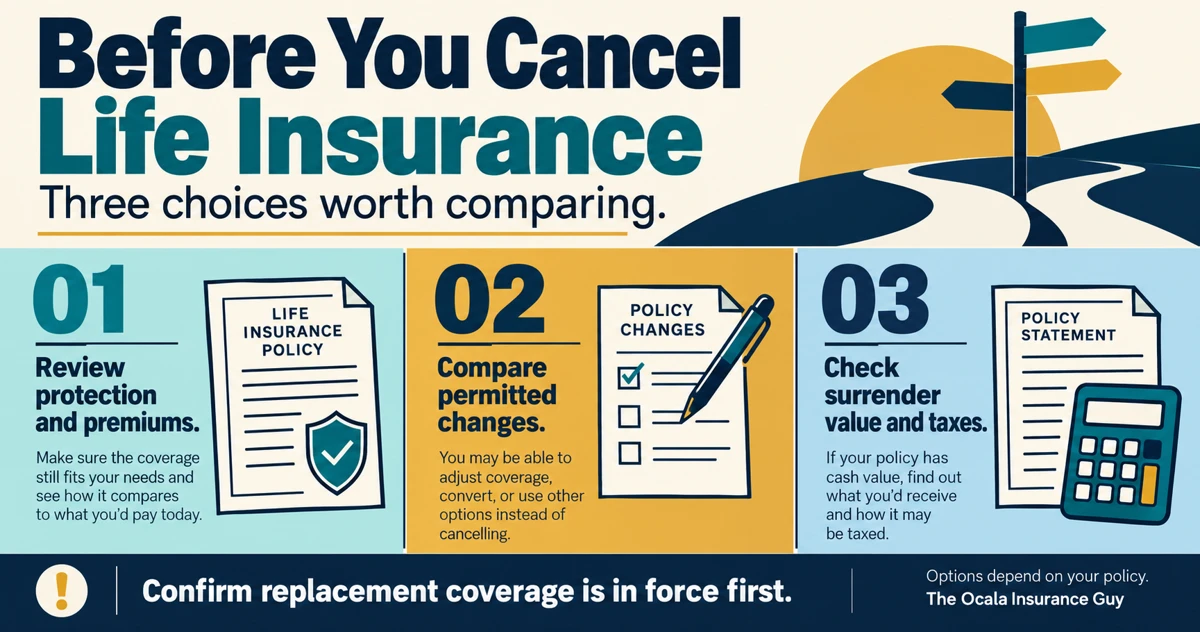
Sometimes the problem is the size of the commitment, rather than the need for insurance itself. Ask whether the current contract permits reducing the death benefit, changing an optional rider, or making another adjustment. Request the resulting premium and benefits in writing.
Some cash-value policies, particularly whole life, also offer what are called nonforfeiture options. That term describes ways to preserve some value when regular premium payments stop. Reduced paid-up insurance uses eligible value to support a smaller benefit without the original ongoing premium schedule. Extended term insurance uses eligible value to provide protection for a specified period. Availability and the actual benefit depend on the contract.
The New York Department of Financial Services consumer FAQ explains these concepts. It is useful background, not a statement that a New York rule governs your policy in another state.
Compare three possible outcomes side by side: keep the current arrangement, modify it if permitted, or end it. Write down the cost, death benefit, duration, cash access, and lost features for each. A smaller benefit that you can maintain may address the actual concern. It may also fall short of the remaining need. Get the numbers before choosing.
Can you reduce payments on a universal life policy?
Do not confuse a flexible payment feature with permission to pay nothing indefinitely. Ask the insurer for an in-force illustration, an updated projection using the existing policy’s current values. Have it show the payment pattern you are considering.
Separate guaranteed results from results based on current assumptions. A projection is not a promise that interest credits, dividends, charges, or other nonguaranteed elements will remain unchanged. The NAIC explanation of life insurance illustrations describes the difference between guaranteed and nonguaranteed elements and how in-force illustrations update the picture for existing coverage.
We would ask: “If we make this payment change, what has to happen for the coverage to last?” Follow that with questions about guarantees, future payments, loans, and how often to review the policy. If the plan relies on optimistic assumptions, ask to see what happens with less favorable results.
You might ultimately cancel a life insurance policy because the required funding no longer fits your goals. An updated illustration helps distinguish that decision from accidentally underfunding a contract you meant to keep. It also gives you a concrete comparison instead of relying on the illustration you received years ago.
What if you are replacing the coverage?
A quote is not an issued policy, and an application is not confirmation that protection has begun. Before ending existing coverage, verify the replacement has been issued, reviewed, accepted, paid as required, and confirmed in force. The NAIC consumer guidance advises keeping your current policy until you receive the new one and comparing the policies before making a change.
Put the actual offers next to each other. Compare the insured amount, policy duration, premium schedule, exclusions, riders, guarantees, surrender provisions, and any new contestability or suicide exclusion periods. These periods and their treatment depend on the contract and applicable law. A lower opening premium tells only part of the story.
If your health has changed, check the replacement’s final underwriting decision rather than the price originally advertised. Underwriting is the insurer’s evaluation of an application to decide the terms it can offer. You may find the existing coverage more valuable than expected once the new offer arrives.
Review conversion rights before giving up a term policy. A conversion option may let you change eligible term coverage to specified permanent coverage under the contract’s rules. Our term life insurance conversion guide explains the deadlines and questions to ask. Conversion is an option to evaluate, not an automatic recommendation.
Can the insurer cancel you because your health changed?
A new diagnosis and an insurer ending coverage are different issues. The NAIC life insurance overview states that an insurer cannot cancel an issued policy simply because the policyholder’s health changes. That does not erase payment obligations or contract conditions.
Application misrepresentations, unpaid required amounts, expiration, and other contractual issues need their own review. If you receive a termination or lapse notice, do not assume the cause. Read the reason, relevant dates, payment information, and instructions. Ask for clarification in writing if the notice is unclear or appears inconsistent with your records.
Gather premium receipts, bank records, previous notices, and relevant policy pages. If a problem remains unresolved, your state insurance department can explain its consumer assistance process. Keep a timeline of the steps you take and the responses you receive.
If you were about to cancel a life insurance policy because you believed a diagnosis had already made it invalid, first verify that assumption. Similarly, do not assume a new policy will be easy to obtain just because your existing one remains active. The current contract and a future application are separate matters.
How to cancel a life insurance policy in an orderly way
Once you have reviewed the consequences and decided to proceed, ask the insurer for its current instructions. Procedures vary, so a generic cancellation letter may not satisfy every requirement.
- Confirm authority. Identify the owner and any assignment, trust, business, beneficiary, or legal restriction that needs attention.
- Request the correct form. Specify whether you intend a free-look return, ordinary cancellation, or full surrender.
- Get dated figures. Request the refund or net surrender amount, charges, debt treatment, and available tax information.
- Choose the effective date deliberately. Ask when protection ends and how that relates to receipt and processing of the request.
- Complete the insurer’s requirements. Follow its signature, identity-verification, delivery, and payment instructions through an approved channel.
- Obtain confirmation. Retain the submitted request, acknowledgment, final status, payment record, and tax documents.
Ask how recurring payments should be handled during processing. Monitor the account afterward and resolve any unexpected debit or missing refund with the insurer. Keep proof of the requested transaction and its completion. “We sent the form” and “the insurer confirmed the result” are separate milestones.
What should you keep in your records?
Save a copy of the policy, recent statement, surrender or refund quote, signed request, and confirmation of the effective date. Keep any illustration or comparison you used to make the decision. If coverage was replaced, retain the confirmation that the new policy was active before the old one ended.
Put a short explanation in your own file: what changed, what alternatives you reviewed, and how the remaining financial need will be met. It does not have to be elaborate. A few clear sentences can save a family member considerable confusion later.
Update the place where your household keeps insurance information so survivors do not mistake a cancelled policy for active protection. If you share an insurance inventory with a trusted person, make sure that copy reflects the change. Preserve the old documents separately for records and any tax questions.
When you cancel a life insurance policy, keep sensitive information in the insurer’s secure process. An educational inquiry through our website does not require account numbers, payment details, or medical records. We can identify what needs review without asking you to place private documents in a general contact message.
Three situations that deserve different answers
A temporary income setback
Imagine a hypothetical household whose income has fallen for several months while two children still depend on it. The immediate question is affordability. Review permitted changes and available resources before ending all protection. Ask what a lower benefit would cost, which options preserve coverage, and what each choice gives up. Is this a temporary budget problem, or has the need for protection changed for good? Those are different questions.
A protection need that has largely ended
Now imagine a hypothetical retiree with independent children, no mortgage, and a spouse whose needs are adequately covered by dependable resources. The review might support reducing or ending coverage. Document the assumptions, including any remaining final expenses or obligations. The useful question is what the coverage can still do for this household. The years of premiums already paid cannot be undone, but the policy’s current guarantees, benefits, and available value still deserve a fair comparison.
A cash-value policy with substantial debt
A third hypothetical owner needs cash and has borrowed heavily from a permanent policy. Before surrender, obtain the net payment, debt information, basis, and tax review. Also compare any workable modification. The biggest figure on the annual statement is not the amount available to spend, and loan history may change the result. These examples show different questions, not recommendations for a particular reader.
What if the policy has already lapsed?
Ask for the exact current status and whether reinstatement is available. Reinstatement means restoring a lapsed contract under its rules. It may require payments, interest, evidence of insurability, or other conditions. Deadlines matter. Do not assume the insurer must restore coverage just because you can now pay.
Compare reinstatement terms with any alternative actually available to you. Find out whether coverage is active during the process and what dates apply. Until the insurer confirms the result, avoid treating a submitted payment or request as proof that protection has resumed.
The Florida consumer overview provides background on reinstatement. For your situation, the insurer’s written decision and applicable contract provisions are what you need to examine.
Make the decision with today’s facts
Before you cancel a life insurance policy, we would ask three things: Do you still need the protection? What will you actually receive or give up? What is the plan once the coverage ends? Get a clear explanation of what ends, what is paid, what may be taxable, and which alternatives exist. If you are replacing coverage, finish that comparison and confirm the new protection first.
For a broader check of what you already own, our life insurance policy review guide provides questions to bring to the discussion. If you would like help understanding the insurance choices, use The Ocala Insurance Guy Contact Form. Tell us what changed and what you want the coverage to accomplish. We can start there.
About Jay A. Cohen, The Ocala Insurance Guy
Jay A. Cohen is a licensed health and life insurance agent based in Ocala, Florida, licensed in Florida, Virginia, Illinois, Utah, and California. We help individuals, families, and business owners understand insurance choices, costs, benefits, and limitations in plain language.
We begin by listening. What are you trying to protect? What changed since you purchased the policy? Which part of the decision feels unclear? Those questions help us understand the concern before discussing a product or a policy change.
Our educational approach gives you room to ask questions and compare practical options. We explain what is guaranteed, what depends on assumptions, and what needs confirmation from the insurer. A review may support keeping the policy, adjusting it, or considering another approach. A review does not automatically mean buying something new.
If you are considering whether to cancel a life insurance policy, we can help organize the insurance questions and identify information to request. Legal and tax questions belong with qualified advisers. Our goal is for you to understand the decision and how it fits the responsibilities that matter to you.
Explore our life insurance information, learn more about Jay A. Cohen and our educational approach, or use The Ocala Insurance Guy Contact Form to share your questions.
This article provides general educational information and is not individualized insurance, investment, legal, or tax advice. Policy provisions, benefits, availability, refunds, and requirements vary by insurer, contract, state, and circumstances. Consult qualified professionals before replacing, surrendering, borrowing from, or materially changing a life insurance policy.