

Can you get part-time health insurance through work? Sometimes, yes. Working fewer hours does not automatically rule out coverage, but it does not automatically qualify you either. The employer’s plan, its eligibility rules, and the way your hours are counted matter more than the label on your schedule.
That can be frustrating when you are trying to make a real decision: accepting a job, cutting back your hours, or building benefits for a small business. We suggest starting with three questions. Who is eligible? When would coverage begin? What would you actually pay? Once those answers are in writing, comparing your options gets much easier.
Who is eligible for part-time health insurance?
They can be when the employer offers coverage to their employee category and the plan permits it. HealthCare.gov’s guidance for part-time workers explains that some employers offer these workers health coverage and others do not. The important step is checking the actual offer rather than assuming every employer follows the same rule.
For example, a person working a reduced schedule might be eligible under one employer’s plan and ineligible under another. That difference does not tell us which job offers the better overall compensation package. We still need the employee contribution, coverage details, and start date.
Ask the benefits administrator for the written eligibility provision that applies to your position. A recruiting advertisement saying “benefits available” is a starting point. It does not answer whether the benefit is medical insurance, who qualifies, or how long a new hire must wait.
Before offering part-time health insurance, employers need to confirm what the contract allows. A promise should come after that check. A generous offer creates problems if the enrollment rules cannot support it. Our group-benefits information provides a broader starting point for comparing benefit strategies.
Why the 30-hour rule does not answer everything
You may have heard that full-time means 40 hours. For federal employer shared responsibility purposes, the IRS uses an average of at least 30 hours of service per week or 130 hours per month. That is a specific definition for a specific set of rules, rather than a universal definition for every workplace benefit.
The IRS describes two ways to count those hours. One looks at each month. The other, called the look-back method, reviews hours over an earlier period to determine full-time status for a later period, known as the stability period. Certain paid time off can count too. In other words, counting this week’s shifts may not give you the whole answer.
When checking part-time health insurance, the payroll label may not tell the whole story. A payroll system may describe someone as part-time while the benefits rules reach a different conclusion. If your schedule regularly approaches the threshold, ask how the employer determines your status. Request the relevant dates and method instead of relying on a verbal estimate.
What if you work fewer than 30 hours? That does not automatically mean the employer cannot cover you. Part-time health insurance can be available when the plan permits it. We need to check what the employer is required to offer and what its plan actually allows.
Employer size and employee eligibility are different questions
The Affordable Care Act’s employer shared responsibility provisions generally apply to applicable large employers. The IRS explains that this generally means an average of at least 50 full-time employees, including full-time equivalents, during the previous year. Related employers and special rules can affect the calculation.
A full-time equivalent is a way of counting the workforce: hours from people who are not individually full-time are combined for the employer-size calculation. But being counted does not automatically give an employee a place on the health plan. “How big is the employer?” and “Can I enroll?” are two different questions.
A small employer outside those federal shared responsibility provisions may still choose to offer benefits. A larger employer needs to evaluate its obligations carefully, but its size alone does not establish every part-time worker’s enrollment rights. Employers near the threshold should have their benefits and tax professionals evaluate the actual records.
For an employee, we would keep the first conversation simple: “Which eligibility rule applies to my job, and how did you apply it to my hours?” You should not have to solve the employer’s entire compliance calculation to learn what offer is available to you.
What small-business owners should check before expanding coverage
Offering part-time health insurance may help a business support valued people who cannot work a full schedule. A caregiver, student, or experienced worker reducing hours may care a great deal about medical coverage. The useful question is whether the business can offer a benefit it can administer and sustain.
A useful starting point for part-time health insurance is a workforce census: employee roles, work locations, expected hours, and current benefit eligibility. Use the secure process your benefits professional provides for personal information. You do not need employees’ detailed medical histories in a general planning spreadsheet.
Then confirm permitted employee categories, minimum hours, employer contributions, participation requirements, and enrollment timing with the insurer or plan administrator. Avoid building the budget around an assumption that every eligible employee will accept, or that everyone will decline. Compare several realistic enrollment scenarios.
SHOP, the Small Business Health Options Program, is one possible route for eligible businesses. HealthCare.gov’s SHOP eligibility guidance says employers can choose to offer coverage to part-time employees. SHOP has its own business eligibility and participation rules, and local plan availability still needs verification.
Outside SHOP, confirm the actual carrier’s requirements rather than copying SHOP rules into another plan. Ask for written confirmation of the proposed eligibility design. State requirements and the type of arrangement can also matter, especially when employees work in several states.
Make the budget concrete. Review the employer’s monthly contribution, employee deductions, administrative work, and renewal exposure. Our guide to small-business health insurance costs addresses that separate budgeting question. The goal here is establishing who can participate before comparing the price.
When would coverage actually begin?
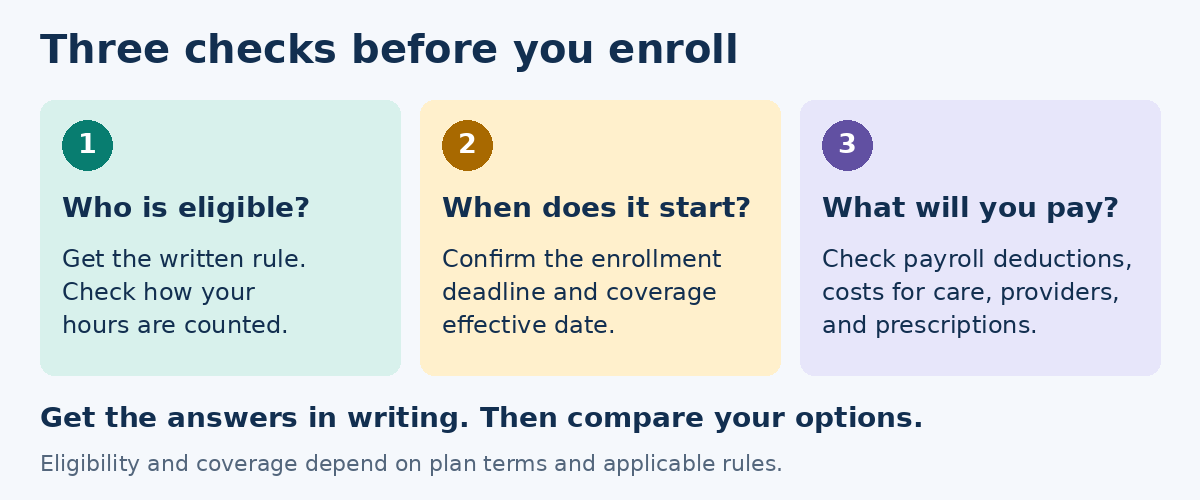
An offer of part-time health insurance is not confirmation of active coverage. Ask for the date you become eligible, the enrollment deadline, and the date benefits take effect. Keep those three dates together. “After the waiting period” is less useful than an actual calendar date.
The federal waiting-period rule generally prevents a group health plan from imposing more than 90 days of waiting after someone is otherwise eligible. The final waiting-period regulations published by the IRS explain the distinction between substantive eligibility conditions and waiting for time to pass. This does not mean every employee becomes eligible on day 91 after being hired.
For a worker whose hours vary, determining whether the eligibility condition is met can involve separate rules. Do not simply add three months to a start date and assume you have coverage. Ask the administrator to explain the process and provide the resulting effective date in writing.
Before ending other insurance, confirm that enrollment was accepted and the new coverage will be effective when expected. If you have a scheduled appointment, prescription refill, or ongoing treatment, check how the transition affects it. A coverage gap is much easier to prevent before the old plan ends.
What happens if your hours change?
A busy month followed by a quiet month raises a fair question: do benefits switch on and off with every schedule? The answer depends on the plan and applicable measurement rules. Ask what triggers a review and whether an established coverage period applies.
Consider a hypothetical retail employee who usually works 24 hours a week and temporarily covers extra shifts during a busy season. We cannot conclude from that one week alone that benefits begin immediately. We need the employer’s hours-counting method, the employee’s classification, and the applicable plan terms.
Now consider someone already enrolled who reduces hours to care for a parent. Before accepting the new schedule, that employee should ask when eligibility would change, whether coverage continues for a period, and what notices or continuation options may apply. The paycheck change is only one part of the decision.
Keep a copy of any status-change notice and the coverage termination date. If you believe the employer used incorrect hours, provide your records and ask for a written explanation or correction. Addressing a mismatch promptly is more useful than discovering it after a medical claim arrives.
Comparing part-time health insurance
Eligibility is good news, but it is not the whole comparison. Part-time health insurance may include an employer contribution, convenient payroll deductions, or a network that works well locally. It may also leave you with a substantial premium or limited access to a particular specialist.
Request the Summary of Benefits and Coverage, often shortened to SBC. It is a standardized summary that helps you compare benefits and cost sharing. Also obtain the employee premium schedule; a benefits summary alone will not tell you your payroll deduction.
Compare the premium, deductible, copays, coinsurance, and out-of-pocket maximum. The premium keeps coverage active. The deductible is an amount you may pay for covered services before the plan pays its share, depending on the service. Coinsurance is a percentage of covered costs; a copay is typically a fixed amount.
The insurer’s name alone cannot tell you whether part-time health insurance fits your medical needs. Check providers and prescriptions for the specific plan. Two plans from the same insurer can use different networks or drug coverage. If an important physician appears in a directory, confirm the plan’s network participation and verify the information with the provider’s office before relying on it.
Look at employee-only and family coverage separately. Adding a spouse or child can change the monthly cost considerably. A household may need to compare more than one arrangement rather than assume everyone belongs on the same plan. Our health-insurance overview explains the broader coverage choices.
A hypothetical paycheck comparison
Let’s put some numbers to it. Suppose a part-time employee is offered employee-only medical coverage for $180 a month, while another option costs $120. These are hypothetical figures to show the comparison, not quotes or estimates for an Ocala business.
The $60 monthly difference becomes $720 over a full year. But that does not settle the decision. If the lower-premium plan has a different deductible, excludes a needed provider from its network, or handles a medication differently, the household’s total spending could move in either direction.
Start with a full year of premiums, then consider expected covered care and the plan’s cost sharing. Also ask what a difficult medical year could mean financially. The out-of-pocket maximum has conditions and generally does not include premiums or every possible expense, so read what counts toward it.
For a reduced-hours worker, cash flow deserves attention too. Ask how deductions are handled when a paycheck is unusually small or a pay period includes unpaid time. An affordable annual total can still be awkward if the collection schedule does not fit your income pattern.
Could you use the Marketplace instead?
If part-time health insurance is unavailable at your workplace, individual Marketplace coverage is worth investigating. Eligibility for financial help depends on your circumstances and current rules. Part-time work by itself does not establish the amount of assistance you receive.
If your employer offers coverage, declining it does not automatically create eligibility for Marketplace savings. The offer’s affordability and minimum value can affect the answer. Minimum value is a federal standard for the coverage a job-based plan provides. Use the employer’s actual offer information when completing the Marketplace application.
HealthCare.gov’s affordability explanation distinguishes the employee’s self-only offer from the family coverage comparison. That distinction can matter when employee-only insurance is reasonably priced but adding family members costs much more. Have the household’s situation evaluated rather than treating one payroll figure as the answer for everyone.
Enrollment timing matters as well. HealthCare.gov explains that qualifying coverage losses may create a Special Enrollment Period. A reduction in hours alone is different from actually losing qualifying coverage. Verify the event, deadline, documentation, and effective date before making a change.
Before you sign an enrollment form
Before enrolling in part-time health insurance, check that the application lists everyone you want covered, that names and birth dates are accurate, and that the coverage tier matches your election. Save a copy of what you submitted and any confirmation. A completed form and an accepted enrollment are different steps.
Ask how you will receive your member identification information and where to check the enrollment status. If an appointment comes before the card arrives, verify active coverage through the plan’s official process. Having a deduction on your pay statement is worth checking, but it does not answer every question about effective dates or dependent enrollment.
Employers can make this easier by giving each eligible worker a concise explanation of deadlines, contributions, and where to find the plan documents. Use the same clear process for comparable employees. People should not have to piece together their medical coverage from a job advertisement, a break-room conversation, and a deduction they do not recognize.
Five questions to send your benefits administrator
You can make the first exchange short and specific. We suggest asking for these answers in writing, so you can compare the offer without relying on memory:
- Does my position qualify for medical coverage, and which written eligibility provision applies?
- How are my hours counted, including variable schedules and relevant paid time?
- What are my enrollment deadline and confirmed coverage effective date?
- What will employee-only and dependent coverage cost per pay period, and can I receive the SBC?
- If my hours fall, when could coverage change and what continuation information would I receive?
If an answer seems inconsistent with your offer letter or payroll records, point to the specific discrepancy. Ask who can resolve it and when to expect a response. There is no need to turn a straightforward benefits question into an argument; the aim is a usable, documented answer.
Common questions about part-time health insurance
Can an employer cover someone who works 20 hours?
Possibly. Twenty hours is not a universal eligibility rule. The employer’s plan must permit the arrangement, and applicable requirements still need to be satisfied. Ask for the actual minimum-hours provision and whether it applies to your employee category. An example from another company does not establish your eligibility.
Can I combine hours from two unrelated jobs?
Do not assume that two part-time schedules create eligibility under either employer’s plan. Ask each employer about its own rules. Related-employer arrangements and specialized plans can involve different considerations, so get a specific explanation if those circumstances apply.
Does a dental or accident benefit mean I have medical insurance?
No. A benefits package may contain different products with different purposes. Ask whether you are being offered comprehensive medical coverage, a dental plan, a fixed-payment supplemental policy, or something else. Obtain each product’s documents so you understand what it pays and what expenses remain yours.
Can a small business offer coverage only to a favorite employee?
Before promising an exception, check the rules. A benefits plan needs permitted eligibility categories that are applied consistently; it cannot simply be a list of people the owner would like to cover. The plan administrator and appropriate advisers should review carrier rules and any applicable nondiscrimination requirements before the business makes that commitment.
Should an employer reimburse a worker’s individual premium instead?
That deserves a separate, structured review. Employer reimbursement arrangements have their own requirements and can affect Marketplace assistance. Avoid assuming that casually paying someone’s individual premium is equivalent to establishing a compliant benefit. Compare the available approaches with qualified benefits and tax professionals before committing.
Turn the eligibility question into a workable plan
The next step with part-time health insurance is getting the eligibility rule, enrollment dates, and employee cost together in one place. Then compare what the coverage actually does for your household or workforce. We would rather help you ask a clear question now than have you discover an important limitation after enrollment.
If you would like help understanding the options, use The Ocala Insurance Guy Contact Form. Tell us whether you are an employer or employee and what decision you are facing. Keep Social Security numbers, medical details, and other sensitive records out of the form.
About Jay A. Cohen, The Ocala Insurance Guy
Jay A. Cohen is a licensed health and life insurance agent based in Ocala, Florida. Jay is licensed in Florida, Virginia, Illinois, Utah, and California.
Our approach is educational: we listen to understand your needs, goals, and budget, then explain your options in plain language. We walk through the benefits, costs, and limitations, welcome your questions, and help you make an informed decision without pressure to buy a particular product.
For more about workplace coverage options, explore our group-benefits information.
To explore permanent coverage and available policy options, visit the Jay A. Cohen life-insurance information page. You can also learn more about Jay’s educational approach and insurance experience.
For questions about your coverage choices, use The Ocala Insurance Guy Contact Form.
This article provides general educational information, not individualized legal, tax, or insurance advice. Eligibility, benefits, costs, and effective dates depend on the actual plan documents and applicable requirements. Hypothetical examples are not quotes. Consult the plan administrator and appropriate qualified professionals about your situation.