

Can life insurance be used as collateral? Yes, some policies can help secure a loan through a collateral assignment, provided the insurer permits it and the lender accepts the arrangement. But using life insurance as collateral changes who has a claim on the policy. Before signing anything, we need to understand what the lender can receive and what protection remains for the people you want to help.
Here is the question we would start with: if the policy helps secure the loan, will your family still have the protection it needs? We need to look at the loan, the insurance, and the assignment together. Seeing $500,000 on the policy’s front page does not tell us how much you can borrow, whether the lender will approve you, or what your beneficiaries would receive.
Jump to: Who gets paid · Assignment versus policy loan · Term coverage · Before you sign
What does using life insurance as collateral actually mean?
Collateral is property or a financial right pledged to support a debt. Using life insurance as collateral gives a lender specified rights in a life insurance policy as security for an obligation. The lender is the assignee. The exact rights depend on the policy, the assignment document, and the lending agreement.
The owner, insured person, and beneficiary have different roles. The owner controls the policy, subject to its terms and any restrictions. The insured is the person whose death can trigger a covered benefit. The beneficiary is the person or organization designated to receive proceeds. One person can fill more than one role, but being insured does not automatically make someone the owner.
That distinction matters if a spouse, business, or trust owns the coverage. You cannot simply pledge a policy because your life is insured by it. Start by confirming ownership and who has authority to sign. If an entity owns the policy, have its legal adviser confirm the required authorization.
Who gets paid: the lender or your family?
With a properly structured collateral assignment, a lender generally has priority for the amount secured by the assignment, and beneficiaries receive the remaining proceeds. MassMutual’s explanation of business-loan collateral describes that basic arrangement. The amount owed at the time of a claim matters; it may differ from the amount originally borrowed.
Let’s put some numbers to it with a hypothetical example. Suppose the covered death benefit available for distribution is $500,000 and the lender’s valid secured claim is $80,000. Assuming no other deductions or claims, $80,000 would go to the lender and $420,000 would remain for the beneficiaries. The illustration shows the arithmetic; the actual contracts determine the payment.
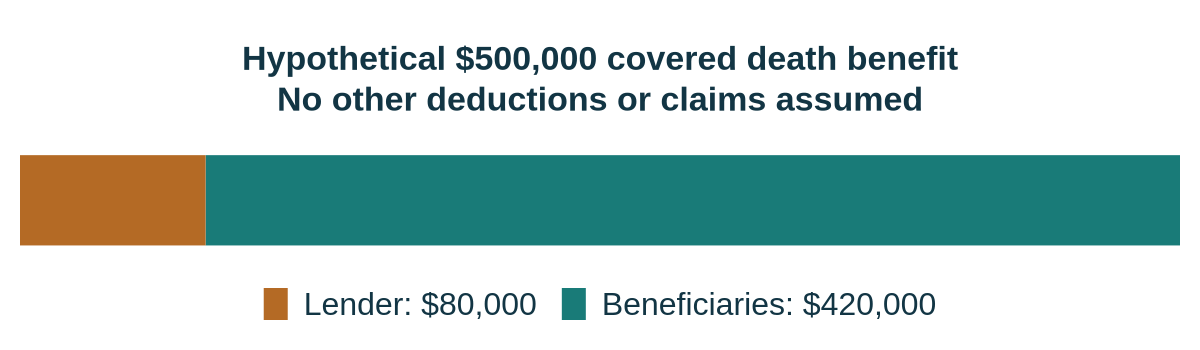
Now ask whether $420,000 would still do the job your family needs. Perhaps the policy was intended to replace income, help with a mortgage, and support a dependent. The lender’s portion cannot also be counted as money available for those purposes. We need to avoid giving the same dollar two jobs.
Also ask what the secured obligation includes. Does the document cover a particular loan, interest, permitted expenses, or additional obligations? Request an explanation tied to the actual wording. Do not assume the lender’s rights are limited to the balance shown on your latest statement without checking the agreement.
Why not just name the lender as beneficiary?
Naming a lender as beneficiary and making a collateral assignment are different actions. A beneficiary designation may direct proceeds according to the percentage or amount listed. An assignment is intended to establish security rights tied to an obligation. Using the wrong form can create a result you did not intend.
For life insurance as collateral, ask the lender and insurer which assignment process applies. Have your attorney review provisions you do not understand. Simply putting the bank’s name in the beneficiary field is not a reliable substitute for coordinating the required documents.
Keep your family designations current as well. Ask what happens if a beneficiary has died, a child is still a minor, or a trust is involved. Those questions do not disappear when a lender has an assignment. Our guide to naming a minor as a life insurance beneficiary explains why the way a child receives money needs its own planning.
Collateral assignment versus a policy loan
These two arrangements are easy to mix up. With an outside loan secured by a collateral assignment, a bank or other lender provides the money under a lending agreement. The life insurance policy supports that obligation. The lender still decides whether the borrower and proposed security satisfy its requirements.
A policy loan is borrowing from the insurance company under an eligible cash-value policy’s loan provisions. It uses available policy value as security. It is not a bank loan created by assigning the death benefit. Guardian’s policy-loan guide explains the effects of loan interest, reduced death benefits, and possible lapse or tax consequences.
Ask a simple question whenever someone says “borrow against your life insurance”: who is lending the money? Then ask which agreement governs repayment, what interest applies, and what happens if you do not repay. Those answers are more useful than a label that might describe two different transactions.
Our cash-value life insurance guide covers the policy-value side in more detail. Here, our focus is the outside lender’s assignment. Understanding the difference helps you compare options without assuming that a death benefit is cash sitting in an account.
Can term life insurance be used as collateral?
Sometimes. Term coverage may be acceptable when the insurer allows assignment and the lender accepts the policy and its remaining duration. Term insurance generally has no cash value to borrow from. That does not automatically prevent an assignment of its death-benefit rights, but it does mean the policy is not a savings account the lender can freely turn into cash.
The lender may be concerned about repayment if the insured dies during the loan period. It may also have requirements concerning the insurer, benefit amount, coverage duration, and assignment wording. Bankers Life’s collateral overview notes that term policies may qualify in some situations and that not every lender accepts them.
Check the actual premium schedule and policy dates. A level-premium period ending is not always the same as the contract terminating, but renewal premiums may change substantially. A loan lasting beyond the affordable coverage period can create a funding problem even if continuation is technically available.
Do not assume a future conversion will solve that mismatch. Conversion rights have deadlines and product restrictions. Before using life insurance as collateral, compare the loan’s expected duration with the policy’s actual provisions. Our term-conversion guide can help you prepare questions about an existing contract.
What changes with whole life or universal life?
Permanent coverage may offer a death benefit and cash value, subject to policy requirements. That creates more rights to examine. An assignment can affect access to withdrawals, policy loans, surrender values, or other benefits. Ask which actions require the lender’s consent before assuming you can keep using the policy exactly as before.
An actual assignment form shows why the details matter. The Life Insurance Company of Boston & New York’s example form assigns specified rights involving proceeds, surrender, loans, and dividends, while reserving certain other rights. This older form illustrates the kinds of provisions to examine; request your own insurer’s current paperwork rather than copying it.
Get a current policy statement and, when appropriate, an in-force illustration: a projection for coverage you already own. Separate guaranteed values from results based on current assumptions. A projected cash value is not a guaranteed future balance or a promise about the amount a bank will lend.
What happens if you pay less into the policy than planned, or it earns less interest than the illustration assumed? Ask for those scenarios before pledging it. Existing policy loans, charges, and withdrawals can affect available value and the benefit. The insurance needs to remain suitable and sustainable throughout the loan, not merely look adequate on the day the assignment is signed.
What a lender still needs to decide
Owning a $500,000 policy does not establish that you qualify for a $500,000 loan. A lender may review income, business cash flow, credit, other debts, the purpose of borrowing, and other security. Insurance can address one concern without resolving the entire lending decision.
For example, a hypothetical auto-repair business might seek financing for equipment. Using life insurance as collateral could help address the lender’s concern about an insured owner’s death. It would not make the equipment profitable, pay monthly installments during a slow season, or guarantee the business will succeed.
Ask the lender to describe its requirements before buying new coverage for the transaction. Does it accept an existing policy? Is an assignment enough, or is other collateral also required? What documentation is needed before funds are released? Written answers can prevent an unnecessary purchase or an avoidable closing delay.
Be cautious about promises that life insurance as collateral automatically creates favorable interest rates, eliminates personal guarantees, or guarantees approval. Compare the actual written loan offer. Any improvement in borrowing terms needs to be demonstrated for your situation.
Check the family’s protection before pledging it
Start with the reason you bought the coverage. Who depends on your income or unpaid work? What bills would continue? What other dependable resources are available? Then consider how the assignment changes the money available for those needs.
A lender’s requirement and a household’s protection need may be very different amounts. Meeting the bank’s requirement does not establish that the family is adequately protected. Likewise, a family policy that once looked sufficient may need a fresh review when part of its benefit supports business borrowing.
Our Life Insurance Needs Calculator can help organize a household estimate. It does not evaluate collateral documents, approve lending, or value a business. Use it to prepare the family side of the discussion, then analyze the loan and assignment separately.
Could separate coverage handle the loan while your existing policy continues protecting your family? That may be an option if suitable coverage is available and affordable. Different collateral or a smaller loan may also deserve a look. We would compare the costs and practical trade-offs; reviewing an assignment does not automatically mean replacing your current policy.
What if you miss payments or need policy changes?
With life insurance as collateral, there are two payment responsibilities to track: the outside debt and the insurance funding. Paying the lender does not pay the policy premium. Keeping the insurance active does not satisfy the loan installment. Build both into your budget, including any expected changes.
If you default on the outside loan, the lender’s remedies come from the relevant agreements and applicable law. Some assignments provide rights involving cash value or surrender. Do not assume the lender can only act after death, and do not assume every assignment gives identical rights.
Ask about notices before a missed premium becomes a crisis. Who receives lapse warnings? Which address is on file? Does someone monitor notices when the business owner is away? Clear responsibilities are more helpful than hoping everyone else is watching the policy.
Before reducing coverage, taking a withdrawal, exercising a rider, or replacing the policy, check the assignment restrictions. A rider is an additional policy provision that may offer a particular benefit. Accessing a living benefit can affect amounts pledged to the lender, so determine whether consent is required before relying on that option.
How to arrange life insurance as collateral
To arrange life insurance as collateral, begin with the lender’s written request and the insurer’s current procedure. Confirm ownership, the policy’s status, any existing assignments or loans, and the rights being pledged. Have your insurance professional explain policy mechanics and your attorney review the legal agreement.
Use the required forms, signatures, and submission method. Keep copies and obtain confirmation that the insurer recorded the assignment. An email saying you sent the form is different from confirmation that the required step was completed. Coordinate timing with the lender’s closing requirements.
For an example of carrier procedures, Sun Life’s individual-policy questions identifies assignment and release forms. Its procedure should not be treated as universal; your insurer and contract control your process.
If new coverage is needed, allow time for underwriting, meaning the insurer’s evaluation of the application and risk. An application is not active coverage. Do not treat an anticipated policy or preliminary illustration as completed security. Confirm issue, acceptance, required payment, and the effective date before relying on the insurance.
After payoff, get the release recorded
The loan is paid off. Wonderful. Now there is one more piece of paperwork to finish. Ask the lender to complete the required release and confirm the insurer records it. Keep that confirmation with the policy and loan-payoff records.
Sun Life’s assignment-release instructions, for example, require the assignee to complete the release form with the policy numbers. Check your insurer’s procedure and verify its records. A paid-in-full letter from the lender is useful, but do not assume it automatically removes the assignment from the insurance record.
Also review beneficiary designations, addresses, premium arrangements, and remaining coverage needs. Paying off the debt does not automatically mean you should cancel the insurance. The policy may still support a family or business purpose worth preserving.
What if you refinance or borrow again?
A new loan does not necessarily fit the old assignment of life insurance as collateral. Before refinancing, ask whether the current lender will release its interest, whether the new lender needs a separate assignment, and how the insurer handles the transition. Keep the insurance requirement on the closing checklist alongside the financial documents.
Using life insurance as collateral for more than one obligation needs particular care. A second lender may not accept a policy already subject to another claim. Even when multiple interests are permitted, priority and the total obligations need legal review. We should not assume the same benefit is fully available to several lenders and the family at once.
Consider a hypothetical owner who has nearly repaid an equipment loan and now wants expansion financing. The original paperwork may still appear in the insurer’s records. Before promising that the policy is available for the new transaction, obtain the payoff and release information, then verify what rights remain restricted.
Keep a simple inventory: policy owner, insured person, current benefit, existing policy loans, assignees, and the debts each assignment secures. Update it after a refinance, business ownership change, or loan payoff. Store sensitive documents securely and tell the appropriate person where the records are kept.
Three quick questions we would ask next
Can a policy through work do this job?
Do not assume employer coverage can be pledged like an individually owned policy. Ask the plan administrator whether assignment is permitted, who controls the relevant rights, and what happens when employment ends. The coverage needs to remain available for the loan period under the plan you actually have.
Will buying a new policy create immediate borrowing value?
No particular borrowing amount follows simply from buying insurance. The lender must accept the proposed security and approve the loan. New permanent coverage may have little available cash value initially. Paying a premium should not be confused with depositing the same amount into a readily available collateral account.
Should we replace an older policy to meet a request?
First ask whether the existing coverage can meet the requirement. Replacement may involve new underwriting, different costs, surrender charges, and new contractual periods or restrictions. Compare the existing and proposed arrangements in writing. Keep current coverage in place until the replacement decision and any required transition are properly completed.
Questions to settle before you sign
- Which exact debt does the assignment secure, and what amounts can the lender claim?
- Which policy rights will require consent, including loans, withdrawals, riders, or surrender?
- Will coverage and affordable funding last through the expected loan period?
- What benefit would remain for beneficiaries under realistic debt balances?
- Who monitors premiums, notices, annual policy reviews, and the final release?
- What alternatives exist, and what are their total costs and risks?
What about taxes? Do not assume an assignment makes premiums deductible or every borrowing strategy tax-free. Policy type, ownership, business use, distributions, and later lapse can matter. Have your tax professional evaluate the proposed transaction before it is completed. This article does not determine your tax result.
Life insurance as collateral can serve a useful purpose when everyone understands the arrangement. We want the borrowing to support a clear goal while keeping the family’s protection visible. Bring the written loan requirements and a current policy statement to the discussion; those documents make the comparison concrete.
About Jay A. Cohen, The Ocala Insurance Guy
Jay A. Cohen is a licensed health and life insurance agent based in Ocala, Florida, licensed in Florida, Virginia, Illinois, Utah, and California. We help individuals, families, and business owners understand coverage and the practical questions behind an insurance decision.
Our approach is educational: we listen to understand your needs, goals, and budget, then explain your options in plain language. We walk through the benefits, costs, and limitations, welcome your questions, and help you make an informed decision without pressure to buy a particular product.
To explore permanent coverage and available policy options, visit the Jay A. Cohen life-insurance information page. You can also learn more about Jay’s educational approach and insurance experience.
To discuss your insurance questions, use The Ocala Insurance Guy Contact Form. Please keep policy numbers and sensitive financial or medical details out of the form; we can arrange an appropriate way to review relevant documents.
This article provides general educational information, not individualized insurance, lending, investment, legal, or tax advice. Loan approval, assignment rights, coverage, benefits, and availability depend on the lender, insurer, policy, agreements, applicable law, and individual circumstances. Hypothetical figures illustrate a concept and do not predict an actual payment. Consult qualified legal and tax professionals about your transaction.