

How do life insurance companies make money if they promise to pay a benefit much larger than one person’s premiums? It’s a fair question. The short answer is that insurers collect premiums across many policies, invest assets supporting their obligations, and aim to earn more than the total cost of benefits, expenses, and other commitments over time. They can also lose money when results fall short of expectations.
Understanding how life insurance companies make money helps you ask better questions about a policy. It does not tell you, by itself, whether the coverage fits your household. For that, we still need to look at what you’re protecting, how long the need lasts, and what payment you can comfortably maintain.
Let’s follow the money without turning your afternoon into an accounting seminar. We’ll separate the insurer’s business from your benefits, explain why investment income matters, and look at what you should actually compare before buying.
Have a question about your own coverage while you read? Use our Contact Form and we’ll help you sort through it.
How life insurance companies make money: the risk pool
A life insurance policy transfers a defined financial risk to an insurer under a contract. You pay the required premium. If the insured person dies while coverage is in force and the claim meets the contract’s requirements, the insurer owes the applicable death benefit. That obligation isn’t limited to the premiums that person happened to pay.
The company considers a large group of insured people, not just one household. It estimates how many covered deaths may occur, when benefits may become payable, and what it will cost to operate the business. Individual outcomes remain uncertain, even when group estimates are useful.
Here’s a hypothetical example, purely to explain the idea. One person might die shortly after a policy begins, having paid relatively little. Another might pay for years and outlive a term policy. The company has obligations across both situations and many others. Those patterns help explain how a large benefit can be supported by a smaller periodic payment. These are not predictions about any reader or promises about a particular claim.
Pooling risk doesn’t make the risk vanish. An insurer can experience more claims, higher expenses, or weaker investment results than expected. The quality of its pricing, financial resources, and risk management matters because its promises may extend decades into the future.
Life insurance premiums are revenue, not instant profit
Life insurance premiums are the payments required under the policy’s terms. Seeing a company collect those payments does not mean the entire amount becomes earnings. It still has to support benefits, operating expenses, and future obligations. Revenue is money coming into the business; profit is what remains after the applicable costs and accounting adjustments.
A useful comparison is your household paycheck. The deposit into your account isn’t all available for a vacation. Housing, food, bills, and commitments still need funding. An insurer’s accounting is much more complicated, but the distinction between money received and money freely available is familiar.
For a real company example, Citizens, Inc.’s 2025 annual filing with the SEC identifies life insurance premiums and income from invested assets as its main revenue sources. That is one company’s disclosure, not a universal revenue mix or an endorsement of its products.
Be cautious with a claim that a fixed percentage of every premium goes straight to profit. Products, companies, policy years, and accounting methods differ. Without the underlying report and definitions, a tidy percentage may tell you less than it appears to.
What your premium has to support
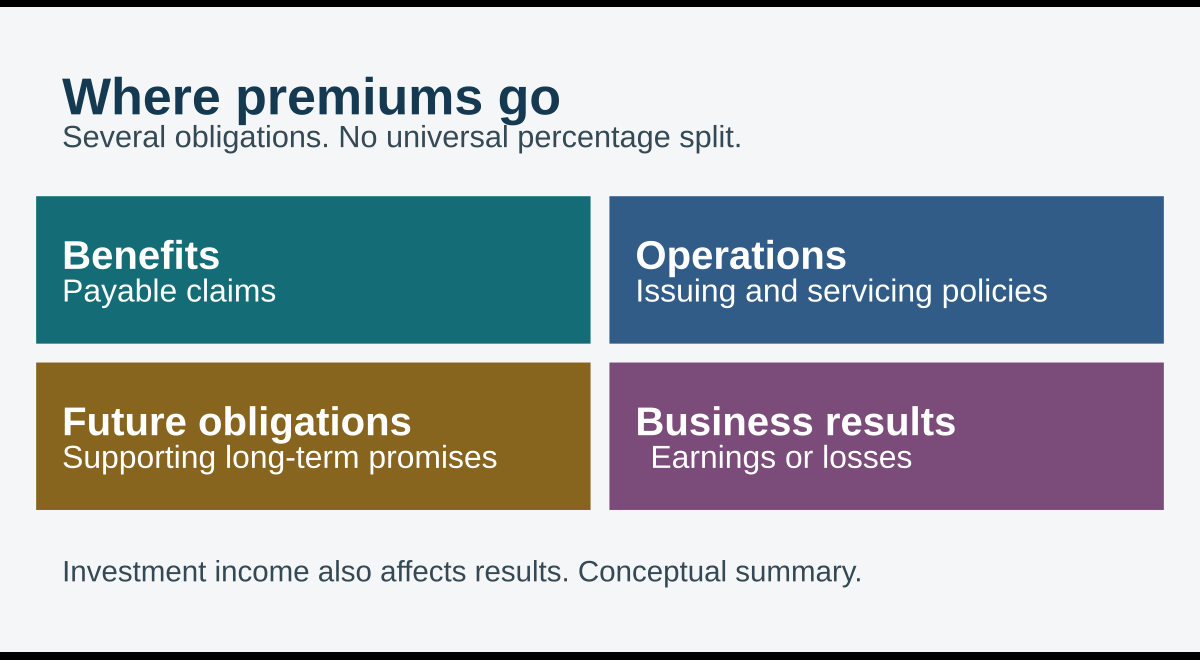
Think in terms of several jobs rather than a dollar being dropped into a single jar. Insurance operations must handle payable benefits, policy administration, application evaluation, distribution, technology, and other business costs. Assets also support obligations that have not yet come due. These functions overlap in the company’s finances; they aren’t a universal allocation formula.

For example, issuing a policy involves work before the first annual statement arrives. Applications must be reviewed, information checked, documents produced, and records maintained. Later, the company needs systems for premium collection, policy changes, beneficiary records, and claims. The work continues after the sale.
Some expenses occur early, while premiums may arrive over many years. That timing is one reason a company’s economics cannot be understood by comparing this month’s premiums with this month’s claims alone. Future obligations and the cost of maintaining the business belong in the picture.
The ACLI 2025 Life Insurers Fact Book reports industry income, benefits, investments, and expenditures separately. It is historical industry reporting, not a quote, a forecast, or a measure of what any one policy will deliver. We aren’t using industry totals to assign a cost breakdown to your premium.
Why investment income matters
Premiums and benefits don’t always arrive at the same time. Insurers hold assets to support obligations and may earn investment income on those assets. Interest on bonds is one example. Investment results help shape the company’s overall finances, but investing also introduces risks.
A bond is a loan to an issuer, such as a company or government entity. It may provide interest and repayment under stated terms. The issuer can run into trouble, market values can change, and reinvesting money later may produce a different yield. Buying bonds does not remove uncertainty.
The NAIC’s explanation of interest rates and insurance discusses the relationship between life insurers’ assets and long-term liabilities. A liability is an obligation the company must meet. An insurer needs to consider when money will be required, not simply which investment advertises the highest return.
Imagine an obligation that might require payment next month. An asset that cannot be sold promptly without a substantial loss may be a poor match for that need. Longer obligations create a different planning problem. Matching expected cash flows is part of the work behind an insurance promise.
Investment income is therefore part of how life insurance companies make money, but it isn’t a free bonus without consequences. Weak returns, credit losses, and timing mismatches can hurt results. A description of the business model is not a guarantee of financial success.

THE OCALA INSURANCE GUY · HOUSE AD
Are You Sure You Have the Right Beneficiaries?
Enthusiasm is lovely. Especially when it isn’t quite this enthusiastic. When did you last check who is listed on your policy?
Does the insurer’s return become your policy’s return?
No automatic connection should be assumed. An insurer may earn money on its general investments without crediting that same return to your policy. Your rights come from the issued contract, including its benefits, charges, crediting terms, and guarantees.
With term coverage, the central benefit is generally protection during a specified period, not an investment account. A typical term policy doesn’t build cash value. If you outlive the covered term, a death benefit isn’t payable simply because you paid premiums. Specific return-of-premium features, when available, have their own conditions and costs.
For cash value coverage, distinguish the insurer’s investment performance from the values available to you. Cash value, the amount accessible under the policy’s provisions, may be affected by charges, loans, withdrawals, surrender terms, and the kind of policy. It is not necessarily equal to premiums paid.
Our cash value life insurance guide explains those mechanics in more detail. When reviewing an illustration, identify guaranteed values and nonguaranteed projections separately. A strong-looking projection is still an assumption about the future, not a promise that the illustrated result will occur.
How life insurance premiums reflect underwriting
Underwriting is the insurer’s process for evaluating an application and deciding what coverage and terms it can offer. Depending on the product, it may review age, health history, tobacco use, financial information, and other permitted factors. The information required and the way it is evaluated vary.

Pricing has to consider the expected claims and costs associated with the coverage being offered. A larger benefit or longer commitment changes the obligation. Different insurers may evaluate the same application differently, so an initial estimate isn’t the same as an issued offer.
The NAIC insurance glossary defines underwriting and other financial terms used in insurance. For a shopper, the practical task is simpler: ask what information the estimate assumes and what could change when underwriting is complete.
Don’t guess on an application or leave something out because you expect it to increase the price. Accurate answers let the insurer evaluate the actual situation. An easier application also does not prove that the coverage has fewer limitations. Ask about benefit timing, exclusions, and the full payment obligation.
Our guide to comparing life insurance costs can help you compare written offers. Compare the coverage and conditions alongside life insurance premiums rather than selecting the lowest number on the first screen.
Reserves and capital: two ideas worth separating
A reserve is an accounting amount associated with future insurance obligations under applicable rules. It isn’t necessarily a separate envelope containing the face amount of your individual policy. The company holds assets supporting its liabilities across its business.
Capital and surplus provide additional financial resources beyond liabilities, subject to regulatory definitions and requirements. These resources help absorb adverse results. Neither a reserve entry nor a capital figure should be mistaken for a personal savings account you can withdraw from.
Why does this matter to you? Because a company can receive plenty of premium income and still have substantial obligations. Looking only at sales, advertising, or total assets can miss the other side of the balance sheet. Assets and obligations need to be considered together.
You don’t need to calculate an insurer’s reserves at the kitchen table. You can ask for current financial information, learn what any financial-strength rating measures, and identify the issuing insurer on the contract. Ratings are opinions based on a particular agency’s method and date; they are not guarantees of future claims payment.
Does the company need people to outlive their policies?
With term insurance, benefits are tied to the covered period. The possibility that someone survives that period is part of the product’s design and pricing. That does not make the protection imaginary. During the covered years, a payable death claim can transfer a financial burden that a household could not comfortably carry alone.
We would evaluate the purchase by the risk it covers. If a family needs income protection while children grow up, having everyone survive those years is a good personal outcome. The premiums purchased protection during the period. They weren’t necessarily deposits waiting to be returned.
Permanent coverage has different objectives and funding requirements. It is designed for longer-lasting protection when contractual requirements are met. That does not mean every permanent policy will remain in force regardless of payments, loans, or policy performance.
Our term versus whole life insurance comparison covers that choice. Understanding how life insurance companies make money should clarify why products differ, not turn the discussion into a contest to see who can “beat” the insurer.

What happens when people stop paying?
An insurer considers policy persistency: how long policies are expected to stay in force. Some people keep coverage for decades. Others cancel, surrender, or allow it to lapse. Those outcomes can affect revenue, expenses, benefits, and the recovery of costs incurred earlier.
It is too simplistic to say every canceled policy is pure profit. A surrender may require a payment, and the company may already have incurred costs. Accounting results depend on the product and circumstances. Nor should you assume cancellation is financially harmless to you.
Before ending coverage, review what benefit disappears, any available surrender value, charges, outstanding loans, and possible tax consequences with an appropriate professional. If replacement is being considered, confirm the new coverage is accepted and effective before ending existing protection.
The better shopping question is whether you can maintain the commitment. A policy that only works during your easiest budget year deserves another look. Ask what happens after a failed bank draft, what notices are provided, and which provisions apply if payments become difficult.
Where do commissions and reinsurance fit?
Distribution expenses may include compensation paid to agents or agencies. Those payments are one part of the insurer’s business costs. They are not the same as the insurer’s profit, and they don’t necessarily arrive as a separate bill to the policyholder.
Our explanation of life insurance commissions focuses on that separate question. Ask how the professional is compensated and whether any separate fees apply. Then return to whether the proposed coverage solves your actual need.
Reinsurance is another business arrangement: an insurer transfers part of an insurance risk to another insurer under a separate contract. It can help manage exposure, but it has costs and introduces reliance on another company’s performance. The Citizens filing linked earlier describes its own reinsurance arrangements and related obligations.
For the policyholder, the issuing insurer’s contract remains the place to begin. Don’t assume that a familiar parent-company name, an agent’s agency, and a reinsurer are interchangeable entities. Ask which legal company issues the policy and is responsible under its terms.
What about mutual companies and dividends?
A company’s ownership structure is another consideration, but a label doesn’t settle the buying decision. Mutual insurers are owned by policyholders under their governing arrangements; stock insurers have shareholders. Product features and rights still require a contract-level comparison.
A participating policy may be eligible for dividends when declared. Dividends are not guaranteed, and an insurer’s profit is not a promise of a particular dividend for your policy. A dividend scale, the insurer’s investment yield, and an illustration’s projected values are different measures.
The NAIC consumer life insurance resource explains policy categories and dividend considerations. Ask how a proposed policy works if nonguaranteed elements are less favorable than illustrated. A plan that depends on a projected dividend paying future premiums needs careful examination.
We wouldn’t select an insurer solely because it is mutual or publicly traded. We would consider the actual coverage, payment requirements, guarantees, financial information, service, and fit. Ownership structure belongs in the conversation alongside those facts.
THE OCALA INSURANCE GUY · HOUSE AD
The pillows are not a financial plan.
A little extra padding can only do so much. What financial protection would your family need if you weren’t here?

Questions that make the business model useful to you
Suppose, hypothetically, two households see the same advertisement. One needs ten more years of income protection. The other has a lifelong financial obligation. They should not automatically choose the same policy just because they have learned where insurer earnings come from.
Start by defining your own need. Our life insurance needs calculator can help organize obligations and available resources. It provides a planning starting point, not a quote, underwriting decision, or personalized recommendation. Use your own figures and avoid counting money someone else needs for living expenses.
- What financial problem does the benefit address, and for how long?
- Which payments and benefits are guaranteed, and what can change?
- How do life insurance premiums change after the initial period?
- What happens if investment income or other nonguaranteed assumptions disappoint?
- What would we receive after a surrender, withdrawal, loan, or death under the relevant provisions?
- Which company issues the policy, and what current financial information is available?
Ask for the answers in writing and locate the important provisions in the policy. An explanation should make the decision clearer. If you cannot explain the coverage in ordinary language after the discussion, another question is a reasonable next step.
Bring the question back to your household
How life insurance companies make money comes down to managing a long-term business: receiving premiums, earning investment income, paying benefits and expenses, and supporting obligations through uncertain conditions. No single premium, claim, or calendar year tells the entire story.
Your decision is more personal. What needs protecting? Can you maintain the payment? Do you understand the benefits and limitations? We want life insurance premiums to fit a sustainable plan, with investment income assumptions and other nonguaranteed elements clearly separated from promises in the contract.
About Jay A. Cohen, The Ocala Insurance Guy
Jay A. Cohen is a licensed health and life insurance agent based in Ocala, Florida. He is licensed in Florida, Virginia, Illinois, Utah, and California.
Our approach is educational: we listen to understand your needs, goals, and budget, then explain your options in plain language. We walk through the benefits, costs, and limitations, welcome your questions, and help you make an informed decision without pressure to buy a particular product.
To explore permanent coverage and available policy options, visit the Jay A. Cohen life-insurance information page. You can also learn more about Jay’s educational approach and insurance experience.
Have a general question about how life insurance companies make money or how a policy works? Use The Ocala Insurance Guy Contact Form. Please leave medical records, account details, and policy numbers out of the initial message.
General educational information, not individualized insurance, legal, tax, accounting, or investment advice. Examples are hypothetical. Policy terms, underwriting, availability, charges, guarantees, and insurer results vary. Historical reports do not predict future performance. References to a company’s filing or industry report are educational, not endorsements or statements of affiliation. Coverage depends on the issued contract and remaining in force.