

Group health insurance vs individual coverage: which one fits your household? The first difference is how you get the plan: group health insurance generally comes through an employer or another eligible group, while individual health insurance is coverage you select for yourself or your household. Who chooses the options? Who helps pay? And what happens when your job changes? Those are the questions worth working through.
It does not tell you which plan will be better for your family. A strong employer contribution can make workplace coverage attractive. An individual plan may offer a different fit when you are self-employed or between jobs. Either way, the useful question is the same: can you afford the coverage and use it where you actually receive care?
We would start with the people, the doctors, and the budget, then work outward. If you want help organizing the comparison, use The Ocala Insurance Guy Contact Form. A general description of your situation is enough to begin; leave medical records and sensitive identification information out of the initial message.
Group health insurance vs individual coverage: the starting point
With a traditional employer group plan, the employer selects an insurer or benefit arrangement and establishes the options available to eligible employees. You might have one plan to choose from or several. Your choice is usually within that employer’s menu, rather than every plan sold in your county.

Individual health insurance follows a different route. You shop for a policy for yourself and any family members you want to include. The Health Insurance Marketplace is one way to obtain individual coverage; individual policies may also be available outside it. Buying outside the Marketplace does not provide access to Marketplace premium tax credits.
In this comparison, “individual coverage” means comprehensive individual major-medical insurance, especially Affordable Care Act coverage. It does not mean that every product advertised to individuals provides the same protection. A fixed-payment supplement, discount program, or short-term product needs a separate review. The sales label is no substitute for the contract.
The route into a plan matters. What the plan actually pays for matters just as much.
Group health insurance: what does your employer actually pay?
A premium is the amount paid to keep insurance active, whether or not you use medical care that month. With group health insurance, separate the plan’s full premium from your payroll deduction. Your employer may contribute toward your own coverage but pay a different share for a spouse or children. That is why the employee-only price can look attractive while the family price tells a different story.
Ask for the cost of the enrollment category you actually need. An attractive employee-only deduction does not tell you what family coverage costs. Also check whether the payroll figure is per week, every two weeks, twice monthly, or monthly. “Two hundred a paycheck” is not a complete annual price.
With individual health insurance, compare the full premium with the amount you would actually pay after any verified assistance. A Marketplace premium tax credit helps eligible households with premiums; it is not an employer contribution. Put that verified household payment beside the group health insurance payroll cost for the same people. Comparing an employee-only work deduction with an individual family premium would give you the wrong answer before you even reach the benefits.
Employers comparing benefits for a workforce can start with our group benefits resource. Our small business health insurance cost guide separately explains employer budgeting. Here, we are looking at the household decision: what leaves your pocket, and what protection do you receive?
Can you decline work coverage and get Marketplace savings?
You may be able to buy individual coverage even when an employer offers a plan. That does not automatically make you eligible for financial assistance. HealthCare.gov explains that an offer of job-based coverage can affect Marketplace savings, even if you do not accept the offer.
Two terms matter here: affordability and minimum value. They are technical eligibility tests, not a casual judgment that a bill feels expensive or a plan looks good. Minimum value concerns the plan’s coverage standard. Affordability uses applicable rules, the required contribution, household income, and the relevant coverage category.
An affordable offer for the employee does not automatically settle the answer for the rest of the family.
The employee’s result and family members’ results can differ. Do not assume that an affordable employee-only offer settles the question for everyone in the household. Bring the employee-only and family premium figures, the employer’s benefit information, and your household income estimate to the review.
We would not decline a plan based on an online subsidy estimate that leaves out the employer offer. Have the Marketplace evaluate the actual facts for the coverage year. If circumstances change, update the application. Paying a lower monthly amount is helpful only when the eligibility behind it is correct.
Compare group health insurance costs with individual coverage
Premiums are one part of the budget. A deductible is an amount you may need to pay for covered services before certain plan payments begin. A copayment is a specified amount for a service. Coinsurance is your share expressed as a percentage of an allowed charge. These can work differently across services within one plan.
Neither group health insurance nor individual health insurance wins this comparison on premium alone. A lower monthly payment may leave you with more to pay when you receive care. A higher premium needs to buy a benefit you can actually use: lower charges for expected treatment, for example, or access to an important provider. Our higher-deductible comparison explores that trade-off. Work through the same expected appointments and prescriptions under both options.
The out-of-pocket maximum is another important number. Review which covered expenses count toward it and which do not. Premiums, noncovered care, and some out-of-network expenses can sit outside that limit. Do not describe it as the most your household could possibly spend on anything medical.
For a practical worksheet, put each plan’s annual household premium beside its deductible, common service charges, and applicable in-network out-of-pocket maximum. Then compare a lighter-use year and a heavier-use year. Avoid adding a deductible again when it already counts toward the maximum.
A hypothetical comparison: the cheaper premium is only the opening bid
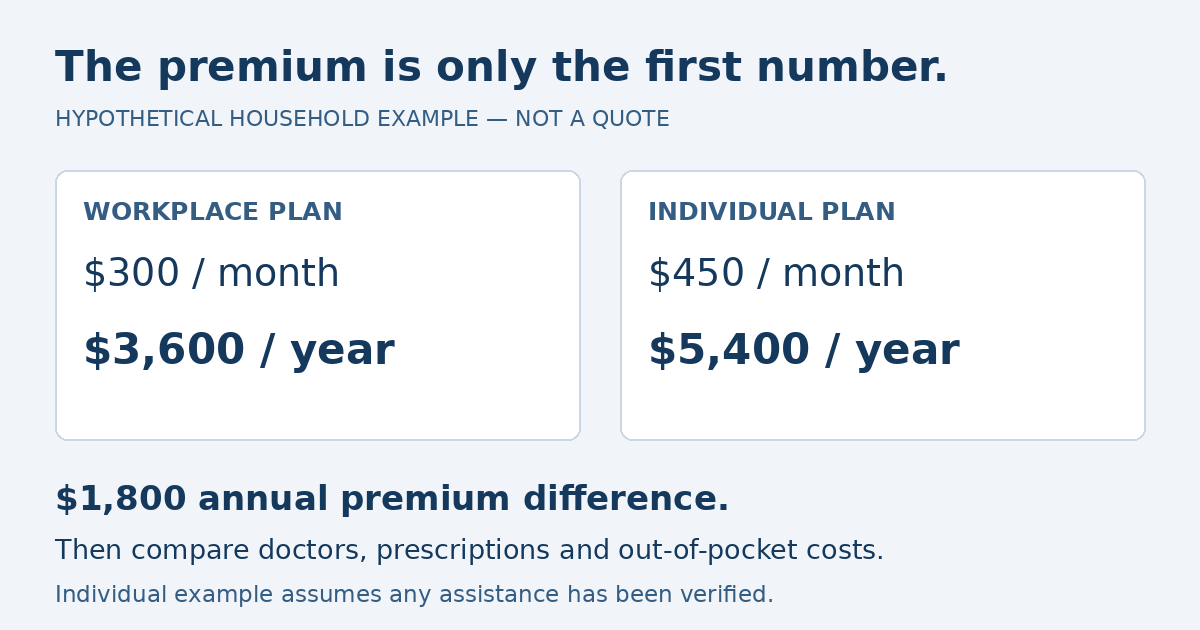
Suppose a household is comparing two fictional plans. Its share of a workplace premium is $300 monthly. An individual plan would cost $450 monthly after any assistance for which the household has actually been found eligible. These are made-up figures, not quotes, market averages, or a suggestion that this household qualifies for a subsidy.
The workplace premium would total $3,600 over twelve months, compared with $5,400 for the individual option. That is a $1,800 premium difference. Now suppose the individual plan offers better access to an important specialist. The household needs to examine that advantage rather than dismiss the option at the premium line.
Perhaps both plans cover that specialist after all, but through different locations or referral rules. Perhaps one excludes the relevant facility. The next step is verification, not guessing what the benefit card’s logo means. A price comparison is useful only after the actual coverage differences are understood.
We would also ask whether the family could manage an expensive month under each option. Annual totals matter, but so does having money available when treatment happens. A manageable premium paired with an unaffordable deductible can still create a difficult household decision.
Group health insurance vs individual networks: does your doctor participate?
A network is the group of providers and facilities contracted with a plan. Two products from the same insurer can use different networks. “We accept that company” is a starting point, not confirmation that a particular physician, location, and service are in network under your proposed policy.
Check the exact plan name and network with the insurer and the provider. Include the hospital, specialist, laboratory, imaging center, and other facilities you expect to use. If a family member lives away from home, examine routine care access there. Emergency-care provisions do not establish that ordinary appointments will be covered the same way.

THE OCALA INSURANCE GUY · HOUSE AD
Great premium. Wrong species.
If the dog looks more comfortable with your doctor choice than you do, check the network again. A bargain deserves a closer look when your own physician is missing.
Individual health insurance is not automatically worse on networks, and group health insurance is not automatically broader. Availability depends on the actual products and locations. A plan with a familiar logo can still be a poor fit if the care you need is outside its practical reach.
Keep notes showing what was checked and when. Directories change, and a provider can participate at one location but not another. For planned treatment, ask about applicable referral and prior-authorization requirements as well. Authorization is a plan review process; it should not be confused with a promise that every resulting charge will be paid.
Prescription coverage deserves its own comparison
A formulary is a plan’s covered-drug list. Look up the exact medication, dosage, and form rather than just its brand family. One version might have a different cost category or restriction from another. Ask which pharmacy arrangements apply and whether a separate prescription deductible is involved.

Some medications require prior authorization, trying another drug first, or limits on quantity. Those rules can affect convenience, timing, and cost. If a medication is absent from the list, find out about the plan’s exception process before treating coverage as available.
Bring a current medication list to your comparison. Include recurring prescriptions that are inexpensive today; a change in coverage can still matter. For a costly specialty medication, work through the pharmacy requirements and expected member cost with the insurer. Do not assume a manufacturer program will remain available or apply identically under another plan.
If you are considering individual health insurance to replace a workplace plan, check each prescription under the proposed policy before switching. A medication that works smoothly under group health insurance may have different pharmacy rules or member costs under the individual option, and the reverse can also be true. We are not selecting treatment. We are checking how each plan handles the treatment your health professionals have already recommended.
How do benefits and preexisting conditions compare?
Having a medical history does not shut you out of ACA-compliant coverage. HealthCare.gov describes the law’s consumer protections, including protections related to preexisting conditions. That does not mean every treatment is covered without conditions or every plan has identical benefits.
Read the exclusions, service limits, medical-necessity provisions, and cost sharing. If you see an unusually inexpensive alternative, determine what kind of product it is before comparing it with comprehensive coverage. A policy that pays a fixed dollar amount for a hospital stay may leave a very different exposure from major-medical insurance.
Group plans also vary. A fully insured arrangement and an employer self-funded arrangement have different funding structures and can be subject to different requirements. You do not need to become a benefits attorney, but you should know who administers claims and where to find the governing documents.
Our group-plan preexisting-condition guide discusses that specific issue. For this comparison, keep the question concrete: is the service covered under this plan, through which providers, and with what financial responsibility?
Individual health insurance and enrollment timing
Workplace enrollment follows the employer plan’s eligibility and enrollment rules. There may be a new-hire enrollment opportunity, an annual election period, or a special enrollment right after certain events. Ask for the actual deadline and effective date. A start date for your job is not necessarily a start date for insurance.
Individual Marketplace coverage has its own enrollment windows and event-based opportunities. HealthCare.gov explains Special Enrollment Periods. The applicable event, documentation, selection deadline, and effective date need to line up. Do not assume you can change policies whenever you find a lower price.
Losing qualifying job-based coverage may open an enrollment opportunity. Voluntarily dropping coverage or failing to pay premiums does not necessarily create the same right. If a transition is coming, investigate before the old plan ends rather than waiting for the next medical appointment.
For a new job, ask HR to confirm the eligibility and waiting-period terms in writing. Keep a simple transition record: old coverage’s last date, new coverage’s first date, enrollment confirmation, required payment, and any documents still outstanding.
THE OCALA INSURANCE GUY · HOUSE AD
New job. Same bones. Mind the gap.
Your health does not wait for the next benefits start date. Before celebrating the move, check when the old coverage ends and the new coverage actually begins.

Leaving a job: keep group health insurance or buy your own?
Employment-based eligibility can end when the employment relationship or qualifying hours change. Ask when coverage actually terminates; it may not be the final day you work. A new job’s benefits may begin later, creating a gap that deserves attention before you hand over your badge.
COBRA is a federal continuation framework that can let eligible people keep qualifying employer coverage temporarily after certain events. It does not apply to every employer or situation. The Department of Labor’s worker guide to COBRA explains its conditions, notices, elections, and payment responsibilities.
Continuation coverage can be worth comparing when ongoing treatment or existing provider access matters. The price can change substantially when an employer stops contributing. Compare the continuation notice with available individual options, including the coverage dates and what happens to amounts already paid toward deductibles.
Individual health insurance generally stays separate from a particular job. That can be useful when you change employers or work for yourself, but it does not promise the same plan and price forever. Premiums, renewals, residence, service areas, income-based assistance, and payments still matter. Compare the actual individual option with any available continuation of group health insurance, including dates, providers, and amounts already paid toward the deductible.

Individual health insurance when you own the business
Owning a business does not automatically make you a qualifying group. A sole proprietor with no eligible employees generally starts with individual-market options. HealthCare.gov’s self-employed guidance distinguishes those households from employers eligible for SHOP, the Small Business Health Options Program.
If you employ people, the group health insurance decision reaches beyond your own household. Who is eligible? What can the business contribute consistently? How many employees intend to enroll? Review those questions before comparing group proposals with individual health insurance for yourself. Our Florida self-employed coverage article addresses that starting point. A business card, contractor arrangement, or spouse helping occasionally does not by itself settle the insurance classification.
There is also a middle ground: some properly established employer reimbursement arrangements help employees pay eligible individual-coverage expenses. HealthCare.gov describes group coverage and reimbursement arrangements. These arrangements have their own eligibility and coordination rules; handing an employee extra cash is not automatically equivalent.
Ask a benefits professional to explain the written arrangement, employee experience, administration, and interaction with Marketplace assistance. An employer funding decision and an employee policy choice are connected, but they are not the same decision.
Bring these questions to a group health insurance vs individual comparison
- Who needs coverage, and which enrollment categories are available?
- What will the household pay annually in premiums after verified contributions or assistance?
- Are important providers, facilities, and prescriptions included under the exact plan?
- What are the deductible, service charges, and applicable out-of-pocket limits?
- Which benefits, restrictions, and exclusions could affect expected care?
- How does the employer offer affect each household member’s Marketplace eligibility?
- When can coverage begin, and what happens if work or residence changes?
- Which written documents and confirmations support the decision?
Request the Summary of Benefits and Coverage, usually called the SBC, for each option. It is a standardized overview, useful for comparing major terms. It does not replace the complete policy or plan document. Check the current plan year and coverage category so you are not comparing last year’s workplace benefits with next year’s individual proposal.
For additional detail on the numbers, HealthCare.gov’s plan comparison guidance explains why total costs deserve attention. Use a worksheet with your actual health-plan figures and keep its assumptions visible.
One more practical detail: you do not necessarily need one policy for everyone. Different household members may have different suitable coverage paths. Before splitting coverage, compare separate deductibles, separate out-of-pocket limits, premiums, and the administrative work of maintaining more than one plan. A split arrangement can solve one problem while creating another. Write down who is covered where, how each premium is paid, and which documents belong to each person.
Choose around your household, then check the paperwork
Group health insurance vs individual coverage comes down to your household’s actual choices. What does the employer contribute toward group health insurance? What would individual health insurance cost after verified assistance? Then compare doctors, prescriptions, care costs, and coverage dates. Neither label wins by itself. The better fit is the plan you can afford, maintain, and use for the care you need.
We can help you organize the questions without pushing a particular product. Use The Ocala Insurance Guy Contact Form to describe what you are comparing. Clear information about your options is a much better starting point than guessing from a premium or a logo.
About Jay A. Cohen, The Ocala Insurance Guy
Jay A. Cohen is a licensed health and life insurance agent based in Ocala, Florida. He is licensed in Florida, Virginia, Illinois, Utah, and California. Our approach is educational: we listen to understand your needs, goals, and budget, then explain your options in plain language. We walk through the benefits, costs, and limitations, welcome your questions, and help you make an informed decision without pressure to buy a particular product.
To explore permanent coverage and available policy options, visit the Jay A. Cohen life-insurance information page. You can also learn more about Jay’s educational approach and insurance experience. For health coverage questions, use The Ocala Insurance Guy Contact Form.
This article provides general educational information, not individualized insurance, medical, legal, investment, or tax advice. Examples are hypothetical, not quotes or promises of eligibility or savings. Benefits, networks, contributions, assistance, enrollment rights, and availability depend on the plan, applicable rules, state, household circumstances, and coverage year. Governing documents and applicable law control. Confirm current terms and coverage dates before changing insurance.