

A fully funded IUL is usually a description of how an indexed universal life policy is designed and funded—not a separate insurance product or a promise that the policy can never need another premium. People often use the phrase when they want substantial premium going toward long-term policy value while preserving life insurance protection and, where intended, avoiding modified endowment contract (MEC) status—a tax classification that changes how policy withdrawals and loans are taxed.
The important question about a fully funded IUL is not whether someone uses that label. It is what the design actually requires, which limits apply, and what happens when crediting, expenses, or future payments differ from the assumptions. We believe consumers deserve clear answers before committing to a long-term premium schedule.
This fully funded IUL guide explains minimum-funded, accumulation-focused, and maximum-funded approaches, the federal tax rules behind them, and the ongoing responsibilities involved. Our examples compare premium budgets, not projected returns. An IUL remains life insurance, not direct stock-market ownership, an investment account, or a complete retirement plan.
What People Mean by a Fully Funded IUL
There is no universal contractual definition of “fully funded IUL” across insurers and policy designs. One professional may mean a premium sufficient to support an illustrated objective. Another may mean funding close to the maximum amount the carrier calculates can be paid without creating a modified endowment contract, commonly shortened to MEC.
A third person might mean the planned funding period is complete. Those meanings are not interchangeable. A fully funded IUL under one set of assumptions may still need additional support if actual experience is less favorable. We recommend translating the label into a written premium schedule, a specified death benefit, an identified tax test, and a review plan.
When comparing a fully funded IUL, ask how much is planned each year, how many years payments continue, and what funding margin is built into the design. Also ask whether “maximum” refers to this year’s remaining capacity, an initial seven-pay calculation, or the broader funding strategy. A label without those details does not tell you how the contract will behave.
Three Funding Priorities
Minimum-funded or death-benefit-oriented coverage
A lower-funded design generally emphasizes obtaining and maintaining a death benefit with a comparatively smaller premium commitment. Less money may remain for accumulation after expenses. The quoted planned premium is not necessarily the minimum required under every future condition, and it should not be confused with a contractual no-lapse guarantee premium.
Some contracts offer guarantees with specific timing and payment requirements; others rely substantially on policy value to support charges. Paying the amount shown on an illustration does not automatically guarantee lifetime coverage. We ask readers to identify what is guaranteed, for how long, and under which conditions before describing any premium as adequate.
Accumulation-focused coverage
An accumulation-focused design deliberately allocates more premium to a policy relative to its protection objective. The owner wants death-benefit protection and potential cash-value flexibility, with a budget that can be maintained over many years. This approach need not sit at the maximum allowable funding level to be useful.
It still involves insurance costs, surrender restrictions, and uncertain crediting. A design can be accumulation-focused while retaining a cushion below tax limits and leaving room in the household budget for emergency savings and other priorities. Suitability is broader than getting the largest possible illustration number.
Maximum-funded coverage
A fully funded IUL with a maximum-funding objective generally attempts to place as much premium as practical into the policy relative to the death benefit, within the applicable contract and tax limits. If avoiding MEC status is the objective, the carrier must establish the actual allowable payment capacity and track it as payments and policy changes occur.
The objective is often to avoid purchasing unnecessary additional insurance merely to support a given premium budget, while retaining sufficient coverage for the protection need and legal requirements. It is not permission to ignore a family’s death-benefit needs. A fully funded IUL should be evaluated as a complete insurance design, not simply as a place to deposit surplus money.
Fully Funded IUL: Premiums and Death Benefits
Two fully funded IUL designs with the same premium can have different results when their death benefits, charges, riders, and underwriting classifications differ. More coverage can support additional funding capacity, but it can also increase costs. Less coverage may improve some accumulation characteristics, but only when the protection objective and tax requirements are still satisfied.
The insurer’s net amount at risk is broadly the difference between the applicable death benefit and policy value under the contract’s calculation. That amount helps determine cost-of-insurance charges. The relationship changes over time and depends on the death-benefit option, attained age, and policy provisions.
In some fully funded IUL designs, an increasing death-benefit option is used during funding and a different option considered later. That is a design choice, not a universal instruction. Switching options or reducing coverage can have tax-testing and contract consequences. We want the carrier to confirm the effect before a change is made, rather than assume that a lower death benefit always improves the outcome.
IRC §7702: Keeping the Contract Within the Life Insurance Rules
Federal tax law sets limits on the relationship between insurance protection and policy value. Internal Revenue Code §7702 defines qualifying life insurance using either a cash value accumulation test or guideline premium requirements combined with a cash-value corridor.
For a fully funded IUL, these tests help prevent a contract from being treated as life insurance simply because it carries a small death benefit alongside disproportionate cash value. They use actuarial calculations—not a single dollar limit shared by every policyholder.
The guideline-premium approach limits cumulative premiums and requires an appropriate death-benefit relationship to cash value. The cash value accumulation test applies a different relationship between permitted cash value and benefits. The insurer administers the chosen test. Ask which applies, because different tests can produce different funding flexibility and death-benefit behavior.
A fully funded IUL must still meet its applicable qualification rules. Compliance with §7702 does not by itself mean that the contract is non-MEC; that is a separate question.
IRC §7702A: Understanding the MEC Boundary
Internal Revenue Code §7702A establishes the modified endowment contract rules, including the seven-pay test. Broadly, the test compares cumulative payments with calculated limits based on the premiums that would fund the contract’s benefits over seven years.
The seven-pay test is not an instruction to pay for exactly seven years. Nor does passing the first seven years mean that every later change is harmless. Material changes can trigger new testing, and benefit reductions can affect the calculation. Timing matters, including the contract’s payment history.
A MEC remains life insurance but generally receives less favorable treatment for distributions. IRC §72 generally makes MEC distributions taxable gain first and treats policy loans as distributions; an additional 10% tax may apply to taxable amounts before age 59½ unless an exception applies.
Do not assume an accidental excess payment can always be reversed or that ordinary premium changes erase MEC status. Ask the carrier for written guidance on limits, corrective procedures, and any pending change. The tax outcome should be reviewed with a qualified tax professional.
Why Additional Premium May Require a Different Death Benefit
Suppose a fully funded IUL owner wants to increase planned payments substantially. An existing policy may not have enough room for the additional premium under its current design. Depending on the contract, the insurer may limit or return a payment, require an adjustment, or determine that a different coverage structure is needed.
A higher death benefit can sometimes accommodate more premium, but an increase may require underwriting and may create additional charges or new testing. It is not a cost-free doorway to unlimited contributions. Age, health, riders, policy history, and carrier rules can all influence the available choices.
There is also a distinction between an elected increase and an automatic increase required to maintain a tax corridor. Neither should be treated as proof that the policy has performed better. We review why the benefit changed and what the change means for charges and long-term sustainability.
For a fully funded IUL, the premium amount and death benefit should be designed together from the beginning. If your budget later changes, obtain a revised illustration and carrier-confirmed funding capacity before sending an unusually large payment.
A Hypothetical Example: Funding Below, At, and Above the Limit
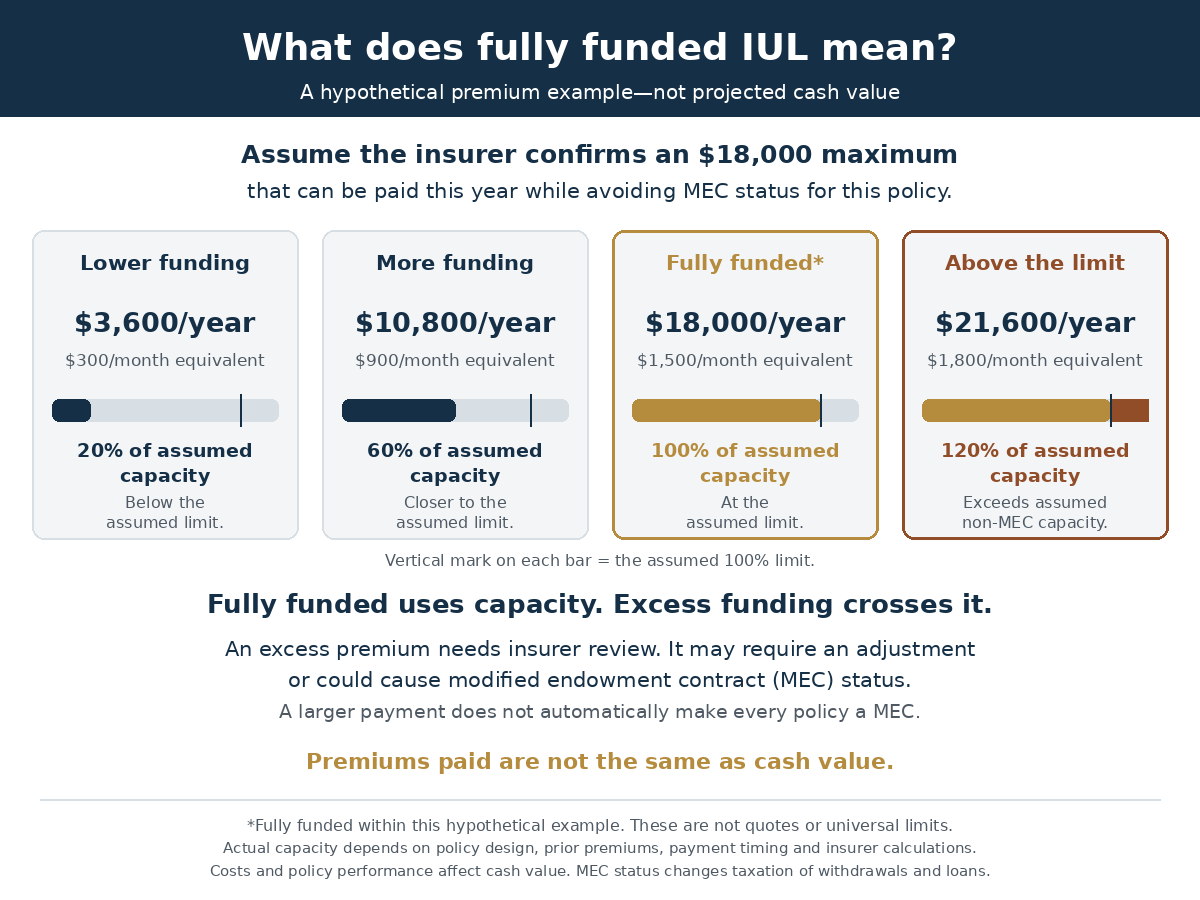
Consider one hypothetical policy with the same insured and death-benefit design throughout this comparison. Assume the insurer confirms that $18,000 can be paid this year while avoiding modified endowment contract (MEC) status, taking the policy’s history and proposed payment timing into account. This is an assumed capacity for teaching purposes—not a carrier quote, actual illustration, or universal funding limit.
Lower funding: $3,600 annually—20% of the assumed capacity. This is equivalent to $300 a month. It is below the hypothetical $18,000 limit, but that does not tell us whether the premium is sufficient to sustain coverage. Minimum payments, ongoing charges, and guaranteed and nonguaranteed illustrations must still be reviewed.
More funding: $10,800 annually—60% of the assumed capacity. This is equivalent to $900 a month. More premium is being paid into the same policy, but the additional payment does not become cash value dollar for dollar. Policy expenses and insurance costs still apply; actual interest credits and other policy activity also affect the resulting value.
Fully funded IUL within this example: $18,000 annually—100% of the assumed capacity. This is equivalent to $1,500 a month. Here, the premium uses the assumed available non-MEC capacity. That is what the graphic illustrates: fully funded describes premium relative to the policy’s confirmed limits, rather than one monthly dollar amount that applies to everyone. Real funding plans should be checked with the insurer before payments are made.
Above the assumed limit: $21,600 annually—120% of the assumed capacity. This is equivalent to $1,800 a month and exceeds the example’s $18,000 capacity by $3,600. The insurer must review the proposed excess payment. Depending on the applicable rules and circumstances, a payment may need to be limited, returned, or otherwise adjusted, or it could cause MEC status. Do not assume every excess payment can be corrected or that a larger payment automatically makes every policy a MEC.
The monthly figures simply divide the annual totals by twelve; they are not insurer-approved payment schedules. Actual testing considers cumulative payments, prior policy activity, benefit changes, and timing. The insurer must confirm the applicable limits for the particular contract and year.
All four amounts are premiums paid—not cash values, returns, or guaranteed benefits. The hypothetical capacity should not be carried forward into future years without verification. A useful real-policy comparison also shows charges, guarantees, surrender values, tax limits, and what happens if payments are reduced or stopped.
Expenses and Cash Value in a Fully Funded IUL
A fully funded IUL is not a savings account with an insurance feature added for free. Depending on the contract, premium loads, administrative charges, cost of insurance, rider costs, and indexed-account charges affect policy value. Some deductions occur when premium arrives; others are taken periodically from the account.
In a fully funded IUL, cash value is the account amount under the policy’s rules. Cash surrender value is the amount available if the contract is ended, after applicable surrender charges and adjustments. The amount accessible through a loan can differ again. These terms should not be used as though they describe the same spendable balance.
Cost-of-insurance rates commonly vary with age and underwriting class. Current charges and guaranteed maximum charges are different columns worth examining. Even when a contract offers premium flexibility, charges continue. A missed payment may be absorbed by available value for a time, but flexibility does not eliminate the need for sufficient funding.
Ask for a clear accounting of base-policy and optional rider charges. A bonus, multiplier, or enhanced account may involve additional costs. Compare the policy with and without optional features when appropriate, and evaluate net results rather than an appealing headline crediting rate.
How Index Crediting Works—and What It Does Not Do
A fully funded IUL uses a contractual formula linked to an external index to determine interest credits for an indexed account. The policyholder does not buy shares of the index or directly participate in stock ownership. Index measurement periods, allocation dates, and the timing of premiums can affect when a particular payment becomes eligible for crediting.
A cap limits the credited rate. A participation rate determines how much of a measured index change enters the calculation. A spread subtracts a stated amount from the calculation. A floor sets a minimum index credit under that account’s terms. These features can interact, so reading one number in isolation is misleading.
For a simplified mathematical example only, a 10% measured index gain with a 70% participation rate gives 7% before any other applicable adjustment. A cap or spread could reduce the result. This is not an actual account, a forecast, or a rate available from a particular insurer.
Other limitations can include excluded dividends, index methodology, segment rules, account fees, and restrictions on transfers or early distributions. Current caps and participation rates may change subject to contractual limits. A high participation rate on one index is not automatically comparable with a lower rate on a differently constructed index.
A 0% crediting floor in a fully funded IUL does not stop policy value from declining because insurance charges, expenses, distributions, and loan interest can still reduce it. Pacific Life’s explanation of indexed-account rates states that IUL does not directly participate in stock or equity investments and that policies incur monthly charges. Its information describes its products; your contract controls your own provisions.
Fully Funded Does Not Mean Paid Up
“Paid up” generally describes coverage that no longer requires premiums under its contractual provisions. A plan to pay an IUL for ten or twenty years is not automatically such a guarantee. If the illustration assumes policy value will cover later charges, stopping scheduled premiums relies on those values remaining adequate.
A fully funded IUL can therefore have a completed planned payment schedule without being contractually paid up. Lower crediting, changed charges within permitted limits, withdrawals, or loans can change the outlook. Ask whether future funding is guaranteed unnecessary or merely projected unnecessary under the illustrated assumptions.
We also distinguish the scheduled premium from the carrier’s “target premium.” A target premium can serve product or compensation purposes and need not represent the correct amount for your objectives. The written funding plan should explain the amount selected, not rely on a label as evidence that the policy is sufficient.
Using Withdrawals and Loans Later
If a fully funded IUL develops sufficient value, withdrawals and policy loans may provide flexibility later. Withdrawals remove value from the contract and can reduce the death benefit. Loans are advances secured by policy value, with interest and terms specified in the contract. Outstanding debt generally reduces what remains for beneficiaries.
Policy basis generally starts with premiums paid and is adjusted for prior transactions under tax rules. For a non-MEC policy, withdrawals may generally recover policy basis before gain, subject to important exceptions. Loans are generally not immediately taxable while the contract remains qualifying and in force, but that statement is not a promise of tax-free income for life. Policy history, distributions, and termination must be reviewed with a tax professional.
A fully funded IUL loan strategy should identify the interest charged, whether interest is paid or added to the balance, and how borrowed value is credited. Fixed and variable loan arrangements differ. Illustrated loan leverage is not guaranteed profit; borrowing costs can exceed credits, and weak crediting can make a previously comfortable distribution plan unsustainable.
A fully funded IUL needs a borrowing plan as carefully considered as its premium plan. Ask what amount could be reduced or suspended after disappointing years, and how the policy would respond to several low-credit years rather than only a smooth average.
The Loan, Lapse, and Tax Risks That Need Attention
For a fully funded IUL, lapse means the coverage terminates after available value and applicable guarantees no longer support required charges. A large outstanding loan can accelerate that problem. Interest added to debt increases the balance even when no new cash is withdrawn, while insurance expenses continue alongside it.
A policy that lapses or is surrendered with debt can generate taxable income even if little or no cash is received at termination. The exact calculation depends on basis, gain, and the transaction. IRS Publication 525, Taxable and Nontaxable Income explains that surrender proceeds above policy cost can be taxable. Obtain a carrier calculation and independent tax review before a major distribution or termination.
Some contracts offer loan-protection provisions with eligibility rules, charges, and restrictions. They do not justify assuming every policy can safely support unlimited borrowing. Likewise, a stronger funding start can improve resilience without eliminating lapse risk. An owner may need to repay debt, reduce distributions, increase premiums, or reconsider the plan.
Insurer guarantees depend on the issuing company’s claims-paying ability. Financial-strength information is useful but is not a government guarantee of policy performance. Review the actual issuing company and the policy’s guaranteed provisions, not only the name used in marketing.
Comparing Illustrations and Using Our IUL Funding Calculator
Our IUL Funding Calculator can help organize funding, estimated charges, and crediting assumptions, or review figures from a carrier illustration. Its educational outputs are not underwriting decisions, carrier quotes, or verification of a MEC limit. Use carrier-confirmed inputs when evaluating an actual contract.
For a fully funded IUL comparison, keep insured information, premium dates, distribution timing, and coverage objectives consistent. Identify every difference in riders, death-benefit options, tax tests, and account assumptions. Compare cash surrender value rather than only account value when liquidity matters.
Request the guaranteed illustration, the current nonguaranteed illustration, and lower-crediting scenarios. An illustration is a structured demonstration of assumptions, not a forecast. Ask how long coverage survives if crediting is weaker and premiums end on the originally planned date. Our guide to reading an IUL IRR report explains why cash-value and death-benefit measurements answer different questions.
Also compare a fully funded IUL with reasonable alternatives. Depending on the need, term coverage, whole life, guaranteed universal life, or a combination of insurance and separately managed savings may fit better. Consider affordability, guarantees, liquidity, complexity, and how much ongoing monitoring you want—not just the illustrated accumulation.
Fully Funded IUL: What to Review Each Year
We would review a fully funded IUL at least annually and after significant changes. Gather the annual statement, premium history, loan balance, current account terms, and a new in-force illustration. Compare actual experience with the plan rather than assuming that automated payments mean the design remains on track.
Confirm remaining premium capacity with the insurer before extra payments. Revisit beneficiaries, affordability, protection needs, and planned distributions. If premiums will stop, ask for projections that explicitly reflect that decision. If loans are outstanding, test a less favorable crediting path and increasing debt.
The most useful review produces decisions: continue the plan, adjust funding, reduce distributions, repay debt, or investigate alternatives with qualified professionals. Do not replace a policy simply because a new illustration looks better; surrender costs, new underwriting, fresh charges, and new contestability provisions can matter.
About Jay A. Cohen, The Ocala Insurance Guy
Jay A. Cohen is a licensed health and life insurance agent based in Ocala, Florida, licensed in Florida, Virginia, Illinois, Utah, and California. We help individuals, families, and business owners understand coverage choices through listening, education, and plain-language comparisons.
When reviewing a fully funded IUL, we begin with the responsibility you want to protect, your sustainable budget, and your expectations about guarantees and access to value. We can explain insurance provisions and help prepare questions for investment, tax, and legal professionals without providing individualized advice in those areas.
Explore our life insurance information, learn more about Jay A. Cohen and The Ocala Insurance Guy, or use our Contact Form to discuss your questions. There is no requirement to replace existing coverage or choose a particular funding approach.
This article provides general educational information and is not individualized insurance, investment, legal or tax advice. Policy provisions, availability and requirements vary by insurer and state. Consult qualified professionals before replacing, surrendering, borrowing from or materially changing a life insurance policy.