

Can group health insurance exclude a condition you already have? For an employer’s comprehensive group medical plan subject to the federal health-plan rules, preexisting condition exclusions are prohibited. A diagnosis before enrollment does not, by itself, let the plan refuse benefits for that condition.
That is reassuring when you are changing jobs, joining a spouse’s plan, or comparing benefits while managing ongoing care. But it leaves another important question: will the new plan cover the particular treatment, doctor, or prescription you need—and what will you pay?
We want you to understand both parts. Protection from preexisting condition exclusions is valuable. So is checking the details that determine whether a new plan works in everyday life. Let’s separate the legal protection from enrollment timing, benefits, and costs, then put together a practical plan for the transition.
What are preexisting condition exclusions?
A preexisting condition is a health condition that was present before new coverage began. An exclusion based on that history treats earlier illness or injury as a reason to withhold coverage. The key issue is why a benefit is being denied, rather than simply whether the person has a diagnosis.
The federal regulation on preexisting condition exclusions prohibits them for group health plans and insurers offering group health coverage. Its examples include a plan change followed by an exclusion for an injury that happened before the new policy began. Moving to a different insurer does not make that kind of exclusion acceptable.
Think about what that means for a hypothetical employee with asthma who accepts a new job. The new group medical plan cannot exclude the employee’s asthma simply because it existed before enrollment. The employee still needs to check the actual inhaler benefit, pharmacy requirements, and physician network. Those are separate questions.
We are discussing comprehensive medical coverage here. A workplace benefits menu can also include life insurance, disability coverage, dental coverage, and supplemental policies. Do not transfer an answer about the medical plan to every other benefit. Request the documents for the particular product you are considering.
Does an older or grandfathered group plan change the answer?
A grandfathered plan is a plan that retains a particular status under the Affordable Care Act, generally connected to coverage that existed when the law was enacted and the changes made since then. The word does not mean the plan is exempt from every federal protection.
The HHS explanation of preexisting-condition protections identifies the exception for certain grandfathered individual policies—the kind bought outside an employer plan. Grandfathered job-based medical plans remain subject to the prohibition on preexisting condition exclusions. That distinction matters when someone says, “Our policy is old, so those protections don’t apply.”
Ask whether the document describes an employer group medical plan or an individual policy, and which provision supposedly permits the restriction. An informal label from a benefits conversation is not enough to resolve a coverage dispute. You need the actual plan type and written terms.
We would also be careful with an old search result describing a six-month look-back period or a twelve-month exclusion. Historical explanations can remain online long after the governing rules change. Check current guidance before assuming you must wait out an exclusion described in an old booklet.
Three questions to keep separate from preexisting condition exclusions
1. Are you eligible to enroll?
First, find out whether you meet the employer plan’s eligibility requirements and how to elect coverage. Protection for a condition you already have does not enroll you automatically. Ask about your employee category, dependent eligibility, required forms, enrollment deadline, and any permitted conditions that apply to the offer.
For someone working a reduced schedule, our guide to part-time health insurance through work addresses the separate question of who can join. A conversation about exclusions should not skip over that starting point.
2. When does coverage actually begin?
An enrollment waiting period is different from excluding treatment because a condition existed earlier. The federal waiting-period rule generally limits waiting periods to 90 days for someone otherwise eligible under a group health plan. Requirements tied to the job or work hours, including rules for workers with changing schedules, need their own review.
That does not mean every person starts coverage exactly 90 days after being hired. Some plans begin sooner. Some workers first need to meet a job-related eligibility requirement. Get the effective date in writing rather than calculating it from a phrase like “benefits after probation.”
3. What does the plan cover after that date?
A covered person can still encounter benefit limitations, network restrictions, required referrals, or an authorization requirement. Those need to be evaluated under the plan and applicable law. The prohibition on preexisting condition exclusions does not turn every requested service into a payable claim.
Keep three lines on your worksheet: enrollment eligibility, coverage start date, and benefits for the care you expect to use. When a question arises, put it under the correct line. That small organizational step helps you ask a much clearer question and avoids treating every problem as the same problem.
Will your doctors and prescriptions work with the new plan?
Start with the exact plan and network name. An insurance company may offer multiple networks, and a provider’s participation can differ between them. “The office takes that insurance company” is a useful lead; it is not the complete verification you need.
The practical next step is checking both the plan’s provider directory and the provider’s office for the specific proposed coverage. HealthCare.gov’s guidance on medical care and networks explains the role of contracted providers. Although that page addresses Marketplace coverage, the basic comparison question also belongs in a group-plan review: which providers participate in this exact network?
Make your list specific. Include the specialist, practice location, hospital, laboratory, and any other facility involved in scheduled care. A physician and the facility where a procedure occurs are separate entries to verify. Ask how referrals work and whether ongoing treatment requires a new review after the coverage change.
For prescriptions, a formulary is the plan’s covered-drug list. Look up the exact medication, strength, and form. Check its cost category, pharmacy network, quantity restrictions, and any prior authorization, which means advance approval from the plan. A drug’s appearance on a list does not explain every condition attached to payment.
HealthCare.gov’s prescription guidance shows why covered-drug lists, pharmacy participation, and exceptions processes matter. For employer coverage, obtain the corresponding documents and procedures from that plan. Do not assume a Marketplace example establishes the terms of your workplace benefit.
If a medication is missing or restricted, ask about the applicable exception and appeal process. Bring your clinician into the discussion about medical reasons and alternatives. We can help explain insurance terms; treatment choices belong with you and your treating professionals. Avoid changing or stopping medication based on an insurance comparison alone.
Covered does not mean free: compare your share of the cost
Even without preexisting condition exclusions, using coverage can involve meaningful household expenses. The Summary of Benefits and Coverage, often shortened to SBC, provides a standardized starting point for comparing job-based plans. Request it alongside the full benefit documents when a detail needs clarification.
The premium is the recurring payment for coverage. For workplace insurance, compare your actual payroll deduction for the enrollment category you need. An employee-only deduction does not show the price of covering a spouse or children.
The deductible is the amount you pay for specified covered services before the plan begins sharing those costs. A copayment is a stated amount for a covered service. Coinsurance is your percentage of the plan’s allowed cost. Different services can have different payment rules, so one headline deductible rarely tells the full story.
The out-of-pocket maximum limits specified cost sharing for covered in-network care. Premiums and noncovered services do not count toward that limit; out-of-network expenses generally do not either. Confirm the actual individual and family rules. It is not a ceiling on every dollar your household might spend on health care.
As a hypothetical budgeting exercise, imagine one plan costs an employee $200 a month and another costs $260. The second plan requires another $720 a year in premiums: $60 multiplied by twelve. That is a real difference, but it does not settle which plan is more useful for ongoing treatment.
Next, compare the expected services under each proposal: office visits, prescription refills, tests, and treatment appointments. Use the plan’s actual payment rules, and clearly label any costs you can only estimate. These invented premium figures are arithmetic examples, not quotes, market averages, or a recommendation.
Also ask when the deductible and other limits reset. A midyear plan change can create a different cost-sharing picture; do not assume money paid under the old plan transfers to the new one. Ask whether any credit applies and obtain confirmation. Our guide to small business health insurance costs explains the employer and employee budget distinction in more detail.
What if a claim is denied and someone says “preexisting”?
Start with the written explanation. A shorthand comment from a conversation may not identify the actual reason the claim was denied. You want the service date, coverage effective date, benefit provision, and specific reason used in the decision.
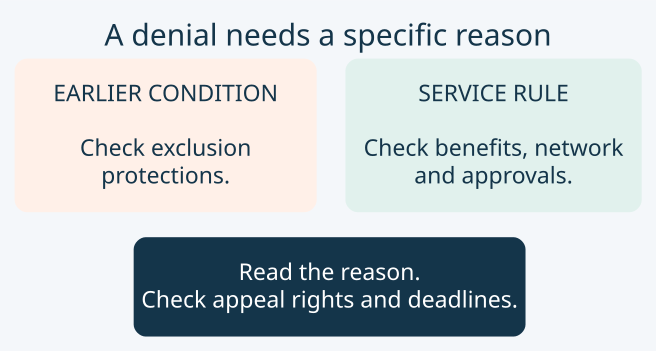
Then ask a focused question: was payment refused because the condition existed before enrollment, or because the plan says a different requirement was not met? Preexisting condition exclusions and disputes about a service’s authorization or benefit classification require different follow-up. Neither should be resolved by guessing.
For example, a hypothetical denial for a missing authorization needs an examination of the authorization rules and what was submitted. A denial explicitly based on an illness beginning before enrollment raises the exclusion-protection question. Calling both situations “preexisting” can send you looking for the wrong documents.
Medical necessity is another term to understand. It refers to the standards a plan applies when deciding whether care meets its requirements for medical appropriateness. A dispute about medical necessity is not automatically a preexisting condition exclusion. It may require clinical records and an appeal explaining why the requested service meets the plan’s criteria.
The Department of Labor’s guide to filing a health-benefits claim explains the importance of plan procedures, denial notices, and appeal rights for covered employment-based plans. Review your notice promptly. Deadlines and review options depend on the claim, plan, and applicable rules; do not assume an informal discussion pauses a deadline.
Keep copies of the notice, relevant benefit pages, submitted documents, and any written responses. A short timeline helps: when the service occurred, when the claim was filed, what the plan requested, and what you supplied. If the denial appears to use prohibited preexisting condition exclusions, request a review under the applicable protection and seek appropriate benefits or legal assistance.
Changing jobs while receiving care: a practical transition worksheet
We would put the transition on one page before ending existing coverage. Start with the last covered day under the old plan and the confirmed effective date under the new plan. Then add enrollment deadlines and any payment or document requirement. Your employment start date and insurance start date may differ.
Below those dates, list appointments already scheduled and the medications you need to discuss privately with the plan and clinician. Mark each item as confirmed, awaiting an answer, or needing a different arrangement. “We checked everything” is less useful than seeing which question still needs an answer.
Ask whether current referrals, authorizations, and treatment arrangements must be reestablished. Request information about any available transition-of-care process if a provider is outside the new network. Availability and conditions vary; do not assume an existing authorization automatically follows you to another plan.
If there is a gap, compare any continuation coverage or other enrollment options available to you before canceling anything. Federal COBRA, state continuation, a household member’s employer plan, and individual coverage involve different eligibility and timing rules. The Marketplace’s preexisting-condition protection is useful context, but it does not create an unrestricted right to enroll at any time.
Our health insurance information page introduces broader coverage choices. For this transition, the goal is to confirm how you will move from the old coverage to the new coverage and resolve the practical care questions along the way. Protection from preexisting condition exclusions makes changing plans more workable; careful coordination helps you use that protection.
What should employers explain—and what should stay private?
Employers can help by giving employees accurate plan documents, clear enrollment instructions, and the right contact for benefit questions. Avoid a blanket promise that “everything you already have is covered.” Explain the protection from preexisting condition exclusions while directing specific treatment questions to the actual plan.
There is also a privacy difference between planning a benefit and collecting medical histories. A general workforce planning spreadsheet should not become a list of employees’ diagnoses, prescriptions, or family treatments. When an insurer or administrator legitimately needs health information, ask why, who receives it, and which secure process should be used.
Fully insured and self-funded arrangements can differ in pricing, funding, administration, and employer obligations. That does not make a medical questionnaire proof that an employee’s condition can be excluded. Separate the group’s proposal and funding questions from an individual’s coverage rights. Get qualified assistance when a proposed arrangement raises compliance questions.
Our group benefits overview covers those broader business choices. For employees, a useful benefits announcement identifies the plan, enrollment steps, dates, and where to verify care. Clear instructions do more good than a confident promise that the documents do not support.
How can you get a useful answer without sharing your whole medical history?
Keep the first question narrow. For example, here is a hypothetical request to a benefits administrator: “We are comparing the medical plan offered for the next coverage period. Where can we find the eligibility rules, effective-date confirmation, provider directory, covered-drug list, and process for asking a private benefit question?”
That request gets the comparison moving without placing a diagnosis in a general workplace message. Once you reach the appropriate secure process, identify the exact service or medication, proposed date, and plan. Ask for the relevant benefit provision rather than a general assurance that the condition is covered.
If preexisting condition exclusions are mentioned, ask for the wording and the reason it is being applied. Keep the question factual: which product is involved, which condition-related restriction is proposed, and which rights or review procedure apply? This helps distinguish an actual exclusion issue from an incomplete enrollment, billing error, or misunderstanding about another benefit.
Before relying on the response, check that it describes the correct plan year and coverage option. Save it with your comparison notes. An answer about last year’s plan—or a different option from the same insurer—may leave the original question unresolved.
Before you decide, ask for answers to these questions
- Is this comprehensive group medical coverage, and which documents describe the plan?
- What must we do to enroll, and what is the confirmed effective date?
- Does any proposed restriction rely on the condition existing before enrollment?
- Are the specific doctors, facilities, prescriptions, and scheduled services covered?
- What referrals, authorizations, or transition arrangements need attention?
- What will the household pay in premiums and applicable cost sharing?
- How do we obtain a written benefit explanation or appeal a denial?
You do not need to memorize insurance regulations to make progress. Begin with the protection, then ask the questions that show how the offered plan will work for you. If an answer is vague, request the document or written explanation that supports it.
Preexisting condition exclusions should not be accepted as an unavoidable cost of changing jobs or group medical plans. At the same time, take a close look at access, covered care, and your share of the bill. We want you to leave the comparison knowing what is protected, what is confirmed, and what still needs an answer.
About Jay A. Cohen, The Ocala Insurance Guy
Jay A. Cohen is a licensed health and life insurance agent based in Ocala, Florida. He is licensed in Florida, Virginia, Illinois, Utah, and California. We help individuals, families, and business owners understand insurance choices and the practical questions behind them.
Our approach is educational: we listen to understand your needs, goals, and budget, then explain your options in plain language. We walk through the benefits, costs, and limitations, welcome your questions, and help you make an informed decision without pressure to buy a particular product.
To explore permanent coverage and available policy options, visit the Jay A. Cohen life-insurance information page. You can also learn more about Jay’s educational approach and insurance experience.
For help understanding your coverage choices, use The Ocala Insurance Guy Contact Form. Tell us your general question and timing; please leave detailed medical information, policy numbers, and other sensitive records out of the initial form.
This article provides general educational information, not individualized insurance, medical, legal, tax, or investment advice. Plan type, benefits, eligibility, enrollment, costs, networks, and appeal rights depend on the applicable documents, law, and circumstances. Hypothetical examples are not quotes or coverage determinations. Confirm the terms of your particular plan and consult qualified benefits, medical, or legal professionals as appropriate before changing coverage or treatment.