

A life insurance lapse happens when coverage ends because the policy’s payment or funding requirements have not been met after any applicable grace period and notice protections. That can leave the people you meant to protect without its death benefit. But a missed payment, a grace-period notice, and an actual lapse are different stages. Your first job is to find out which stage you are in.
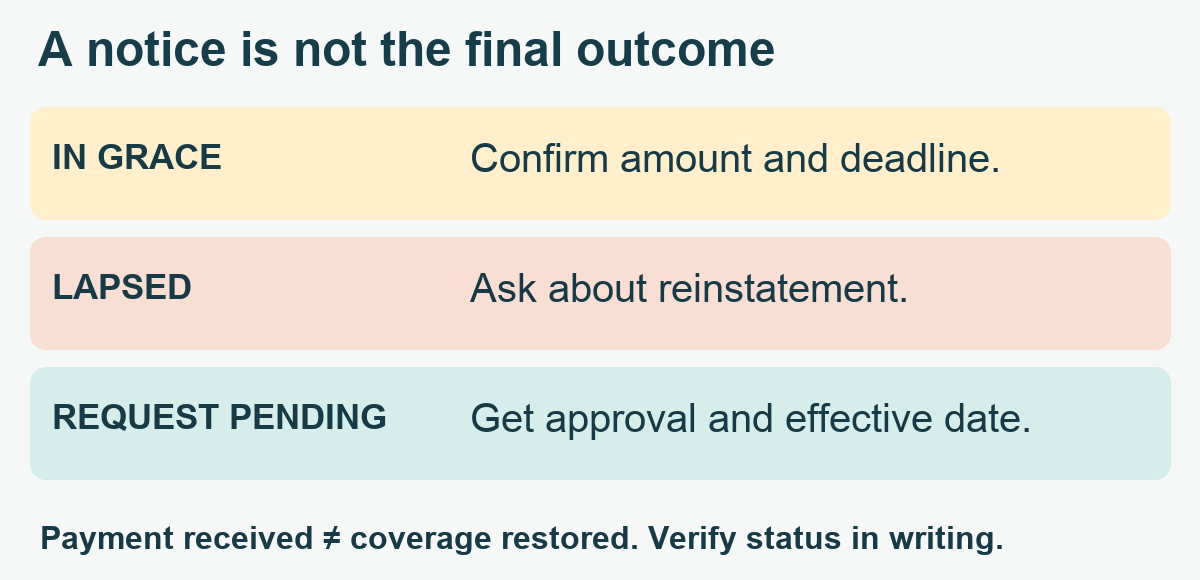
If you have just opened an overdue notice, take a breath—and read the deadline. There may still be time to keep the policy active. If coverage has already ended, reinstatement may be available, subject to the contract’s requirements. Sending money does not, by itself, prove that protection has resumed.
We would start with three questions: Is the policy active today? What must happen next? And what written confirmation will show the problem is resolved? This guide focuses on individually owned life insurance, with Florida examples. Employer coverage and policies governed by another state’s law need their own review.
A late premium or a life insurance lapse? Confirm your status
A premium is the payment for insurance. A grace period is a limited window to address an unpaid required premium while coverage continues under the applicable terms. A lapse is the termination of coverage when the policy’s payment or funding requirements are not met after the applicable protections have run their course.
A notice saying your policy will lapse is not the same as a statement saying it has lapsed. Look for the notice date, amount required, final payment deadline, and proposed termination date. An annual statement may describe an earlier snapshot; it does not necessarily establish today’s status.
Use the insurer’s current records and written response. A familiar policy number, an old insurance card, or an automatic payment listed in your bank account cannot answer every coverage question. Ask whether the contract is in force and whether any action remains outstanding.
If you intentionally want to end coverage, that is a separate decision. Our guide to canceling a life insurance policy explains cancellation and surrender. Here, we are concentrating on an unwanted interruption and the steps that may preserve protection.
Who has authority to straighten it out?
The owner, insured person, premium payer, and beneficiary can be different people. The owner generally controls the contract, while the insured person is the person whose life is covered. Paying a premium does not necessarily give someone authority to change the policy or obtain all its information.
If you are helping a parent, spouse, or business partner, ask what authorization the insurer needs before discussing private records. An appropriate representative may need to provide documentation. Keep the owner involved when possible, and avoid signing for someone simply because you manage the household bills. Establishing authority early can prevent a well-intended payment inquiry from stalling while a deadline approaches.
How does the grace period work in Florida?
For life policies subject to Florida Statutes section 627.453, the grace period for a premium after the first must be at least 30 days, and the policy continues in force during that period. The statute also permits specified interest and deductions from a claim settlement for unpaid premiums.
To prevent a life insurance lapse, use your policy’s exact deadline rather than counting days from memory. Your contract may provide a longer period, and a universal life notice may involve funding requirements that differ from a simple overdue bill. Obtain the exact deadline and required amount for your policy.
We would ask whether payment must be received by that date, which authorized payment methods are available, and what confirms timely receipt. Do not assume a postmark, a pending bank transaction, or a payment scheduled for the last day satisfies the insurer’s instructions.
In a hypothetical example, an owner receives a notice with a stated deadline and an amount needed to prevent termination. The useful response is to verify the notice, arrange the required payment through the insurer’s authorized process, and retain confirmation. Guessing that “there is always another month” adds avoidable uncertainty.
What to do when a lapse notice arrives
Keep the entire life insurance lapse notice, including attachments and the envelope when mailing dates could matter. Locate the policy, latest statement, payment history, and any earlier messages. Then work through the request in a clear order.
Verify the source. Use an established insurer website or the information on your existing policy documents. A surprise message asking for urgent payment deserves verification before you enter financial information. Do not use an unfamiliar payment link merely because the message includes an insurer’s logo.
Confirm the remedy. Ask for the current status, amount, deadline, and payment instructions. If the notice lists a larger amount than your usual premium, ask why. A permanent policy with a funding shortfall may require more than restarting the old monthly draft.
Close the loop. Save the payment receipt and request confirmation that the requirement was satisfied. Check for a returned payment or an unresolved balance afterward. A payment attempt is a useful record; a confirmed policy status is the result we need.
If money is tight, explain that promptly and ask which contractual options exist before the deadline. Do not wait for the perfect long-term plan while an immediate, documented opportunity to preserve coverage expires.
“But our bank shows we paid.” What then?
To investigate a possible life insurance lapse, match your bank records to the insurer’s transaction history. Was the payment completed or merely scheduled? Was it returned? Did it reach the correct policy? Was the amount sufficient? Were there several policies with similar drafts?
A new bank account, replaced debit card, closed account, or canceled authorization can interrupt a payment arrangement. Updating one company does not update every company. Review the policy’s actual payment method rather than assuming the bank will automatically carry the instructions forward.
Ask the insurer to trace a disputed payment using the transaction date, amount, and reference number through its secure process. Keep a short timeline of what was sent, posted, returned, and corrected. Avoid distributing full account numbers in ordinary messages.
If the records disagree, request a written explanation of the discrepancy and the policy provision being applied. Do not treat an informal assurance that someone is “looking into it” as an extension of the deadline. Ask explicitly how coverage and the deadline are being handled while the issue is reviewed.
Why term, whole life, and universal life need different questions
Term life generally provides protection for a specified period without building cash value. Missing a required premium can put that protection at risk. However, reaching the end of a term or level-premium period is a different event from failing to pay a premium. Read a renewal notice before labeling it a lapse.
Whole life generally has a contractual premium schedule and cash value. Some policies offer features that use available value when premiums stop, but the feature and its consequences need to be verified. An automatic premium loan, for example, creates policy debt; it is not a free premium.
Universal life—including indexed universal life—requires attention to both incoming premiums and the value available to support policy charges. A planned payment is not necessarily a guarantee that coverage will last for the intended duration.
Our term versus whole life comparison and cash value life insurance guide explain the broader differences. For a notice sitting in front of you, identify the exact product and the specific reason the insurer says action is needed.
Can a policy lapse even if you kept making payments?
Yes. A life insurance lapse can happen when a flexible-premium permanent policy is not adequately funded, even if planned payments continued. The North Carolina Department of Insurance’s universal life explanation describes how policy value can run down as insurance costs and fees are deducted. Its guidance encourages owners to review annual statements and ask how long current payments will support coverage.
Separate two amounts: what is required to address the immediate notice, and what is projected to maintain coverage over the years ahead. A payment that cures today’s shortage may not solve the longer-term problem.
Request a current in-force illustration—a projection using the policy’s present situation—and ask for guaranteed and nonguaranteed results to be identified. Review the assumed premiums, outstanding loans, charges, and illustrated duration. An illustration is a planning tool, not a promise about future nonguaranteed values.
Ask whether a no-lapse guarantee exists and which conditions maintain it. Payment timing, withdrawals, loans, and policy changes may matter under the contract. Do not assume that a positive cash value guarantees coverage, or that a low value automatically defeats a separate guarantee.
MetLife’s universal life FAQs illustrate why some owners receive a required payment different from their regular billed premium. Those explanations concern its described policies; obtain the corresponding calculation for your own contract.
Check policy loans before making a funding decision
A policy loan borrows against available policy value. Interest can increase what is owed, and outstanding debt can affect the resources supporting coverage and the amount payable to beneficiaries. Ask for the current balance, accrued interest, and the effect of further borrowing.
There can also be a tax issue when a policy terminates with debt outstanding. The New York Department of Financial Services’ over-loan protection guidance explains that heavily borrowed policies can face a taxable event at lapse. A particular policy’s history and tax treatment need individual analysis.
If a life insurance lapse is approaching on a heavily borrowed policy, request the insurer’s current figures and discuss them with a qualified tax professional. Ask whether any contractual over-loan protection is present and what invoking it would change. Do not take another loan just to silence a warning without understanding the next set of charges.
After a life insurance lapse, can you get coverage back?
Reinstatement can restore a policy after a life insurance lapse, provided its requirements are met. It can be valuable when you still need the protection, but it is a process with conditions. The original contract, applicable law, elapsed time, and current circumstances all matter.
For policies within its scope, Florida’s reinstatement statute provides for written application within three years after premium default, subject to exceptions and requirements. These include satisfactory evidence of insurability and addressing overdue premiums, indebtedness, and applicable interest. A policy surrendered for cash value or expired paid-up term coverage falls within the statute’s stated exceptions.
Evidence of insurability means information the insurer uses to assess eligibility for restoration. Ask what application, health information, records, or examination is required. Do not assume the original approval obligates the insurer to approve the present request.
Request an itemized reinstatement amount and an explanation of how money is handled while the application is pending. Ask when coverage would resume if approved and whether there is any coverage during the process. Submit accurate information through the insurer’s secure channel.
The three-year provision should not become a waiting strategy. Coverage may already be absent, and later health changes may affect your options. Keep copies of every submitted item, respond to requests, and obtain the final written decision and effective date.
Does paying the overdue amount automatically restore coverage?
No. A cleared payment may be only one step in the reinstatement process. Approval, required documents, and effective-date confirmation may still be outstanding. Ask the insurer to distinguish money received from reinstatement completed.
Read the approval carefully. Confirm the death benefit, riders, premium arrangement, any changed terms, and future payment requirements. A rider is an addition that changes or supplements the base policy. Do not assume every optional benefit returned exactly as before.
Also ask how contestability applies. Florida Statutes section 627.472 addresses challenges based on fraud or material misrepresentation relevant to reinstatement. It does not mean every old issue automatically restarts. Answer reinstatement questions accurately and retain the application with the approval.
Once coverage is restored, address what caused the life insurance lapse. If the old payment was unaffordable or insufficient, putting the same arrangement back in place may leave the household facing the same problem again.
What if keeping the same coverage no longer fits the budget?
Ask for real alternatives under the existing contract before deciding that the only choices are “pay everything forever” or “lose everything.” Depending on the policy, a lower death benefit or a nonforfeiture option may be available. Nonforfeiture provisions describe ways certain accumulated values may support benefits when regular premiums stop.
The Florida Department of Financial Services’ life insurance overview describes reduced paid-up and extended-term options. Reduced paid-up coverage generally provides a smaller amount of coverage without further scheduled premiums under that option. Extended-term coverage uses available value for protection over a limited period. Availability and exact results depend on the contract.
Ask the insurer to provide the proposed benefit amount, duration, remaining values, loan treatment, and effect on riders. Put those results beside the household’s current needs. Our life insurance needs calculator can help organize that discussion; it cannot determine your policy’s status or generate a reinstatement approval.
Replacement may also deserve consideration, but compare actual available coverage, underwriting, guarantees, costs, and new contract restrictions. An application or attractive quote is not active replacement insurance. Do not give up existing protection based only on an expected approval.
Can another person receive lapse warnings?
Ask about a secondary addressee—a person designated to receive certain notices. This can be helpful when the owner travels, experiences illness, or wants another set of eyes on important mail. Permission to receive notices is different from policy ownership or authority to change benefits.
Florida Statutes section 627.4555 provides particular notice protections for qualifying policies covering someone age 64 or older, with issue-date, duration, and other conditions. It includes exceptions for certain monthly or more frequent payment arrangements, including specified automatic-payment methods, and special timing for longer grace periods.
Do not automatically add 21 days to a deadline because you read a general explanation online. Ask whether the provision applies to the actual contract and payment arrangement. If a lapse is disputed, retain the notice history and seek qualified assistance rather than drawing a legal conclusion from a missing envelope.
Workplace coverage and death claims need separate handling
If coverage ended after a job change, retirement, or reduced hours, request the group plan’s eligibility and termination records. Portability or conversion may have strict deadlines. Those rights are different from reinstating an individual policy after missed premiums. Our guide to life insurance through work after a job change addresses that situation.
If the insured person has died, do not assume a lapse notice settles the claim. The coverage date, grace period, payment record, and applicable notices may require review. Submit accurate claim information, preserve the records, and obtain the insurer’s written determination. A dispute over a substantial benefit may warrant qualified legal help.
Make the next payment problem easier to catch
Once the immediate issue is settled, check the mailing address, email preferences, bank authorization, and trusted-person arrangements. After changing banks, verify the first completed insurance payment. Review annual statements even when drafts appear to be working.
Keep a concise policy inventory: insurer, owner, insured person, payment method, premium frequency, record location, and review date. Store sensitive details securely. A trusted person should know where to find the records without having unrestricted access to every financial account.
Whether you are trying to prevent a life insurance lapse or restore protection, start with the notice and your current policy status. Confirm the next action and deadline, and finish with written evidence of the outcome. If you want help understanding the questions to ask, use The Ocala Insurance Guy Contact Form. Please leave policy numbers, medical records, and detailed financial information out of the initial form.
About Jay A. Cohen, The Ocala Insurance Guy
Jay A. Cohen is a licensed health and life insurance agent based in Ocala, Florida. He is licensed in Florida, Virginia, Illinois, Utah, and California. We help individuals, families, and business owners understand the practical choices behind their insurance decisions.
Our approach is educational: we listen to understand your needs, goals, and budget, then explain your options in plain language. We walk through the benefits, costs, and limitations, welcome your questions, and help you make an informed decision without pressure to buy a particular product.
To explore permanent coverage and available policy options, visit the Jay A. Cohen life-insurance information page. You can also learn more about Jay’s educational approach and insurance experience.
For questions about your insurance choices, use The Ocala Insurance Guy Contact Form.
This article provides general educational information, not individualized insurance, legal, tax, investment, or medical advice. Policy provisions, state law, payment and notice requirements, reinstatement eligibility, and coverage dates vary. Florida examples do not establish another state’s rules. Hypothetical examples are not coverage determinations or guarantees. Confirm your contract and current status with the insurer and consult qualified professionals about your circumstances.