

Can you cancel group health insurance at any time? Not always. The answer takes more than a quick request to payroll. If you are still eligible for your employer’s plan, your enrollment choice, the way premiums are paid, and the reason for the change can affect when you may leave. And being allowed to cancel does not automatically mean another plan will let you enroll that day.
We understand why you would ask. Perhaps your spouse has a better offer, the family premium is stretching the budget, or a different plan appears to cover your doctors. Before you cancel group health insurance, we want to answer two separate questions: Can the current coverage end when you want it to, and can suitable replacement coverage begin when you need it?
This guide focuses on an employee’s decision to leave employer-sponsored medical coverage. An employer terminating an entire benefits program is a different decision. So is cancelling life insurance, dental insurance, or a supplemental policy.
Start with three different decisions
It helps to separate the process into three parts. First, your employer’s benefits administrator determines how to process your requested change under the plan. Second, the replacement plan determines whether you can enroll and when coverage starts. Third, you decide whether the new arrangement works for your household.
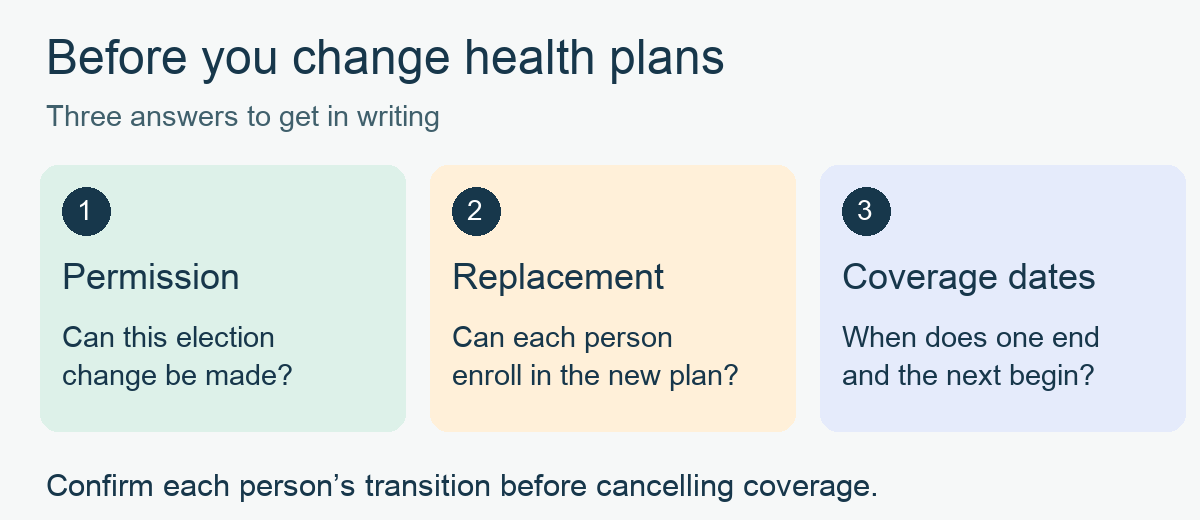
A yes at one step does not settle the others. A new insurer may offer a plan that looks attractive, while your current enrollment election cannot change yet. Or your current coverage may be ending because you lost eligibility, while the replacement option has a later start date.
We suggest keeping a simple planning sheet with a line for each person covered. List the current plan, proposed replacement, last covered day, first covered day, and any unanswered question. That makes it much easier to spot a child whose coverage was accidentally left out of the discussion.
For the broader employer side of these choices, our group benefits overview explains the different ways a business may provide benefits. Here, our concern is your transition between plans.
Why payroll cannot always cancel group health insurance immediately
Many employees pay their share of medical premiums before income taxes through a Section 125 cafeteria plan. Despite the name, this has nothing to do with lunch. It is a written employer benefits arrangement with tax rules attached to the choices you make.
Those choices generally remain in place for the coverage period unless an allowed change applies. A midyear change must fit the applicable rules and the employer’s written plan. Federal regulations permit certain changes; they do not require every cafeteria plan to offer every optional change. The election-change regulation describes that distinction.
That is why “my coworker cancelled last month” is not enough information. Your coworker might have had a different qualifying event, a different coverage arrangement, or a different effective date. Ask which provision applies to your request.
If you want to cancel group health insurance and your premiums are paid after tax, do not assume this particular tax restriction settles the answer. Ask for the actual enrollment and termination rules. The payment method is an important fact to verify, not a shortcut around the plan documents.
What changes might allow a midyear switch?
Marriage, a change in employment, or a dependent’s loss of eligibility can be relevant to a permitted election change. The requested change generally must correspond with the event. A change affecting one person does not necessarily authorize dropping everyone.
Rather than trying to choose an event from a website menu that sounds close enough, describe what happened, who gained or lost eligibility, and the actual date. Ask the administrator which change is permitted, what evidence is needed, and when the request is due.
Keep the distinction between a benefits change and a tax election in mind. A conversation about leaving the medical plan may also involve the payroll election used to pay for it. We would want written confirmation that both pieces were handled, rather than assuming one request updated every system.
Useful questions include: Does the plan allow this specific change? Who may be removed? Does the replacement coverage need to be elected first? Which effective date is available? If the answer is no, ask for the reason and the next enrollment opportunity.
Can you cancel group health insurance for a Marketplace plan?
Possibly, but a Marketplace enrollment opportunity and permission to change the employer’s election are separate requirements. IRS Notice 2014-55 allows cafeteria plans to permit certain prospective changes tied to Marketplace enrollment or specified reductions in hours, subject to conditions. An employer must offer the applicable permitted change through its plan.
For a Marketplace switch, ask the administrator to review the applicable provision and required timing. Do not read the notice as a general right to leave any employer plan whenever you find a cheaper premium. Ask the Marketplace to confirm your enrollment opportunity separately.
Does group health insurance cover family members?
Ask which dependents the employer’s plan permits and which people are actually enrolled. Do not assume that changing the employee’s election affects every family member in the same way.
For family members, IRS Notice 2022-41 provides an additional permitted route for certain changes from family coverage so related individuals can enroll in Marketplace coverage. Conditions include an appropriate Marketplace enrollment opportunity and coordinated coverage dates. The employer must adopt the permitted change. This may allow the employee to remain covered at work while affected family members move elsewhere.
If that sounds like your situation, make the request person by person. Specify who would remain on the employer plan and who would leave. The practical goal is a clear household coverage map, not one cancellation instruction that sweeps everyone along.
Does voluntarily dropping coverage create special enrollment?
Do not assume it does. A Special Enrollment Period is an opportunity to enroll outside the usual annual window because you meet particular conditions. The reason coverage ends matters, and the rules for one type of coverage do not automatically apply to another.
For example, HealthCare.gov’s special enrollment guidance explains that voluntarily dropping coverage as a dependent does not, by itself, qualify you for a loss-of-coverage enrollment opportunity. It describes additional circumstances that may change the result. Voluntarily ending COBRA early also does not ordinarily create that opportunity.
Before you cancel group health insurance, establish the replacement enrollment opportunity. Ask what event supports it, which people qualify, what documents are required, and what start date is available. Keep the eligibility notice with your other coverage records.
We also would not use nonpayment as a way to force the issue. A missed payment is not an enrollment strategy. If affordability is the problem, say so while there is still time to compare legitimate options and deadlines.
What if your spouse has another employer plan?
Start with the receiving plan. Is your spouse newly eligible? Is that employer holding open enrollment? Or are you relying on a special enrollment right following a qualifying loss of other coverage? These are different routes into coverage.
The Department of Labor’s portability FAQs explain that certain losses of eligibility or termination of employer contributions can trigger special enrollment. For these events, a group plan generally must provide at least 30 days to request enrollment. Other events have different rules, so confirm the deadline for your circumstances.
Ask both administrators to identify the route you are using. The receiving plan should confirm who can enroll and the effective date. Your current plan should confirm whether and when your election may change. Neither administrator can resolve the other plan’s requirements simply by saying, “You should be fine.”
Before you cancel group health insurance, compare the actual family premium under the spouse’s plan. An employee-only price does not tell you what adding a spouse and children will cost. Also ask whether a working-spouse surcharge or restriction applies. Those are questions about the particular offer, not assumptions about all employers.
Put the coverage dates side by side
A plan name and a monthly price are not enough. We want an exact last covered day under the current plan and an exact first covered day under the replacement. “At the end of the pay period” and “next month” are easy phrases to misunderstand.
Here is a hypothetical timing example, not a coverage determination. Suppose the current plan confirms June 30 as the last covered day, and the new plan confirms July 1 as its first covered day. Those dates line up. If the current coverage instead ends June 15, a July 1 start leaves June 16 through June 30 to address.
Do not assume the new plan will backdate coverage to fill that space. Ask what options actually exist before authorizing the change. Also distinguish the date you submit a request from the date the administrator approves it and the date coverage changes.
Save the final confirmation, not just a screenshot showing that a form was submitted. If an answer changes, update your planning sheet and revisit the transition. Checking dates now is much easier than sorting out an uncovered bill later.
What if you are leaving your job?
Losing eligibility because employment ends is different from voluntarily dropping coverage while you remain eligible. Ask when your employer coverage actually ends; the last day worked and the last covered day may differ.
HealthCare.gov explains options after losing job-based insurance, including Marketplace coverage and possible COBRA continuation. Its loss-of-job-coverage guidance describes a 60-day Marketplace application window after the loss. Review options before the loss when possible, and confirm the available effective date rather than assuming immediate coverage.
What if the new plan has a waiting period?
Ask the new employer for both the eligibility date and the first covered date. Then compare those dates with the old plan’s termination confirmation. An offer of benefits at a new job is useful information, but it does not tell us how medical bills during the transition will be handled. Identify the interval that needs attention before choosing any bridge coverage.
COBRA lets eligible people temporarily continue a group plan after specified events. Eligibility, election and payment deadlines, and the premium deserve their own review. The Department of Labor’s COBRA FAQs are a useful starting point. Federal COBRA does not cover every employer arrangement; state continuation rules may also be relevant.
Before choosing to continue or cancel group health insurance, put the actual continuation offer beside the replacement proposal. Keeping the same plan may matter when treatment is underway, but its cost may change when employer contributions end. Compare the written choices rather than assuming either continuation or replacement is automatically better.
Will switching really lower your household costs?
If you want to cancel group health insurance to lower expenses, the premium is only part of the decision. The premium is what you pay to keep coverage. A deductible is an amount you may need to pay for certain covered services before the plan begins sharing those costs. Copayments and coinsurance are other ways you may share the bill.
HealthCare.gov’s plan comparison guide recommends considering premiums, out-of-pocket costs, and networks together. Review the doctors, facilities, and prescriptions that matter to you, as well as the services you expect to use.
Our practical suggestion is to compare two household budgets: an ordinary year and a year with heavier covered medical use. Include payroll deductions, replacement premiums, likely cost sharing, and any employer contribution you would give up. Use the plan’s actual figures. We would rather see a rough comparison with honest assumptions than a polished estimate built on the wrong premium.
Ask whether amounts already paid toward a deductible or out-of-pocket limit will receive any credit under the new arrangement. Do not assume those amounts transfer. Ask how individual and family limits work, too; the number printed in the largest type may not describe every family member’s exposure.
Our article on small business health insurance costs explains the employer’s contribution side. To compare your own choices, use the actual benefit documents and a household budget.
Can Marketplace savings replace the employer contribution?
Maybe, but do not build the decision around an assumed subsidy. Declining an employer plan does not erase the offer of coverage. The offer’s affordability and minimum value, along with household circumstances, can affect eligibility for premium tax credits.
HealthCare.gov’s employer-to-Marketplace comparison explains that the employee and other household members can have different affordability results. Complete the application with accurate employer-offer information and review the eligibility determination before relying on savings.
We suggest keeping the employer premium information alongside the Marketplace notice so you can see what was entered. If the employer offer, household income, or family enrollment changes, ask what needs updating. An estimated shopping price and a final eligibility determination are different pieces of information.
Check access to care before you cancel group health insurance
Write down the providers and prescriptions you would be reluctant to lose. Check the exact plan and network, not just the insurance company’s name. Ask about scheduled procedures, referrals, authorizations, specialty drugs, and ongoing treatment.
The Summary of Benefits and Coverage is a standardized overview that helps compare plans. Read it alongside the provider directory, drug list, and detailed coverage documents when a particular benefit matters.
A useful question is more specific than “Is my doctor covered?” Try: “Does this particular doctor participate in this exact plan at the location where we receive care?” For a prescription, check the drug, dose, pharmacy rules, and any required approval. Keep the answer and the date you received it.
Do not rearrange treatment based only on a shopping screen. Ask the treating provider and receiving plan how a transition would work. Our health insurance information offers broader context for comparing coverage.
Finish the replacement enrollment, including payment
A saved application is progress, but it is not the same as active insurance. For Marketplace coverage, HealthCare.gov explains that the first premium must be paid for coverage to start. Follow the insurer’s instructions and deadline. Pay the insurer through its authorized process, and keep the receipt.
For another employer plan, ask what confirms the enrollment is complete and whether anything remains outstanding. Review each covered person’s name, the coverage tier, and the effective date. If one family member is moving to a different plan from everyone else, keep that confirmation separately.
We suggest making one final folder containing the old plan’s termination confirmation, the replacement enrollment record, payment confirmation if required, and the documents showing the new coverage date. If a document contradicts another, resolve the difference before treating the transition as finished. A tidy cancellation email cannot finish an incomplete replacement enrollment.
A clear request makes the process easier
You can begin with a short written message to the benefits administrator: “We are considering a coverage change. Please confirm whether the plan permits the requested election change, which people it affects, the documentation and deadline, and the last covered date. We are confirming replacement eligibility and start dates separately.”
That asks for a decision without pretending it has already been made. Keep diagnoses, detailed treatment records, and other sensitive information out of a general workplace message. Ask for the appropriate secure process if a legitimate benefit question requires private information.
Once the change is confirmed, check the next payroll statement and the saved enrollment record. A payroll correction question and an insurance eligibility question may need different administrators. Keep both responses until the records agree.
Questions worth settling before you submit the change
- Which current-plan rule allows the change, and what is the deadline?
- Who stays covered and who leaves?
- What enrollment opportunity permits each person to join the replacement?
- What are the confirmed last and first covered dates?
- Are required documents and any initial premium handled?
- Have we checked family costs, doctors, prescriptions, and ongoing care?
- What confirmation will show the change is complete?
To cancel group health insurance thoughtfully, work through the permission, replacement, and timing questions together. There may be a good reason to switch. We simply want the decision to work on the day you actually need medical care, as well as on the day you compare premiums.
About Jay A. Cohen, The Ocala Insurance Guy
Jay A. Cohen is a licensed health and life insurance agent based in Ocala, Florida. He is licensed in Florida, Virginia, Illinois, Utah, and California. We help individuals, families, and business owners understand their insurance choices and the practical questions behind them.
Our approach is educational: we listen to understand your needs, goals, and budget, then explain your options in plain language. We walk through the benefits, costs, and limitations, welcome your questions, and help you make an informed decision without pressure to buy a particular product.
For more about comparing medical coverage, visit our health insurance information page. You can also learn more about Jay’s educational approach and insurance experience.
For help understanding the questions to ask before changing coverage, use The Ocala Insurance Guy Contact Form. Please leave detailed medical information and sensitive records out of the initial form.
This article provides general educational information, not individualized insurance, medical, legal, tax, or investment advice. Enrollment rights, election changes, benefits, costs, and coverage dates depend on applicable law, plan documents, and your circumstances. Hypothetical examples are not coverage determinations. Confirm your options with the appropriate plan administrator, Marketplace, insurer, or qualified professional before changing coverage.