

Video Explainer · 7:53
If you lost your job tomorrow, what would you check first? Your bank balance? The date your health coverage ends? Whether you can leave your retirement money where it is? These decisions can pile up quickly. In this video, we talk through financial transitions that can interrupt a plan and what you can look at ahead of time, while you still have room to think.
Read the companion guide to the Rule of 110 and retirement risk
Watch the explainer
The video puts a few questions on the same kitchen table. What bills need to be paid right away? Which benefits are tied to a job? And what money was supposed to stay invested for years? As you watch, pick the question you’d have the hardest time answering today. That’s a good place to start.
What would the next month cost?
Start with the bills that still come due if a paycheck stops. Think housing, groceries, utilities, insurance premiums, and any payments you already owe. Then write down what you could cover using money you can reach today. Keep any expected severance or other income separate until you know the amount and when it will arrive. Those two dates can matter as much as the amounts.
Financial transitions feel different when you put them on a calendar. For example, if rent is due before a final paycheck arrives, the question is how to cover that gap. If a household has enough cash for the next several months, it can take more time to sort through bigger decisions. A list of amounts and dates makes it easier to see which decisions can wait.
Which benefits should you review during financial transitions?
Pull out your benefits summary and ask HR for the dates that apply to you. When does your current health coverage end? What options are available after that? If you have life insurance through work, ask whether the policy gives you a way to keep or convert coverage, what it would cost, and when you’d have to act. Write down who gave you the answer and where to find it in the paperwork.
It can help to do this before you need to. If your household depends on your income, take a few minutes to look at what you already have through work and what you own individually. Our Life Insurance Needs Calculator can help you put a number on the obligations you’d want covered. It’s one way to prepare for financial transitions while you have time to review the details.
Where does the Rule of 110 fit?
The video also introduces the Rule of 110. The math is simple. Subtract your age from 110 to get a starting estimate for what share of a portfolio might be in stocks. At age 60, the calculation gives you 50%. That’s a reference point for a conversation about risk. The result alone gives you no information about how much money you need next year, what other income you expect, or how you would respond to a market drop.
Compare two people who are both 60. One plans to keep working for several years. The other has just lost a job and may need to start drawing on savings sooner. The formula gives them the same number. Their financial transitions give them different questions to work through. Look at the timing first. What needs to be available soon, and what can stay invested? The SEC’s Investor.gov guide to asset allocation explains how time horizon and risk tolerance can inform that discussion.
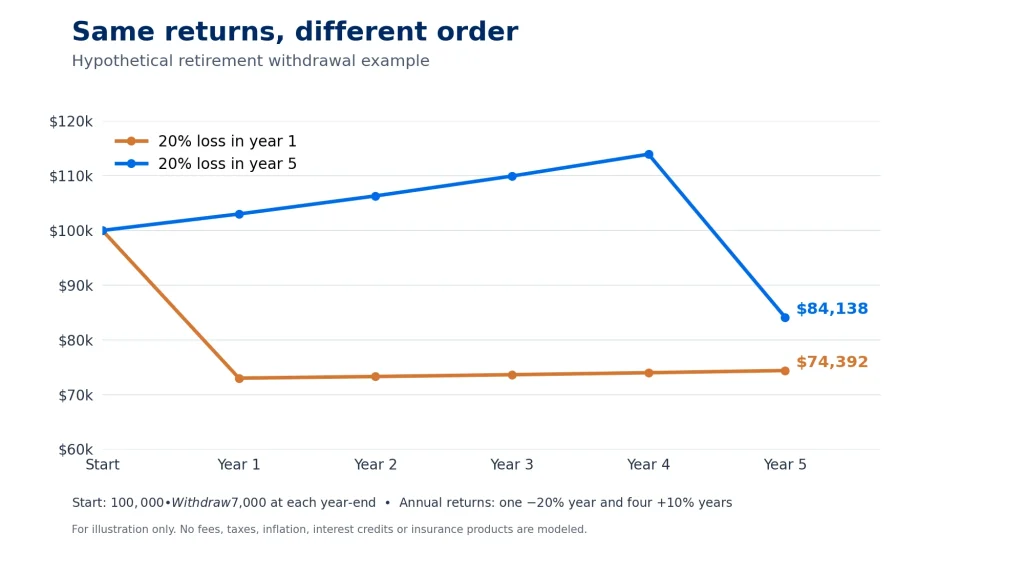
This chart shows how market timing can affect retirement savings during financial transitions. Both examples use the same annual returns in a different order. Compare what happens when the loss comes early and withdrawals are already underway.
What can you check today?
After you watch, take ten minutes to write down three things. List the first bill you’d need to cover, the first benefit you’d need to ask about, and the first source of money you’d consider using. If any answer is fuzzy, you’ve found something specific to check. Financial transitions look different from one household to the next, but that short list gives you a starting point you can come back to.
Jay A. Cohen, The Ocala Insurance Guy, is a licensed life and health insurance agent based in Ocala, Florida, and serves Florida, Virginia, Illinois, Utah, and California. If you’d like help reviewing your insurance ahead of financial transitions, please use our Contact Form. This episode is for general education. Discuss investment decisions and your own circumstances with a qualified financial professional.