

The Rule of 110 is a simple starting point for thinking about how much of a retirement portfolio might be allocated to stocks. Subtract your age from 110, and the result is the percentage the rule suggests for stocks. A 40-year-old would begin with 70% stocks, while a 65-year-old would begin with 45%. The remainder would generally be held in bonds, cash, or other comparatively conservative assets.
That calculation is easy. Retirement planning is not. The Rule of 110 cannot measure your income needs, health, pension, Social Security strategy, tax situation, risk tolerance, time horizon, or ability to withstand a market decline. It is best understood as a conversation starter—not a complete portfolio, a guarantee, or individualized investment advice.
This guide explains what the formula can and cannot do, why investment risk changes over a lifetime, how withdrawals can magnify losses near retirement, and where insurance strategies such as a properly designed indexed universal life policy may fit within a diversified plan.
How the Rule of 110 Works
The Rule of 110 updates an older rule that used 100 as the starting number. Its basic formula is:
110 minus your age = suggested stock percentage
Here are several illustrations:
- Age 30: 110 − 30 = 80% stocks
- Age 45: 110 − 45 = 65% stocks
- Age 60: 110 − 60 = 50% stocks
- Age 70: 110 − 70 = 40% stocks
Under the Rule of 110, the non-stock portion might include bonds and cash, but the formula does not specify which securities to own. It also does not define the quality, duration, concentration, fees, or tax treatment of those holdings. Two portfolios with identical stock percentages can have very different levels of risk.
For example, a diversified stock allocation is different from holding a few individual companies. A short-term government bond fund behaves differently from a long-term, lower-quality bond fund. Cash may provide stability but can lose purchasing power to inflation. The Rule of 110 supplies a rough allocation number; it does not perform security selection or due diligence.
Why Age Matters—but Is Not Enough
Age matters because time affects the ability to recover from losses. A younger worker may have decades of contributions ahead. When markets fall, that person can continue buying investments at lower prices and may have time for a recovery. A person entering retirement may be making withdrawals instead of contributions, leaving less flexibility after a major decline.
That logic supports the Rule of 110, but chronological age is only one variable. Two people who are both 62 can have completely different circumstances. One may have a pension that covers essential expenses, no debt, and a large emergency reserve. The other may rely almost entirely on an investment portfolio and need withdrawals immediately.
The SEC’s Investor.gov guidance on asset allocation says allocation is personal and depends on time horizon and risk tolerance. That is why the Rule of 110 should begin a review rather than end it.
The Rule of 110 and Risk Tolerance
Risk tolerance is the emotional and financial ability to accept market fluctuations. A questionnaire may help describe how an investor feels about volatility, but behavior during an actual decline can be different. Someone who confidently selects “aggressive” in a calm market may sell after a sharp loss.
The Rule of 110 does not know whether a 20% portfolio decline would cause you to abandon the plan. It also cannot determine whether you have enough guaranteed or stable income to continue paying bills while investments recover.
Risk capacity is different from risk tolerance. Tolerance describes willingness; capacity describes ability. A household may be comfortable with market risk but unable to afford a large loss shortly before retirement. Conversely, another household may dislike volatility but have enough pension income and reserves to accept more long-term investment exposure.
A useful review applies the Rule of 110 alongside both measures. Ask how much fluctuation you can emotionally tolerate and how much loss your retirement plan can financially absorb without changing essential goals.
Why Retirement Risk Changes Over Time
During the accumulation years, workers usually add money to retirement accounts. Market declines are painful, but ongoing contributions can purchase more shares at reduced prices. Time and continued earnings may provide room for recovery.
Near retirement, the direction of cash flow changes. Contributions often stop while withdrawals begin. A retiree may need money for housing, food, health care, taxes, and other expenses regardless of market conditions. Selling investments after a decline can turn a temporary market loss into a permanent reduction in the number of shares available for recovery.
The Rule of 110 attempts to recognize this shift by reducing the suggested stock allocation with age. It does not, however, measure the timing or size of withdrawals. A personalized income plan must connect the portfolio to actual spending needs.
Sequence-of-Returns Risk Near Retirement
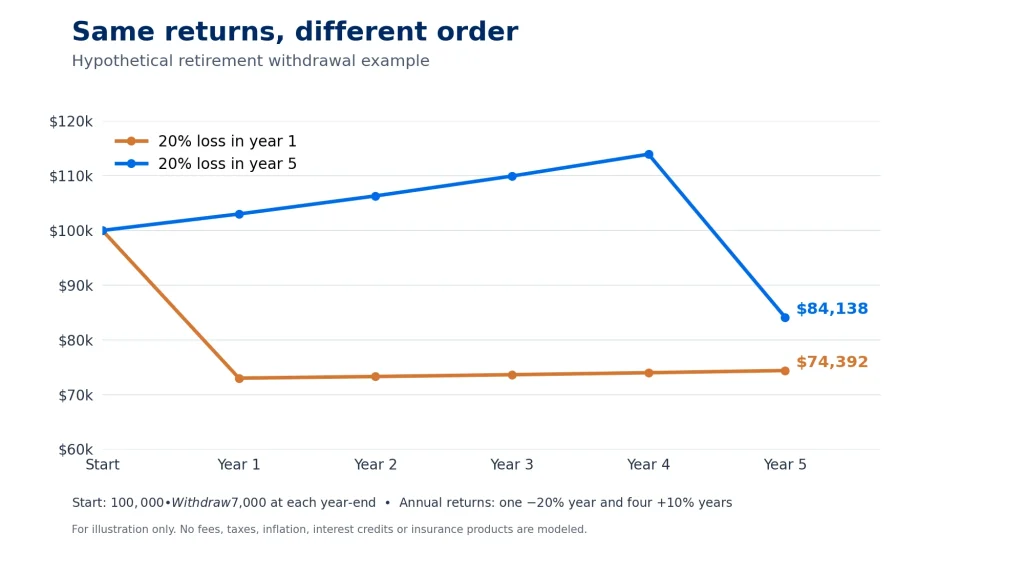
Sequence-of-returns risk is the danger that poor market returns early in retirement will cause disproportionate damage when withdrawals are occurring. Average returns alone do not show this risk. Two retirees can experience the same long-term average return but receive those returns in a different order and end with very different balances.

Imagine two hypothetical retirees with identical starting portfolios and withdrawals. One experiences strong returns in the first several years and losses later. The other experiences losses first and gains later. The second retiree must sell more shares while prices are depressed, leaving fewer shares to participate in the eventual recovery.
The Rule of 110 may reduce exposure to stock-market losses, but it cannot eliminate sequence risk. Bonds can lose value, inflation can erode cash, interest rates can change, and spending surprises can force larger withdrawals. A resilient plan normally uses several tools instead of relying on one percentage.
The Rule of 110 Is a Starting Point, Not a Prescription
Rules of thumb are useful because they simplify a complex subject. Their weakness is the same: they simplify a complex subject. The Rule of 110 does not account for:
- Expected retirement date
- Life expectancy and health considerations
- Social Security claiming choices
- Pension or annuity income
- Required and discretionary spending
- Emergency reserves
- Taxable, tax-deferred, and tax-free accounts
- Concentrated employer stock
- Real estate and business interests
- Legacy and charitable goals
- Long-term-care exposure
- Investment costs and taxes
Because these factors matter, the Rule of 110 should be tested against a written retirement-income projection. That projection can examine different market returns, inflation rates, spending patterns, and life spans. It should also be updated as circumstances change.
Building a Diversified Allocation
Asset allocation divides money among broad categories such as stocks, bonds, and cash. Diversification spreads exposure within and across those categories. According to Investor.gov, diversification can reduce risk but does not guarantee against loss.
A person using the Rule of 110 still needs to decide how the suggested stock portion will be diversified. Domestic and international stocks, large and small companies, and different industries can behave differently. The bond allocation may include government, municipal, corporate, short-term, or inflation-protected securities, each with distinct risks.
Rebalancing is also important. If stocks rise faster than other assets, the stock percentage may move above its target. If stocks fall, it may move below. Rebalancing restores the intended allocation by buying or selling, directing new contributions, or adjusting withdrawals. Consider taxes and transaction costs before making changes.
The U.S. Department of Labor’s target-date fund guidance explains that these funds generally shift toward more conservative investments as their target date approaches. A target-date fund offers an automated glide path, but investors should still review its holdings, fees, risk level, and whether it continues changing after the target date.
Inflation and the Need for Long-Term Growth
Becoming more conservative near retirement does not necessarily mean abandoning growth. Retirement may last 20 or 30 years, and purchasing power can decline over that period. Food, housing, health care, insurance, and other costs rarely remain fixed.
The Rule of 110 maintains some stock exposure even at older ages because growth may help address inflation and longevity. Still, stocks are volatile and can lose value. The correct balance depends partly on how much spending must come from the portfolio and how much is covered by Social Security, pensions, or other reliable income.
Cash can support near-term spending but may not keep pace with inflation. Bonds may provide income and diversification but face credit, interest-rate, and inflation risks. Every asset has tradeoffs. The purpose of allocation is to combine them thoughtfully.
Where Life Insurance May Fit
Life insurance is primarily designed to provide a death benefit. It is not a stock, bond, mutual fund, or substitute for a diversified retirement portfolio. Yet permanent life insurance may provide cash-value access that some households coordinate with other assets.
In the context of the Rule of 110, the relevant question is not whether life insurance produces a better allocation number. It is whether an appropriately designed policy could provide another source of financial flexibility during certain market conditions while continuing to meet a genuine death-benefit need.
Any insurance strategy should be evaluated separately for suitability, affordability, policy performance, and the insurer’s claims-paying ability. Benefits are subject to contract terms, and using cash value reduces policy values and may create risks.
How Indexed Universal Life May Add Flexibility
Indexed universal life, or IUL, is permanent life insurance with flexible premiums and cash-value crediting linked in part to the performance of a market index. Policy cash value is not invested directly in the index. Crediting is determined by the contract’s method and limitations.
A properly designed and adequately funded IUL may provide access through withdrawals or policy loans. During a severe market downturn, that access might reduce the need to sell some market investments at depressed prices. This potential use can complement a Rule of 110 allocation, but it does not eliminate investment risk or guarantee retirement income.
The concept depends on the policy remaining in force and having sufficient accessible value. Results depend on premiums, charges, crediting, withdrawals, loans, interest, and ongoing management. A policy illustration is hypothetical and contains both guaranteed and nonguaranteed values.
IUL Floors, Caps, and Participation Rates
Many IUL crediting strategies have a floor that may prevent a negative index-crediting rate for a segment during a crediting period. A 0% floor does not mean the policy’s total value cannot decline. Monthly policy charges, insurance costs, administrative expenses, loans, and other deductions continue even when no index interest is credited.
Crediting may also be limited by a cap, participation rate, spread, or other factor. A cap limits how much index gain is considered. A participation rate applies only a stated portion of the measured gain. A spread may be subtracted before crediting. These terms may change within the limits of the contract.
That means an IUL policy does not receive the index’s full return and generally does not include dividends. The Rule of 110 concerns an investment allocation, while IUL is an insurance contract with different mechanics. They should not be presented as interchangeable products.
Policy Charges, Surrender Periods, and Funding
IUL policies include charges that can be significant, especially in early years. These can include premium loads, cost-of-insurance charges, administrative fees, rider charges, and surrender charges. Charges vary by carrier, product, insured age, health, benefit amount, and design.
Surrender periods can last many years. Ending the policy early may produce less cash value than premiums paid. Flexible premiums do not mean any funding pattern will work indefinitely. Paying only a minimum amount can increase the risk that the policy will underperform expectations or lapse later.
Before coordinating IUL with the Rule of 110, review guaranteed and current-value illustrations, funding assumptions, death-benefit options, modified endowment contract limits, and stress tests using lower crediting rates. Carrier and compliance review may be required for any product-specific representation.
Policy Loans and Lapse Risk
Policy loans are not free money. Interest accrues, and loan terms vary. Loans and withdrawals reduce cash value and the death benefit. If a heavily borrowed policy lapses or is surrendered, taxable income may be triggered to the extent required under tax law, even if the policyowner no longer has the borrowed funds.
Loan provisions can include fixed, variable, participating, indexed, or wash-loan approaches depending on the contract. The relationship between credited interest and loan interest can change. Do not assume an illustration’s loan outcome is guaranteed.
An IUL used for retirement flexibility requires regular monitoring. Review premiums, current charges, credited interest, cap and participation changes, loan balances, loan interest, death benefits, and lapse projections. The NAIC’s life insurance overview provides general regulatory background, but product details must come from the actual policy and insurer.
A Hypothetical Retirement Example
Consider a hypothetical couple, both age 62, planning to retire at 65. This is a composite example for education and does not represent a real customer or guaranteed outcome. The Rule of 110 suggests approximately 48% stocks for each person based only on age.
The couple also has Social Security, a small pension, cash reserves, and an older permanent life policy. Their essential expenses are partly covered by reliable income, but they expect portfolio withdrawals for travel and home repairs. They are concerned about retiring just before a major market decline.
Instead of automatically adopting 48% stocks, they evaluate spending, taxes, investment concentration, bond risk, cash reserves, and the policy’s current in-force values. They ask whether discretionary spending could be reduced temporarily and whether policy access would be suitable in a downturn.
Their review finds that the Rule of 110 is useful as a benchmark but not a decision. They choose an allocation supported by projections, maintain a reserve for near-term expenses, and schedule annual reviews. Any life-insurance access would be evaluated at the time because loans could reduce benefits and increase lapse risk.
Questions to Ask Before Using the Rule of 110
Before applying the formula, answer these questions:
- When will withdrawals probably begin?
- How much annual spending must the portfolio support?
- Which expenses are essential and which are flexible?
- What income is expected from Social Security, pensions, or annuities?
- How would a 20% or 30% portfolio decline affect the plan?
- How many years of expenses are held outside volatile assets?
- Are investments diversified or concentrated?
- What taxes and fees apply when assets are sold?
- Are required minimum distributions likely to affect allocation?
- Is there a genuine life-insurance need?
- If permanent insurance is involved, has an updated in-force illustration been reviewed?
- Who will monitor the plan and how often?
These questions turn the Rule of 110 from a slogan into a planning discussion. The answers may support the suggested allocation, justify a different one, or reveal that other decisions deserve attention first.
Rebalancing and Reviewing the Plan
FINRA’s retirement-account guidance notes that investors decide when and how to reallocate and rebalance. A regular review can compare the current portfolio with its target and account for changes in spending, income, health, taxes, and family responsibilities.
The Rule of 110 changes by one percentage point each birthday, but that does not mean trades must be made annually. Gradual adjustments through contributions, dividends, or withdrawals may be more practical. Tax consequences and account rules should be evaluated before rebalancing.
Review more frequently after a major market move, retirement, job change, inheritance, death, divorce, diagnosis, home purchase, or change in pension or Social Security plans. Avoid making emotional changes based only on headlines.
Common Mistakes to Avoid
The first mistake is treating the Rule of 110 as personalized advice. It is only a general heuristic. The second is assuming bonds and cash are risk-free. They face interest-rate, credit, reinvestment, and inflation risks.
Another mistake is focusing only on investment returns while ignoring withdrawals, taxes, fees, and insurance costs. A plan succeeds through coordinated cash flow, not a single percentage. Investors should also avoid replacing diversified investments with an insurance product solely because it offers a crediting floor.
Finally, do not use optimistic IUL illustrations as promises. Caps, participation rates, charges, loan interest, and nonguaranteed values can change. A policy should be selected for a valid insurance purpose, funded appropriately, and reviewed regularly.
The Bottom Line on the Rule of 110
The Rule of 110 offers an easy way to begin thinking about age and investment risk. It recognizes that younger investors usually have more time to recover from market losses, while people approaching retirement may need greater stability as withdrawals begin.
Its simplicity is helpful, but incomplete. A sound retirement strategy also considers risk tolerance, risk capacity, income sources, spending, taxes, inflation, longevity, diversification, sequence-of-returns risk, and policy details. The Rule of 110 should be tested against those realities rather than followed automatically.
Life insurance, including a properly designed and funded IUL, may provide one source of flexibility within a broader plan for certain individuals. It is not an investment, a complete retirement plan, a guarantee, or a risk-free product. Policy charges, surrender periods, crediting limits, loan interest, lapse risk, and insurer claims-paying ability all matter.
Learn more about life insurance options from Jay A. Cohen, The Ocala Insurance Guy, or read about Jay’s educational approach and insurance experience.
When you are ready, contact Jay to discuss how your existing life insurance may fit within your broader retirement-income planning.
This article provides general educational information and is not individualized insurance, investment, legal or tax advice. Policy provisions, availability and requirements vary by insurer and state. Consult qualified professionals before replacing, surrendering, borrowing from or materially changing a life insurance policy.