

Episode 3 · 24:01 · Audio Overview
Life insurance and an annuity answer two questions we’d put on the table before looking at a quote. Who would need money if you died next year? What would cover your bills if you lived another thirty years? Those are two different problems. You can have both in the same household.
Read the companion guide: Which option fits your needs?
Listen to the episode
Who would count on a life insurance death benefit?
Picture two people sitting at the kitchen table a few years before retirement. One paycheck still covers most of the household expenses. If that paycheck stopped because its earner died, would the other person have enough to cover rent or the mortgage, groceries, and the time it might take to rearrange work? Some bills would change, but the household might need money right away.
We’d start by writing down how much the surviving household would need, how long they’d need help, and what they could already count on. Savings, existing life insurance, and any confirmed survivor benefits might cover part of it. The difference gives you a starting point for deciding how much coverage to discuss. The life insurance needs calculator can help you organize those estimates.
Could an annuity help cover the monthly gap?
Now imagine both people reach retirement. Their next question is how they’ll pay recurring bills after the paychecks stop. Put the monthly cost of essentials next to the retirement income you expect from sources such as Social Security and a pension. Check those amounts against the latest statements you have, and allow for expenses that are easy to miss, such as property taxes or health care.
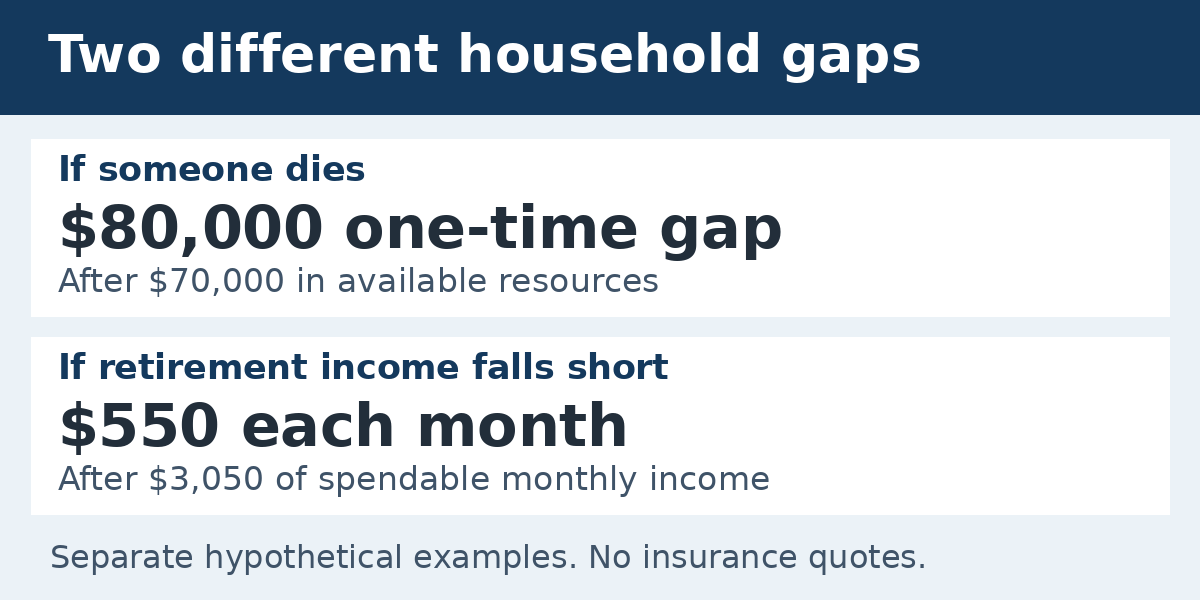
If the essentials come to $3,600 a month and you expect $3,050 in spendable income, the starting gap is $550 a month. Those are made-up numbers for this exercise. What an annuity pays depends on the contract and its terms. Write the $550 as a monthly gap so you can compare it with what an annuity might pay. On the next line, write the total you’d want a life insurance death benefit to cover for the survivor.
How much cash should stay accessible before you buy an annuity?
Before you commit, ask how much cash you could access if the roof failed, you needed to help family, or your own plans changed. Find out when income could start, what withdrawals the contract permits, and whether surrender charges or other restrictions could apply. If someone shows you a payment amount, ask what would happen to that payment if one spouse died and what each option would cost.
Bring those questions with you when you review a quote for an annuity. The SEC’s annuities overview and the NAIC life insurance buyer’s guide explain those products in more detail. Use them alongside the actual policy or contract. If a number is illustrated, ask whether it’s guaranteed and where the contract says so.
What would we bring to a conversation?
Bring three things if you have them. A rough monthly budget. A list of the people who depend on you. The benefit statements or policies you already own. Ask who would rely on a life insurance death benefit if either spouse died first, which monthly bills need a dependable source of income, and how much money you want within easy reach. You might find one gap, two gaps, or that your current plan already covers what matters. Start with the gap you can actually put a number on.
About Jay A. Cohen
Jay A. Cohen is a licensed health and life insurance agent in Ocala, Florida, serving Florida, Virginia, Illinois, Utah, and California. If you’d like help putting those two questions on paper, use our Contact Form. Tell us what you’re trying to protect and which state you’re in. General education only. The example is hypothetical, and product terms and availability vary.