

Episode 4 · 20:25 · Audio Overview
You’re 65. You subtract 65 from 110 and get 45% in stocks. The math takes five seconds. Now suppose the market falls the same month you stop getting a paycheck. Where does next month’s grocery money come from? The Rule of 110 gives you an allocation to think about. The grocery bill is where the retirement conversation gets real.
Read the companion guide to the Rule of 110 and retirement risk
Listen to the episode
What does the Rule of 110 leave out?
Start with two people who both retire at 65. One has a pension and Social Security that cover most of the household’s basic bills. The other needs regular withdrawals to cover housing, groceries, and health care. Give both households the same Rule of 110 calculation and they get the same answer. Give them the same bad market year and the decisions they face can look very different.
Before applying the Rule of 110, we’d put a month of bills on the table. Which expenses come due whether markets are up or down? Which could wait? Then we’d line up the income the household can reasonably count on and see what still needs to come from savings. If you have to draw from the portfolio every month, the size and timing of those withdrawals deserve a place in the conversation right alongside the stock allocation.
Why can the first few years matter so much?
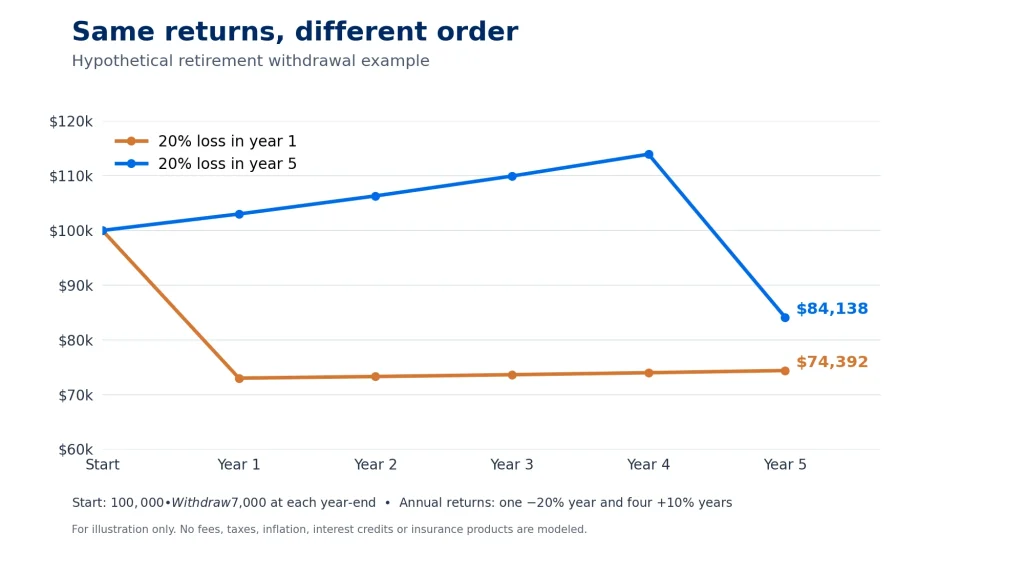
Suppose two retirees start with the same savings and take the same amount out at the end of each year. One encounters a sharp loss early. The other encounters it several years later. Even with the same set of annual returns, the order can leave them with different balances. When you sell shares after a drop to cover a withdrawal, fewer shares are left to participate if prices recover.
The Rule of 110 gives you a stock percentage. The chart from our companion guide shows what can happen when you’re withdrawing money during a downturn. Both paths begin with $100,000 and withdraw $7,000 at each year-end. Look at what happens when the 20% loss comes in year one versus year five. The example leaves out fees and taxes. Its purpose is to show how the timing of a loss can change the result when money is coming out.
What would we write down before changing anything?
If you’re using the Rule of 110 to review your investments, start by writing down what it costs to keep the household running. Then list the income you expect and when it starts. If a pension or Social Security payment starts later than your last paycheck, give that gap its own line. A budget that looks comfortable after every income source starts may have a tight first year.
Next, separate the spending you could defer from the bills you’d pay on time. A postponed trip is one thing. The mortgage and insurance premiums are another. Ask which resources you could use if markets fell and what it would cost to access them. The SEC’s guide explains how time horizon and risk tolerance inform asset allocation. Your own cash-flow timeline gives those ideas something concrete to work with.
Finally, bring that list to the people who help you with your retirement decisions. If you’re reviewing life insurance or annuities with us, we’d ask what job you need the coverage or income to do and what money you still need to keep accessible. A useful question to take into any review is simple. Which bill gets paid from which account if the market has a bad year?
Jay A. Cohen, The Ocala Insurance Guy, is a licensed health and life insurance agent serving Florida, Virginia, Illinois, Utah, and California. If you’d like to talk through where insurance fits in your retirement planning, use our Contact Form. The examples are hypothetical and for general education.