

“We’re already saving. Do we really need life insurance, too?” It’s a fair question, especially when the grocery bill, the mortgage and retirement contributions already have their hands out. Understanding why life insurance is important starts with a much more personal question: who would have a financial problem if you weren’t here to do what you do?
We’re talking about the paycheck that keeps the house running, the parent who handles afternoon pickups, or the adult child who helps an older parent. Those responsibilities don’t all disappear after a death. Sometimes the people left behind need more help just when they have less income and less room to make quick decisions.
For some households, life insurance fills a gap that savings can’t cover yet. For others, the money is already there. We’ll look at income replacement, family protection and what you can afford to keep paying. We can help you decide whether there’s a need before comparing products. Buying a policy shouldn’t be the price of getting an honest answer.
Have a question about your own coverage while you read? Use our Contact Form and we’ll help you sort through it.
Why life insurance is important: the timing problem
Imagine you’re building a reserve a little at a time. That’s useful work. The difficulty is that a financial loss can arrive before the reserve is ready. This is a central reason why life insurance is important: an in-force policy can provide a covered death benefit before you’ve personally accumulated that amount, subject to its terms.
You pay a premium to transfer a defined risk to an insurer. You don’t receive an unlimited promise, and paying a few premiums doesn’t override exclusions, application requirements or claim review. The NAIC’s life insurance overview explains the basic policy types. Before you decide what protection you have, read what the contract actually covers.
Someone may reasonably say, “What if we pay for years and never need it?” With term coverage, surviving the covered period without a claim is possible, and most basic term policies don’t refund premiums. The purpose is protection during that period. Would that loss be manageable if you had to cover it yourself? That’s the question the policy helps answer.
We’d also separate the emotional loss from the financial one. Money cannot replace a person or make grief orderly. It may give survivors more choices about work, housing and caregiving. When we explain why life insurance is important, those practical choices are the point. We’re not promising that the family will face no hardship.
Income replacement starts with the household
Income replacement means helping cover the income the household would lose, for as long as that help is needed. Start with the portion of your earnings that pays shared bills. Some personal costs may stop; other costs may grow. This is why life insurance is important to assess with an actual household budget rather than a salary multiplier.
If the surviving parent has to work fewer hours to handle school pickups, would the smaller paycheck still cover the basics? The loss of one person’s income can also change what the other person is able to earn.
Include the time it takes to reorganize. Someone may need a few months to change work schedules, arrange childcare or move closer to relatives. Income replacement can give those changes breathing room. That helps explain why life insurance is important even when survivors could eventually support themselves. Being able to pay the bills eventually doesn’t help much when they’re due next month.
You don’t need to finish a complicated calculation today. Our life insurance needs calculator can organize rough numbers, and our coverage-amount guide develops the calculation. Here, we’re deciding whether a meaningful gap exists at all. Start with why life insurance is important to you, then explore an amount without treating a calculator result as an instruction to buy.
The work that never appears on a pay stub
Dinner still needs making. Children still need rides, and somebody still has to notice that tomorrow is the school project deadline. Unpaid work is one reason why life insurance is important beyond the highest earner. Replacing some of that help could cost money; doing it yourself could reduce working hours. We’d ask what would actually change in your household.

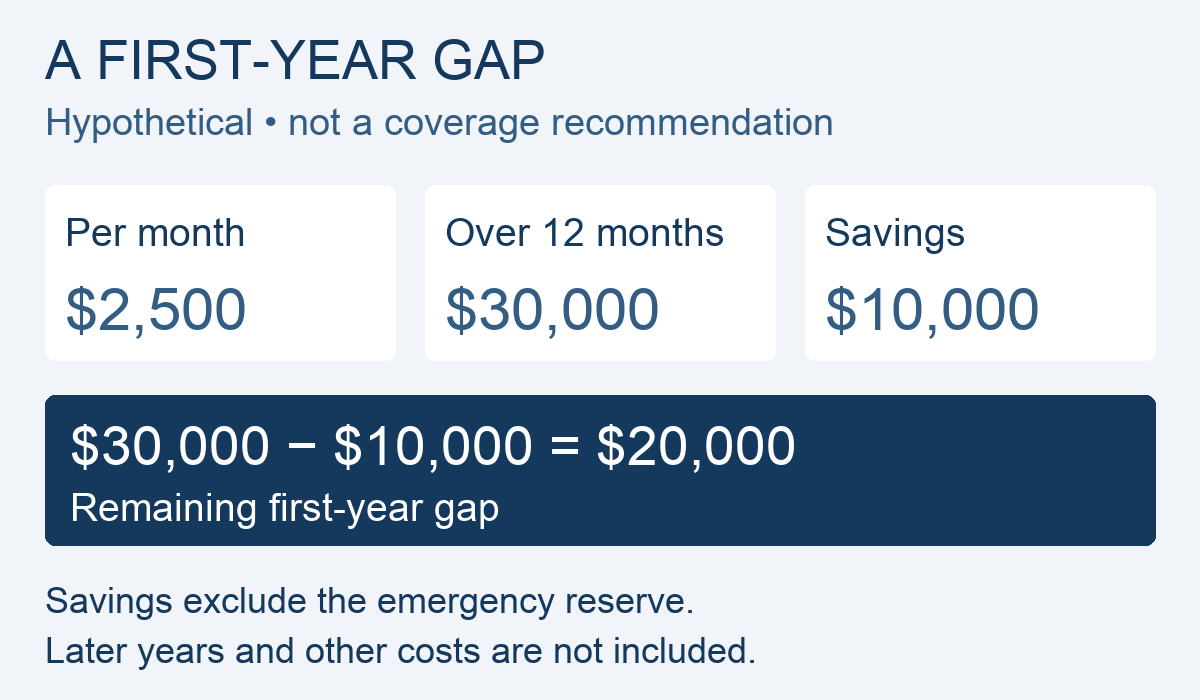
Here’s a deliberately simple hypothetical example. After a death, a household estimates a $2,500 monthly gap between its continuing expenses and reliable survivor income. Over twelve months, that is $30,000. It has $10,000 of savings specifically available for this purpose, separate from an emergency reserve. The remaining first-year gap is $20,000.
That $20,000 is not a recommended policy amount. It excludes later years, inflation, investment results and separate expenses. It simply shows why life insurance is important to consider before assuming “we have savings” settles the matter. The useful question is whether those savings can do the job for the period the family needs.
Change the assumptions and the answer changes. If the survivor can cover the shortfall after six months, the need may be shorter. If childcare costs rise, the gap could grow. Try the numbers again with a shorter gap or a higher childcare bill. Either change could affect how much protection you’d want. We can help you test the assumptions without pretending that a tidy illustration predicts exactly what your family will spend.
A year of bills makes the gap easier to see
Notice that the example used a shortfall after survivor income, not the entire household budget. Counting the surviving paycheck again would exaggerate the problem. Good family protection includes recognizing resources that really will be there. We want to understand why life insurance is important in your circumstances, not make the largest number sound like the safest answer.
Also ask which bills you want the benefit to handle immediately. Paying off a manageable mortgage and replacing the monthly mortgage payment are different approaches. Counting both in full could double count the need. When explaining why life insurance is important, we can compare keeping cash available with eliminating payments.
Debt needs a separate reality check. The Consumer Financial Protection Bureau explains that responsibility after a spouse’s death depends on shared obligations and state law. Don’t assume relatives inherit every unpaid bill. An attorney can confirm liability; we can help organize the insurance questions around the obligations you actually need to address.
What about Social Security? Survivor benefits may provide payments to eligible family members, with eligibility depending on the circumstances. Confirm the actual benefit instead of assuming a round amount. Put that confirmed benefit next to the bills it would help pay. What’s still left over?
Timing also explains why life insurance is important to examine beyond the first year. The immediate transition could require money for travel, temporary help or time away from work. Later income replacement may look different. Writing down those two periods gives us something concrete to discuss and keeps a single large death-benefit number from hiding what the money is supposed to do.

THE OCALA INSURANCE GUY · HOUSE AD
Some jobs need a backup.
The school pickup still needs a driver who fits in the car. Replacing unpaid care is more complicated than finding a spare set of hands, and it may affect the survivor’s workday. We can help identify those costs when you’re asking why life insurance is important. Let’s include the work your household depends on, whether it comes with a paycheck or not.
Savings and insurance do different jobs
Savings can pay for an emergency while everyone is alive. Life insurance generally pays after a covered death. Keeping that distinction clear is part of understanding why life insurance is important. Putting every spare dollar into a policy could leave you short for an urgent repair, while relying on a small reserve could leave a large protection gap.
So the decision may involve both a reserve and coverage, at amounts your budget can support. We’d ask what cash must stay accessible and what loss would be difficult to absorb. Family protection doesn’t improve when an insurance payment forces you to borrow for ordinary expenses. Knowing why life insurance is important helps us balance the premium with the cash you still need available.
Self-insuring means using your own assets to absorb the financial loss instead of relying on an insurance benefit. That can be reasonable when enough accessible resources already exist. When we talk about why life insurance is important, timing matters: could those resources meet the need today, including a less convenient time to sell an asset?
A valuable house isn’t the same as available cash. Selling could take time, involve costs, or require survivors to leave a home they want to keep. We can help identify that mismatch. We wouldn’t assume every asset is untouchable, either. Your family’s actual wishes and practical options determine what belongs in the calculation.
Family protection can reach beyond young children
An older parent may depend on help with shopping, transportation or household expenses. An adult child may depend on ongoing financial support. Those responsibilities are another reason why life insurance is important to consider after the children have grown. We’d discuss who needs help, how long it might continue, and which arrangements need an attorney’s guidance.

A single person may have little need for income replacement but still support a relative or want to provide for final expenses. Another single person may have ample savings and no dependents. Marital status alone won’t tell us why life insurance is important, or whether buying coverage should be a priority. Who’s counting on you, and what would they have to replace?
Business responsibilities are another reason why life insurance is important to evaluate separately from personal needs. A family policy and a policy intended to fund a business agreement may serve different people. Keep those purposes separate rather than counting the same dollars twice. Business ownership, agreements and tax issues need the appropriate advisers; Jay can explain suitable coverage within his authorized insurance role.
The reason for family protection also changes over time. Paying off debt or building savings may reduce a need, while taking responsibility for another person may increase it. Why life insurance is important at thirty may differ from the reason at sixty. A useful plan can recognize that without assuming every change requires a new policy.
Workplace coverage can be a valuable starting layer. Before deciding it is enough, confirm the actual benefit and what happens when employment changes. That’s why life insurance is important to review alongside your job benefits rather than separately from them. Our guide to coverage through work explains questions to ask the plan administrator.
Does coverage through work settle the question?
A benefit described as “one year of salary” tells you an amount, not how many years of expenses it will cover. Compare it with the household shortfall, confirm who would receive it, and verify the conditions. Knowing why life insurance is important includes checking how far a confirmed workplace benefit would actually go.
You may find that work coverage and savings together already address the main concern. That’s a useful result. Or you may find a gap that an individually owned policy could address, subject to availability and underwriting. Understanding why life insurance is important includes knowing which layer does which job and who can confirm each benefit.
Ask the employer or administrator for official plan answers. We can help you compare confirmed benefits with personal coverage options, but we don’t control an employer’s elections or records. Explaining why life insurance is important includes knowing who can confirm each source of family protection. A helpful agent should make that process clearer rather than imply authority they don’t have.
There are also households where additional coverage deserves a lower priority. If nobody depends on your earnings or care, final expenses are funded, and your other goals don’t require a death benefit, the case for buying more may be limited. Explaining why life insurance is important should leave room for that answer without a sales pitch attached.
When buying more coverage may be unnecessary
Having substantial assets can change the conversation. We’d still examine accessibility, existing commitments and the people relying on them. But why life insurance is important is not the same as why everyone must buy it. Someone who can comfortably absorb the loss may make a different choice from a household still building its first reserve.
Would you buy this policy if nobody mentioned cash value, a tax advantage or an investment-like illustration? If the answer is no, we should revisit what you actually need the coverage to accomplish.
A desire to leave a gift is legitimate, too. Just separate that goal from essential income replacement. The reason why life insurance is important to you may put housing stability ahead of a larger legacy. We can help compare those priorities and costs. Family protection should reflect your values and resources, rather than turn every wish into an urgent financial obligation.
If an old policy no longer seems necessary, don’t rush to cancel it. Check current needs, guarantees, costs and options first. Our policy-review guide takes that next step. Understanding why life insurance is important helps clarify the purpose; changing an existing contract deserves its own careful review.
Match the policy to the responsibility
Once a real need is identified, discuss how long it lasts. Term insurance covers a defined period under its terms; permanent coverage is intended for longer-lasting protection when properly maintained. Our term and whole life comparison goes deeper. Why life insurance is important should guide that product conversation, rather than the other way around.
For temporary income replacement, ask whether the coverage period lines up with the responsibility and whether the premium stays manageable. For a lifelong need, ask what it takes to keep protection in force. A flexible payment feature does not eliminate policy costs. We can explain the particular proposal, including what is guaranteed and what depends on assumptions.
Cash value is a feature of some permanent policies, not a substitute for understanding the death benefit. Loans or withdrawals can reduce values and protection, and may have tax consequences. We’d examine the contract before treating available money as an emergency fund. Why life insurance is important begins with a need the policy can actually serve.
Health, age and other application information can affect availability and pricing. Waiting may change your options, but nobody can promise future approval or today’s rate. There is no need to manufacture urgency to explain why life insurance is important. We can discuss the choices available now and what remains uncertain without suggesting that every reader must act immediately. If replacing coverage, keep existing protection until the new policy’s acceptance, terms and effective date are confirmed.
A death benefit needs a workable route
Family protection depends on the benefit reaching the intended recipient. The owner, insured person and beneficiary can have different roles. Check names and backup beneficiaries, and coordinate complicated arrangements with an attorney. Naming a minor or someone receiving means-tested benefits can require extra planning. Knowing why life insurance is important does not settle who can receive or manage the benefit.

Where would your beneficiary look?
Make sure a trusted person knows where to find the policy and how to contact the insurer when needed. Keep sensitive details secure. A benefit is more useful when the person who needs it can find the policy and knows how to start a claim. We can help explain the insurer’s documented requirements.
Don’t budget as though a claim payment arrives automatically the following morning. The insurer needs required documents and must review the claim; timing varies. Accessible cash still matters during the transition. Understanding why life insurance is important also means recognizing that bridge before a benefit is paid. Keep your emergency reserve in the discussion even when the death benefit looks sufficient.
The IRS explains that death proceeds are generally excluded from a beneficiary’s federal gross income, while interest can be taxable and exceptions apply. Ask your tax adviser how those rules apply to your policy and beneficiary arrangements.
Make the premium fit real life
An affordable premium is part of the protection, not a minor detail at the end. Ask what you could maintain through an ordinary difficult month. That is why life insurance is important to discuss with your real budget. A large policy that becomes unaffordable may leave you with less lasting protection than a smaller, sustainable choice.
You can prioritize the most important gap first. That may mean less coverage than the ideal estimate, a different term, or keeping valuable existing insurance. Once you understand why life insurance is important for your main responsibility, we can compare the trade-offs and available quotes. Income replacement does not have to become an all-or-nothing decision just because one proposal costs more than you can comfortably commit.
Know what would happen after a missed payment and which policy features affect future costs. For existing permanent coverage, request current information when appropriate rather than relying only on an original illustration. When you’re weighing why life insurance is important, consider what will keep suitable protection workable. A discussion about affordability should be specific enough that you understand what you’re agreeing to pay.
And keep other risks in view. A standard life policy doesn’t replace disability coverage, health insurance or an emergency reserve. Some riders provide additional benefits, but qualifications and limits vary. Knowing why life insurance is important helps us identify its role alongside those other family protection tools. We can help you see the boundaries so one purchase doesn’t leave you assuming that every financial problem is covered.
THE OCALA INSURANCE GUY · HOUSE AD
Savings takes time.
A savings plan takes repeated effort. That’s worthwhile, but a small reserve may need time before it can absorb a large loss. We can help compare what your savings cover today with the responsibility you want protected. That’s a practical way to explore why life insurance is important while continuing to build accessible savings at a pace you can maintain.

What a useful conversation with Jay looks like
You don’t need a polished spreadsheet to start. Bring a rough budget, confirmed benefit details and the policies you already own. Tell us who depends on you and what you want to keep stable. We can help turn “why life insurance is important” into a decision about your household, rather than an abstract argument about whether insurance is good.
A qualified agent’s value is in the questions and explanation: identifying a genuine need, comparing suitable available coverage, explaining exclusions and guarantees, and coordinating an accurate application. Jay can help within his state licensing and authorized offerings; the insurer decides underwriting. We’ll also identify questions for an employer, tax adviser or attorney instead of pretending insurance guidance replaces their work.
- Who depends on my paycheck or unpaid care?
- What would they need to change in the first year?
- Which savings and benefits are truly available for that purpose?
- Is the need temporary, long-lasting, or already funded?
- What premium could we keep paying without draining emergency cash?
- What can Jay explain, and what must an insurer or another professional confirm?
Those answers give us a sensible place to begin. If you want help comparing income replacement and family protection with what you already have, use our Contact Form. You can start with the broad concern and your state. Keep medical records, account details and policy numbers out of the initial message; sensitive information belongs in an appropriate secure process.
Make one clear decision before shopping
Why life insurance is important comes down to a responsibility and a possible gap. Would someone lose income, care or financial flexibility they couldn’t readily replace? If the answer is yes, coverage may deserve a place in your budget. If the resources already exist, you may have less to solve. Either way, start with the people and the facts.
Your next step can be modest: identify the one responsibility you most want protected, then check what already supports it. We can help compare the gap, timing and sustainable cost. Understanding why life insurance is important should leave you better able to make that choice, including the choice to keep suitable coverage you already have.
About Jay A. Cohen, The Ocala Insurance Guy
Jay A. Cohen is a licensed health and life insurance agent based in Ocala, Florida. He is licensed in Florida, Virginia, Illinois, Utah, and California.
Our approach is educational: we listen to understand your needs, goals, and budget, then explain your options in plain language. We walk through the benefits, costs, and limitations, welcome your questions, and help you make an informed decision without pressure to buy a particular product.
To explore term and permanent coverage options, visit the Jay A. Cohen life-insurance information page. You can also learn more about Jay’s educational approach and insurance experience.
Want help deciding whether income replacement or family protection leaves a gap in your household budget? Use The Ocala Insurance Guy Contact Form. Please leave medical records, account details, and policy numbers out of the initial message.
General education only, not individualized insurance, investment, legal or tax advice. Examples are hypothetical, not quotes or recommendations. Availability, underwriting, benefits, exclusions and costs vary by insurer, state and policy. Guarantees depend on the issuing insurer’s claims-paying ability. Photographs are AI-generated illustrations.