

THE INSURANCE CONVERSATION
Who pays—and what does that mean for you?
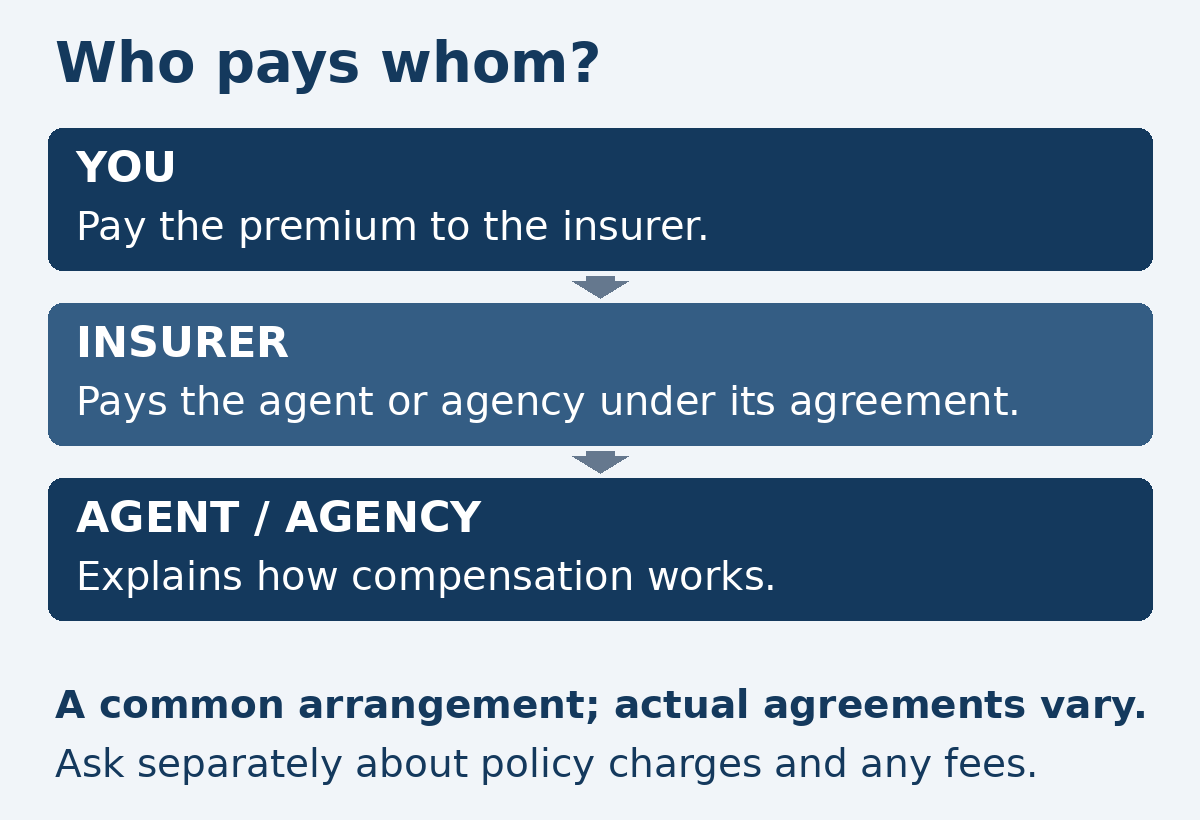
Who pays the insurance agent—and could that paycheck influence the recommendation? Fair questions. In a common arrangement, you pay the insurer your premium, and the insurer pays life insurance commissions to the agent or agency. You usually don’t receive a separate commission bill. But you should still understand the costs and incentives behind the coverage.

You don’t need to apologize for asking how your insurance agent gets paid. We’d want to know, too. The bigger question is whether the life insurance being recommended solves your problem at a payment you can keep up with.
Start with three questions: Who pays you? Would we owe a separate fee? Why does this coverage fit our needs? We’ll walk through the answers, including commissions, ongoing service, and what deserves a closer look.
Have a question about a recommendation you’re considering? Ask us through the Contact Form. A general question is a good place to start; keep medical details and policy numbers out of the initial message.
Who pays life insurance commissions?
In a common commission arrangement, you pay premiums to the insurer and the insurer pays compensation under its agreement with the agent or agency. The premium is the payment required for the coverage. The commission is compensation for distribution and related work. They are connected, but they are not the same transaction.
For example, an insurer may pay through an agency that then compensates the individual who worked with you. The amount received by an agency is not necessarily the amount the individual takes home. Agency expenses, contractual splits, and other arrangements can affect that result.
Some professionals also receive salaries, allowances, bonuses, or other compensation. Others may provide separately compensated services where permitted. Rather than assuming every insurance agent works the same way, ask which arrangement applies to your proposed purchase.
Here’s the practical question: “Am I being asked to pay anything beyond the premium?” If there’s a separate bill, ask what service it covers, who receives the money, and what terms apply. Get that explanation in writing before agreeing to it.
Does that mean the agent’s help is free?
No separate bill? That doesn’t mean the work has no cost. An insurer has expenses for selling and administering policies, as well as paying benefits. Those expenses are reflected in the economics of its products. A commission paid by the insurer does not make distribution cost disappear.
On the other hand, it is also misleading to assume that an agent’s commission is an extra amount automatically added to your quoted premium at checkout. Ask for the actual premium, any separately payable fees, and the policy’s charges. Compare written offers rather than trying to reconstruct a price from a commission estimate.
Imagine a hypothetical shopper with two browser tabs open: one direct-buy offer and one proposal from an agent. The direct offer looks cheaper. Case closed? Only if the coverage, underwriting, benefits, and service are actually comparable. Buying directly does not, by itself, prove that the same policy costs less. Put the written offers side by side before deciding what the difference means.
A useful follow-up
If an advertisement says “no commission,” ask what costs remain and how the seller is compensated. That label tells you something about how the seller operates. You still need to ask whether the coverage fits, whether you can afford it, and what keeps it in force.
How much does an insurance agent earn on a policy?
So, how much does the agent make? There isn’t one percentage that fits every policy. Life insurance commissions depend on the insurer, the product, the way premiums are structured, the policy year, and the agent’s agreement. An online percentage may be accurate for one arrangement and tell you very little about yours.
First-year compensation means compensation associated with the initial policy period. Renewal compensation refers to payments associated with later periods under the applicable agreement. Their amounts and timing can differ. Neither term tells you the complete lifetime compensation without the contract details.
As a concrete industry example, the NYLIFE Securities Customer Relationship Guide, effective September 28, 2026, describes first-year and renewal commissions, allowances, and other forms of compensation on life products. It also explains that compensation varies with agent contracts. That is evidence of how one organization describes its arrangements, not a schedule for every insurer or for our business.
Suppose, hypothetically, someone shows you a commission percentage and says, “That’s what the agent earns.” Your next question is, “A percentage of what—and over what period?” Annual premium, a specified premium category, and cash value are different bases. The figure might describe the agency’s compensation rather than the individual’s payment, and it might leave out later payments. A number can be perfectly clear on the page while telling you very little about the actual arrangement.
A percentage without its base and time period is a little like a price tag without the item attached. You can read the number, but you still cannot make a useful comparison.
What about bonuses and other incentives?
Life insurance commissions may be only part of a compensation arrangement. Depending on the organization and agreement, additional benefits or incentives can relate to production, keeping policies in force, service, or other measures. Ask about relevant financial incentives rather than stopping after the word “commission.”
For an example involving variable products, Northwestern Mutual’s compensation disclosure describes commissions, benefits, other sales compensation, and ongoing servicing compensation. It notes that amounts can differ from those associated with comparable products from other companies. These are that organization’s disclosures for those products; they do not establish what another agent receives.
Picture a hypothetical conversation in which you ask about a lower-premium option and the discussion keeps returning to a different proposal. That alone doesn’t tell you why. We’d bring the conversation back to two questions: “What need does this option meet that the other one doesn’t?” and “Would choosing it change your compensation?” Ask how the company, product, or premium affects pay, and which alternatives are within the agent’s access. You want an explanation you can follow, without having to guess at anyone’s motives.
An incentive is a reason to ask questions. It doesn’t automatically mean something is wrong. But explaining a commission doesn’t fix a policy that fails to meet your needs, either. We want the recommendation and the explanation of pay to make sense together.

Captive or independent: what can your insurance agent actually offer?
People often use “captive” to describe an agent closely associated with a particular insurer, and “independent” to describe an agent who can work with multiple insurers. Those labels are a starting point. The actual companies, appointments, product access, and contractual limits matter more than the label alone.
In a hypothetical comparison, you find another insurer online and ask why it wasn’t included. “Independent” doesn’t automatically mean the agent can offer that company—or every policy in the market. An agent associated with one insurer may know its products well, but that does not make them a fit for every buyer, either. Ask which insurers were considered and why. The label on the business card is the beginning of that conversation, not the answer.
Try this question: “Are you recommending this from the options you can offer, or are you saying it is the best option anywhere?” Those are very different statements. A careful recommendation should describe its scope and avoid claiming a market-wide comparison that was never performed.
You can also ask what happens if the underwriting result is less favorable than expected. Will the agent discuss alternatives? Are there circumstances in which another professional or a different type of coverage would be more appropriate? The answer helps you understand the process before you commit.
Start with the life insurance need, then examine the recommendation
Let’s put the agent’s paycheck to one side for a moment. What would happen financially if someone in your household died? Who would need support? Which bills would keep arriving? And how long would that help be needed? Life insurance is protection and risk management. Start with the job the coverage needs to do.
Our life insurance needs calculator can help organize those questions. It is a planning starting point, not a quote, underwriting decision, or substitute for reviewing the household’s circumstances.
Next, look at the proposed amount and duration. Term coverage generally addresses a defined coverage period. Permanent coverage is designed for longer-lasting protection when its requirements are met and may include cash value. Those differences need to serve a purpose in your plan.
Our term versus whole life insurance guide explores that separate decision. Here, the compensation question is simpler: why is this particular type being recommended for this particular need?
Ask for an explanation that would still make sense if the compensation figures were covered up. Then uncover them and ask whether an alternative would pay the agent differently. You are examining both the suitability of the idea and the incentives behind it.
Compare life insurance costs separately from commissions
A commission figure is not a complete measure of your policy’s cost. Look at the premium commitment, coverage amount, benefits, exclusions, available guarantees, and consequences of stopping payments. For a policy with cash value, review accessible values and surrender charges as well.
A surrender charge is a contractual charge that can reduce what you receive when you end certain policies during a specified period. It is not simply another name for the agent’s commission, and the two figures should not be treated as interchangeable.
Likewise, cash value is not necessarily equal to premiums paid. An illustration may show projected future values, but nonguaranteed projections are not promises. Ask which columns are guaranteed, what assumptions drive the others, and what payments are required to support the intended coverage.
The FINRA insurance overview distinguishes major policy types and explains that variable life products involve investment risk and securities regulation. An insurance license alone does not establish authorization to sell securities or provide every kind of investment service.
Our guide to comparing life insurance costs can help you organize the policy comparison. Keep that comparison alongside the compensation disclosure so neither substitutes for the other.
What you pay
The premium, policy charges, and any separate fee. Ask for the actual costs in writing.
What the agent earns
Commissions and other incentives under the compensation arrangement. Ask how alternatives differ.
What your family needs
The coverage amount, duration, and sustainable payment. Ask why the proposal fits those needs.
Two life insurance proposals. Which one actually fits?
A hypothetical kitchen-table conversation
Picture a hypothetical household at the kitchen table. The children still depend on their income, the mortgage statement is sitting nearby, and two life insurance proposals are open between them. One offers term coverage for a defined period. The other offers permanent coverage with a much larger ongoing premium. Someone asks, “Before we argue about these payments, what are we actually trying to protect?” That’s where we would start. The agent’s paycheck can be the next question.
Before comparing life insurance commissions, ask whether both proposals solve the same problem. Does the household actually need lifetime coverage? Can it maintain the higher payment during an expensive year? What happens when the term ends? What guarantees support the permanent proposal?
Now give that household an expensive year: the car needs repairs, and there is less room in the monthly budget. Could they still keep up with the proposed payment? If permanent coverage serves an additional goal, name that goal and explain its trade-offs. If the need is temporary income replacement, ask why a more complex arrangement is being proposed. If a lifelong need exists, ask what happens when temporary coverage ends. The proposal has to make sense beyond the day it is presented.
Return to the two proposals on the table and ask how compensation differs. That helps the household understand incentives, but the smaller commission does not automatically identify the better fit. A lower-cost policy that ends before the need does can leave a gap. A higher payment that the household cannot sustain creates a different problem. We want them to understand what they are buying, why it fits, and what it will take to keep the protection in place.
We come back to a principle we use throughout our work: There are no bad products. There are only bad solutions. A useful comparison explains why the coverage fits, what you can afford, and what could go wrong. The agent’s paycheck belongs in that discussion, alongside the protection you’re buying.
Replacing a policy deserves an extra compensation question
Suppose that household already has coverage, and the new proposal would replace it. Before putting the old policy aside, we’d ask: “What gets better for us—and what do we give up?” Ask whether the replacement generates new compensation and why the change benefits you after all costs and consequences are considered. A new policy is a new commitment. An appealing feature on the first page is a reason to look closer, not the whole comparison.
Compare the existing and proposed coverage in writing. Consider surrender charges, lost benefits, new underwriting, the treatment of loans, and any new contestability or exclusion provisions. Exact consequences depend on the contracts and applicable rules.
Our life insurance replacement guide covers the broader process. Do not cancel existing protection merely because an application has been submitted or an attractive illustration has been printed. Confirm approval, acceptance, payment requirements, and the new effective date first.
Put keeping the policy on the table
A useful question is: “What happens if we keep the current policy?” Ask for that option to be explained alongside replacement. Sometimes a review leads to keeping coverage, changing an available feature, adding separate coverage, or making no change. A new sale should have a reason beyond generating a new transaction.
What service should continue after the sale?
Ask your insurance agent what help is available after a policy is delivered. Practical needs may include understanding notices, locating beneficiary forms, discussing changes in coverage needs, and finding the insurer’s proper claims or service process.
Think of a simple hypothetical service request: a policyowner wants to change a beneficiary. An agent may help locate the right form or explain the process, but a conversation about the change is not the completed change. Some requests require the policyowner’s authorization and the insurer’s acceptance. Ask who submits what and how you confirm completion. The same boundary matters elsewhere: the insurer decides underwriting and claims under the contract; an agent cannot guarantee approval or payment.
The California Department of Insurance life insurance guide describes an agent’s role as including needs assessment and answering questions. It also advises careful policy comparison. Its state-specific legal details should not be treated as rules for every state.
The policy should outlast the sales conversation
Ask what happens if the agent retires, changes agencies, or no longer services the policy. Keep the insurer’s name, policy records, and service information somewhere accessible. You should be able to get help with your policy even when that person is unavailable.
Questions to ask before signing
Before signing, give yourself room to ask the questions that matter: who pays the agent, whether you owe a separate fee, why this coverage fits, and what help continues after the sale. You don’t need to memorize insurance terminology or make a decision on the spot. We suggest keeping the answers with your proposal so you can compare the explanation with the documents in front of you.
- Who pays you for this purchase, and would we owe a separate fee?
- How are life insurance commissions calculated for this proposal, including the relevant base and policy years?
- Are there bonuses, benefits, or other incentives relevant to this recommendation?
- Which insurers and alternatives did you consider, and what options are outside your access?
- Why does the amount, duration, and payment commitment fit our stated need?
- What ongoing service is available, and who handles requests if you become unavailable?
If a separate professional service is proposed, request its own written scope and compensation explanation. Do not assume an insurance discussion includes legal drafting, tax preparation, investment management, or comprehensive financial planning.
Disclosure requirements vary by jurisdiction and transaction. Asking voluntarily is useful even when you do not know which specific legal disclosure applies. If the explanation conflicts with a document or remains unclear, seek clarification from the insurer or the appropriate state regulator before deciding.
Keep a short decision record
Before making a choice, write down the need you identified, the coverage you selected, the payment you expect to maintain, and the reason you chose it over the alternatives. Add the compensation explanation and the documents you relied on. This can be a simple page of notes; it does not need to become a filing project.

Check the delivered policy against that record. Are the benefit, insured person, premium terms, riders, and ownership details what you expected? If something differs, ask for clarification promptly and check the policy’s review or return provisions and deadlines. Do not rely on a general online description of a free-look period; use the actual contract and applicable state requirements.
Keep the final policy, accepted changes, and insurer confirmations together. A proposal explains what you were considering. The issued contract and accepted records establish what you actually have.
When to slow the conversation down
Give yourself time to get answers
Pressure to sign immediately, refusal to explain material costs, blank forms, or claims that projected returns are guaranteed deserve attention. So does a recommendation that changes whenever you ask about the budget but never returns to the underlying coverage need.
If the answer is, “I need to check that and get back to you,” give the professional room to obtain a clear written explanation. That can be a reasonable response to a detailed question. The problem is leaving the question unresolved while asking you to commit anyway. We’d rather slow the conversation down and understand the answer than have you sign while still wondering what you agreed to.
Verify the insurance agent’s license for your state through the state insurance department. For securities-related services, check the relevant registration as well. A business card, professional-sounding title, or social-media following does not replace the appropriate license or registration.
You do not need to become an expert in life insurance commissions to make a thoughtful purchase. You need understandable answers, comparable documents, time to review them, and a recommendation that follows your needs. A good explanation should make the decision clearer.
What needs protecting?
Identify the people, obligations, and length of time the coverage must support.
Can you keep it going?
Review the payment, guarantees, and what happens if circumstances change.
Why this proposal?
Compare the alternatives and ask how compensation differs.
About Jay A. Cohen, The Ocala Insurance Guy
Jay A. Cohen is a licensed health and life insurance agent based in Ocala, Florida, licensed in Florida, Virginia, Illinois, Utah, and California.
Our approach is educational: we listen to understand your needs, goals, and budget, then explain your options in plain language. We walk through the benefits, costs, and limitations, welcome your questions, and help you make an informed decision without pressure to buy a particular product.
To explore permanent coverage and available policy options, visit the Jay A. Cohen life-insurance information page. You can also learn more about Jay’s educational approach and insurance experience.
For a general question about life insurance commissions or working with an insurance agent, use The Ocala Insurance Guy Contact Form. Please keep policy numbers, medical details, and other sensitive records out of the initial inquiry.
General educational information, not individualized insurance, legal, tax, or investment advice. The household example is hypothetical. Compensation arrangements, disclosures, and policy terms vary. The carrier examples describe those organizations’ arrangements, not Jay A. Cohen’s compensation or affiliations.