

What is a beneficiary for life insurance? It is the person or organization designated to receive the policy’s death benefit when the insured person dies and the benefit is payable. That sounds straightforward. But who comes first, and when would a contingent beneficiary receive the money? Those details belong on the insurer’s designation form, along with each recipient’s share and identifying information.
Life insurance beneficiary rules help turn a good intention into instructions the insurer can follow. We want those instructions to answer three practical questions: Who should receive the money first? Who is the backup? And does the insurer’s current record actually show that plan?
This guide focuses on setting up and checking an individual policy’s beneficiary designation. Employer plans, court orders, trusts, and particular state laws can add requirements. We’ll explain the everyday terms, work through a hypothetical example, and show you what to confirm before putting the paperwork away.
Life insurance starts with three different roles
The insured is the person whose life is covered. The policyowner controls the contract’s ownership rights, subject to its terms and legal restrictions. The beneficiary is designated to receive a payable death benefit. One person may fill more than one role, but the roles mean different things.
For example, someone might own a policy covering a spouse and name an adult child as beneficiary. The spouse is the insured, the owner holds the contractual rights, and the child is the intended recipient. Paying a premium does not, by itself, settle who owns the policy or who receives its proceeds.
Before changing a life insurance beneficiary, locate the owner’s name on the policy and request the current beneficiary record. If a trust or business owns the coverage, identify the person authorized to act for it. A family member helping with paperwork should not sign as owner simply because they handle the household finances.
That small distinction prevents a surprisingly common misunderstanding: “It’s insurance on my life, so surely I can change everything.” The insured and owner may be the same person. Check rather than assume.
What is a contingent beneficiary in life insurance?
A primary beneficiary is first in line to receive a payable life insurance death benefit. A contingent beneficiary is the backup under the policy’s stated conditions, commonly when no primary beneficiary survives the insured. Think of the designation as two levels of instructions: who receives the money first, and who receives it if that first level cannot. Your accepted designation and contract supply the details.
A contingent beneficiary does not ordinarily receive a share simply because their name appears below the primary beneficiary. If the primary beneficiary is entitled to the entire payable benefit, the backup level generally does not share in that payment. Your contract and accepted designation determine the result.
Prudential’s beneficiary FAQ explains these levels and illustrates why the form needs both the recipient and the share. It is a carrier example, not a substitute for another company’s instructions.
Ask the insurer how its form handles multiple primary beneficiaries, a deceased recipient, and any special wording. “Backup” is a useful starting definition. It does not answer every possible order of deaths or distribution instruction.
Life insurance beneficiary rules: what do the percentages mean?
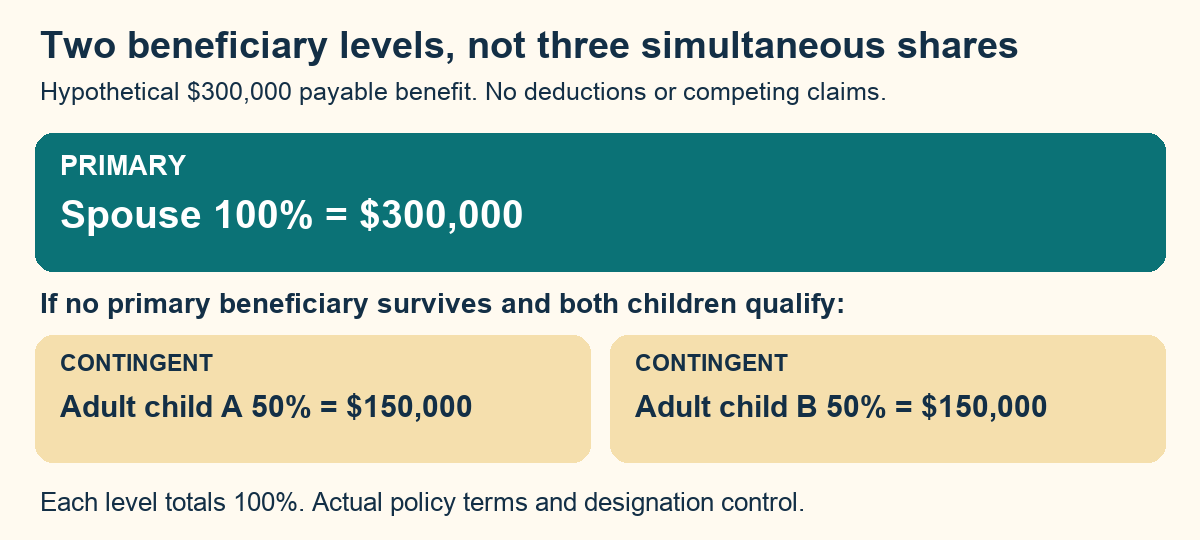
Here is a hypothetical example, assuming a covered death, a $300,000 payable death benefit, no deductions or competing claims, and an accepted designation matching the description. The spouse is the sole primary beneficiary at 100%. Two adult children are contingent beneficiaries at 50% each.
If the spouse survives and qualifies under those instructions, the spouse receives $300,000. The children do not each receive another $150,000. Each contingent beneficiary’s share applies at the backup level, not in addition to the spouse’s share.
If the spouse dies before the insured and both children survive and qualify, the hypothetical benefit is divided into two $150,000 shares. The primary level totals 100%, and the contingent level separately totals 100%. Adding all three names together as though they formed one level would miss the purpose of the designation.
In a different plan, the owner might intentionally name two adult children as primary beneficiaries, each at 50%, with a charity as contingent beneficiary. That is a different instruction. Describe what you want to happen in plain language before filling out the percentages.
Then ask the insurer to explain the result back to you. This is a practical way to check life insurance beneficiary rules without expecting yourself to become a contract specialist.
Life insurance beneficiary rules when someone dies first
Suppose two people share the primary level and one dies before the insured. Does the surviving primary beneficiary receive everything? Does the deceased person’s share pass to descendants? Does another instruction apply? Those are questions for the accepted designation and contract, not guesses based on how a family would prefer to divide things.
Ask the insurer for a written explanation using your actual arrangement. You can say: “We have two primary beneficiaries. Please show us what happens if either one dies first, and what happens if neither survives.” Ask when a contingent beneficiary would become eligible under those same instructions.
You may encounter terms such as per stirpes or per capita, which describe different ways of distributing shares among people or family branches. Do not add a legal phrase because it sounds thorough. Have your attorney explain the intended distribution and confirm that the insurer accepts the wording.
Also ask about any required survival period or provisions for deaths in the same event. A beneficiary who dies before the insured and a beneficiary who survives the insured but dies before payment can raise different questions. Tell the insurer the actual sequence; let the contract and appropriate legal advice resolve the rights.
Who can you name as a life insurance beneficiary?
Depending on the policy and applicable rules, a beneficiary may be a person, a trust, an estate, or an organization such as a charity. An insurer may request additional information or documentation for a particular arrangement. Do not assume a name that fits in an online box is enough to establish a workable designation.
For a person, use the identifying details the insurer requests. For a charity, verify its legal name and identifying information with the organization. For a trust, have the attorney supply accurate identifying language and confirm the trust exists and can receive the benefit.
Fidelity’s term life insurance FAQ provides an example of accepted beneficiary categories and the information its process requires. Different insurers can use different forms and procedures.
Start with the job you want the life insurance money to do. Are you trying to replace income for a spouse, support an adult relative, provide for children, or leave a charitable gift? The recipient and legal arrangement should fit that purpose. A complicated form should not be the first place the family tries to decide what the plan is.
A child’s name needs a plan for an adult to manage the money
Can a life insurance beneficiary be a minor? A child can be named, but a young child generally cannot receive and manage a large payment directly. Naming a child and identifying someone legally authorized to manage the child’s funds are separate tasks.
This matters when a child is a contingent beneficiary too. Naming a spouse as primary and young children as backups can still leave a management problem if the contingent level becomes payable. Review every potential recipient, rather than stopping when the primary beneficiary looks right.
Our guide to naming a minor beneficiary explains custodial and trust considerations in more detail. The appropriate structure depends on the family, governing law, benefit amount, and insurer’s requirements. An estate-planning attorney can help design it.
Naming a trusted adult personally is not automatically the same as naming that person as a custodian or trustee for a child. If you want enforceable instructions about managing someone else’s share, get the legal arrangement right before submitting the insurance form.
Life insurance beneficiary rules do not create a spending plan
An outright adult beneficiary generally receives the benefit for that person’s own use, subject to applicable rights and restrictions. An informal request to “use this for everyone” may not create the legal duties you intended. Talk through the purpose of the life insurance with the people involved, but do not expect a family conversation to carry the whole legal structure.
If your goal is controlled distributions over time, support for someone with a disability, or money managed for several people, discuss the arrangement with an attorney. Receiving assets can also affect some means-tested public benefits. That needs attention before a designation is finalized.
Our life insurance trust guide explains the distinction between a trust receiving proceeds and a trust owning a policy. Trusts can provide useful instructions, but they involve legal drafting, administration, and potential costs. They are not a universal upgrade.
We can help clarify insurance terms and obtain the carrier’s requirements. The attorney designs the legal instructions; qualified tax and benefits professionals address their areas. Keeping those roles clear helps the plan work as intended.
Can you change your primary or contingent beneficiary?
When reviewing life insurance beneficiary rules, start with whether the designation is revocable. With a revocable designation, the authorized owner can generally change the beneficiary by following the policy’s requirements, subject to applicable restrictions. An irrevocable designation gives the beneficiary rights that generally require that beneficiary’s consent to a change. Check the rights attached to each primary or contingent beneficiary before sending a replacement form.
The NAIC insurance glossary describes the consent distinction for irrevocable beneficiaries. A court order, assignment, trust, ownership arrangement, or applicable law may add another restriction. The ordinary online process does not erase those obligations.
Use the insurer’s current form or approved secure online process. MetLife’s policyholder self-service page, for example, distinguishes beneficiary changes from ownership changes and provides forms for different recipient types. Always choose the process for your own contract.
After submission, request confirmation showing the accepted names, levels, shares, and effective information. A saved draft, an uploaded file, and a completed designation are different stages. If something is rejected or incomplete, ask what must be corrected and retain the final confirmation.
Does your will override life insurance beneficiary rules?
Do not assume that signing a new will updates the insurer’s beneficiary record. Life insurance generally follows its valid beneficiary designation, subject to applicable law. Coordinate the will, trust, and insurance instructions with your attorney, then complete the carrier’s process for any insurance change.
The Virginia consumer life insurance guide discusses beneficiary choices and keeping them current. Its Virginia-specific provisions should not be applied automatically to a policy governed by another state’s rules.
Marriage, divorce, a death, or a move can make this coordination particularly important. Do not assume divorce either always removes a former spouse or always leaves the designation untouched. State law, court orders, and the type of coverage can matter. Our separate divorce discussion addresses that more specialized review.
Give the attorney the actual life insurance policy information and current designation, including every contingent beneficiary. A recollection of who was named years ago is not enough. If the attorney recommends a change, ask who will submit it and who will verify completion. An unanswered ownership question should be resolved before signatures are collected.
What if there is no surviving primary or contingent beneficiary?
If a life insurance policy has no effective designation, or no named recipient survives or qualifies, the policy’s default provisions and applicable law determine the next step. Payment may go to the estate. Do not assume that your closest relative, executor, or person paying funeral expenses automatically becomes the beneficiary.
An estate payment may involve probate, the legal process of administering an estate, along with related expenses and delays. Naming the estate can be intentional in a coordinated legal plan. Leaving the form blank because the family will “sort it out” is a different decision.
Ask the carrier: “Under this contract, who receives proceeds if every person on this designation dies before the insured?” Then ask your attorney whether that default fits your estate plan. A contingent beneficiary is useful, but it should still be checked against this last scenario.
This is one reason we prefer reviewing the whole designation on one page. Life insurance beneficiary rules make more sense when you can see both the first choice and the fallback, rather than opening separate screens and hoping they connect.
How much life insurance will a beneficiary receive?
Life insurance beneficiary rules help identify who is entitled to proceeds. The designation alone does not establish that a claim is payable or that the original face amount is the final amount available. Coverage status, policy terms, outstanding loans, prior benefit payments, assignments, and other applicable adjustments or claims can affect the result.
Likewise, naming a beneficiary does not automatically give that person access to the policy’s cash value while the insured is alive. Ownership rights and beneficiary rights are different. Ask which authority is needed for information requests, loans, withdrawals, or changes.
If you are reviewing the amount of protection as well as the recipients, our life insurance needs calculator can help organize income needs, debts, and resources. Its estimate is a planning starting point, not a guaranteed death benefit or a recommendation for a particular product.
What should a life insurance beneficiary know about taxes and claims?
The IRS explains that death proceeds received by a beneficiary generally are excluded from gross income, while interest received is taxable. Exceptions can apply, including certain transfers for value. Estate-tax and other questions require separate analysis; “life insurance is always tax-free” is too broad.
For claims, make sure the intended recipient knows the insurer’s name and where to find the policy records. The NAIC’s beneficiary guidance recommends keeping records accessible to the appropriate people and reviewing beneficiary information regularly. Keep sensitive identifiers secure rather than circulating the complete form among relatives.
A primary or contingent beneficiary entitled to payment must still follow the life insurance company’s claim procedure. Payment options, documentation, timing, and any review depend on the contract and circumstances. Our existing article about locating a policy covers that separate task; this guide’s purpose is to make the designation clearer while there is time to check it.
Check life insurance beneficiary rules for each policy
A designation on one policy does not automatically update another. Make a short inventory of individual coverage and any employer-provided life insurance. Note the company or plan administrator, insured person, owner where applicable, and where the current beneficiary confirmation is stored.
For each life insurance policy, review every primary and contingent beneficiary. Check spelling, identifying details, percentages, and any person who is now deceased, under legal age, or affected by a changed family situation. Employer plans may follow different governing rules and procedures, so use the plan’s own documents.
Keep the inventory useful without turning it into an unsecured collection of private identifiers. A trusted person needs to know how to locate the records. They do not need every sensitive detail in a group message.
Review your primary and contingent beneficiary choices
You do not need to solve every estate-planning question this afternoon. Start by obtaining what the insurer currently has on file. Check who is listed as primary, who is named as a contingent beneficiary, and what happens if a recipient dies first. Compare those instructions with the people and purposes you want to protect.
If the designation needs work, identify whether the question belongs with the insurer, the attorney, or both. Submit changes through the approved process, save confirmation, and set a reminder for an annual check and major life events. A clear record is much more useful than a confident memory.
That is the practical value of understanding life insurance beneficiary rules: the people you intend to help, the instructions on the policy, and the paperwork the insurer can administer all point in the same direction.
About Jay A. Cohen, The Ocala Insurance Guy
Jay A. Cohen is a licensed health and life insurance agent based in Ocala, Florida, licensed in Florida, Virginia, Illinois, Utah, and California.
Our approach is educational: we listen to understand your needs, goals, and budget, then explain your options in plain language. We walk through the benefits, costs, and limitations, welcome your questions, and help you make an informed decision without pressure to buy a particular product.
To explore permanent coverage and available policy options, visit the Jay A. Cohen life-insurance information page. You can also learn more about Jay’s educational approach and insurance experience.
For a general question about life insurance beneficiary rules, use The Ocala Insurance Guy Contact Form. Keep policy numbers, Social Security numbers, and sensitive documents out of the initial inquiry; we can help identify an appropriate next step.
This article provides general educational information, not individualized insurance, legal, tax, investment, or public-benefits advice. Examples are hypothetical. Policy provisions, beneficiary rights, claim procedures, and applicable laws vary by insurer, contract, plan, state, and circumstances. Consult the insurer and qualified legal or tax professionals before making changes involving trusts, estates, minors, restricted designations, or disputed rights. No coverage, claim payment, or tax result is guaranteed.