
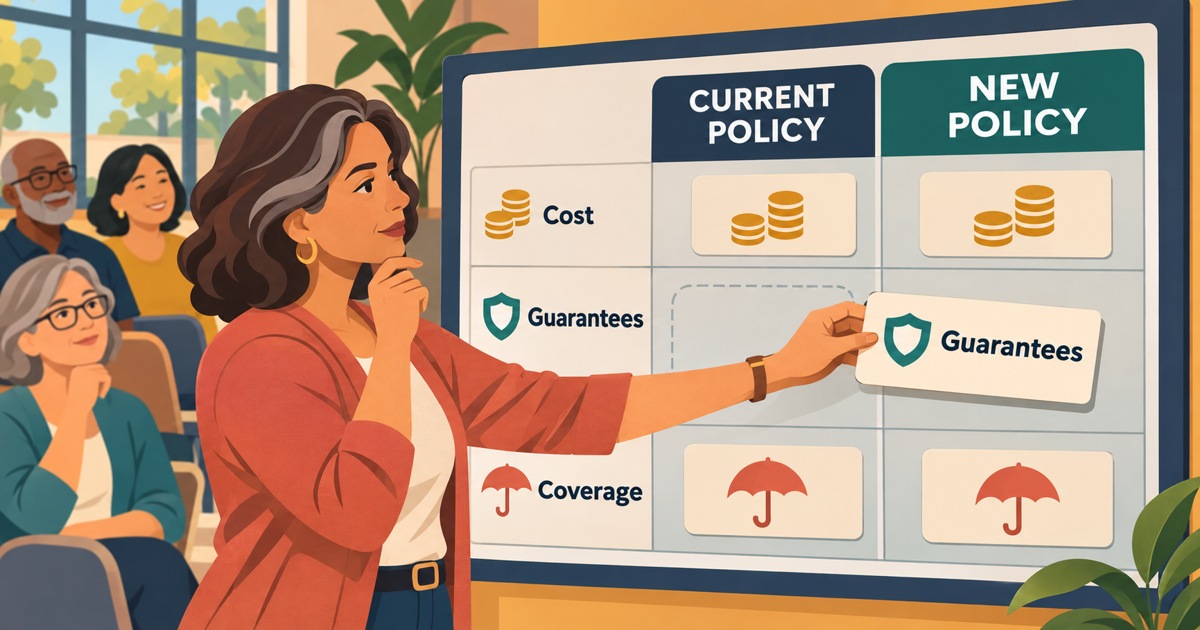
Can life insurance be transferred to another company? Usually, changing insurers means applying for a new policy and deciding what to do with the old one. Your existing contract does not simply move across with its original price, guarantees, and history intact. Some permanent policies may qualify for a properly arranged 1035 exchange of policy values, but that is still a decision about two different contracts.
Life insurance replacement can make sense when your needs have changed or a different policy offers a better fit. It can also give up benefits you would rather keep. Before comparing a new premium with the amount leaving your checking account today, we want to know what you are gaining, what you are losing, and whether the change solves the problem that brought you here.
We will walk through the differences between changing agents, converting coverage, life insurance replacement, and using a 1035 exchange to move policy value. Then we will put the practical questions in an order you can use without turning your kitchen into an insurance filing department.
First, what are you trying to transfer?
The word transfer does a lot of work in this question. You might want better service from a different agent. You might want a lower premium, more coverage, or a policy that lasts longer. Or you may have built cash value and want to move that value into another insurer’s contract. Those are different requests, with different consequences.
A change of servicing agent, when the insurer permits it, generally keeps the existing contract with its issuing company. It does not itself replace your policy. Ask the insurer how agent changes work and whether the proposed agent can service that particular contract. Dissatisfaction with communication does not automatically require surrendering insurance you otherwise like.
A beneficiary change directs who receives the death benefit. An ownership change affects who controls the contract. Neither is the same as changing insurers. Ownership changes can raise legal and tax questions, particularly with trusts or businesses, so use the insurer’s required process and obtain appropriate professional advice before signing.
Write your goal in one sentence before reviewing proposals: “We need affordable protection until the mortgage ends,” or “We want to understand whether our current permanent coverage can remain sustainable.” That sentence becomes the test for every proposed change.
What life insurance replacement actually changes
With life insurance replacement, the new insurer issues a new contract. The old contract may be surrendered, allowed to lapse, reduced, or otherwise changed as part of the transaction. State replacement definitions can extend beyond a straightforward cancellation. Tell the agent how you expect to fund the new coverage and what will happen to every existing policy involved.
The new insurer generally evaluates you under its current underwriting process. Underwriting means evaluating the application and deciding whether to offer coverage and on what terms. Your age, health, tobacco history, requested benefits, and other factors can matter. A shopping estimate is not an approved offer.
The new policy can have different exclusions, riders, premium requirements, guarantees, and early surrender values. A rider is a provision that adds or changes a policy benefit. A familiar benefit name does not establish that the conditions match the benefit in your current contract.
Ask for a written explanation of the proposed improvement. “Newer product” is a description, not a reason to replace coverage. A useful explanation connects the actual contract terms to your goal and identifies the disadvantages as clearly as the benefits.
Does life insurance replacement work differently for term coverage?
Ordinary term life insurance generally does not accumulate cash value to move. To change insurers, you normally apply for another policy. Approval, final pricing, and the new coverage period depend on the receiving insurer. The years you have already paid do not become a transferable account balance.
Compare equal protection periods. An inexpensive ten-year quote is not an even substitute for twenty years of remaining level coverage. Ask what happens when the initial premium period ends, whether renewal is available, and how renewal premiums change. A lower first payment can hide a shorter solution.
Also check your current conversion option. Some term contracts allow conversion to eligible permanent coverage under specified conditions, potentially without new medical underwriting. The available products, deadline, amount, and pricing are controlled by that contract and insurer. Conversion is not a general permission to move a policy to any company.
Our term life insurance conversion guide explains that separate decision. If health has changed, compare the actual conversion option before giving it up. If your coverage need has increased, adding a separate policy may be another possibility rather than replacing everything you already own.
Life insurance replacement: can you transfer cash value?
Permanent policies may build cash value, but the amount shown on an annual statement is not necessarily the amount another insurer will receive. Ask for a current transfer or surrender quote that accounts for outstanding loans, interest, surrender charges, and other applicable adjustments. Identify how long that quote remains valid.
A surrender charge is a contractual charge that may apply when you end or reduce coverage during a specified period. An older policy may be beyond that period, while a new contract can start a new schedule. Review the first several years of accessible values, not just a projection decades away.
Our cash value life insurance guide explains how policy values differ from the death benefit. Sending value to a new policy does not necessarily preserve the same death benefit or create an equal amount of immediately accessible cash. The receiving contract has its own charges and rules.
Before a life insurance replacement, ask the current company for an in-force illustration when available. That is an updated projection of the existing policy under stated assumptions. Compare it with the proposed contract using consistent funding and realistic assumptions. Keep guaranteed values separate from values that depend on future dividends, interest credits, or other nonguaranteed results.
Where does a 1035 exchange fit?
A qualifying 1035 exchange can allow certain insurance contracts to be exchanged without recognizing gain at the time of the exchange. Section 1035 of the Internal Revenue Code includes exchanges of life insurance for other life insurance, among specified permitted categories. It does not provide a general right to move any financial product into any other product.
That tax treatment is separate from whether the new policy is suitable. A qualifying 1035 exchange does not waive surrender charges, eliminate new underwriting, preserve old guarantees, or make a new illustration come true. A tax advantage can be useful while the insurance replacement itself remains a poor bargain.
Ask the receiving insurer and your qualified tax professional to confirm the proposed process before money moves. Do not surrender the policy, deposit the proceeds into your bank account, and assume a later premium payment will be treated as a 1035 exchange. The forms and sequence matter.
The Florida Department of Financial Services annuity overview discusses exchanges involving life insurance values and cautions about receiving distributions directly. Moving life insurance into an annuity also changes the type of protection you own. If someone still needs a life insurance death benefit, that change deserves its own analysis.
Before a 1035 exchange, check loans and tax status
An outstanding policy loan needs its own review before a 1035 exchange. Ask both insurers how the loan would be handled, whether it must be repaid, what amount would actually transfer, and whether the proposed handling could create taxable income. Do not accept a general “1035 means tax-free” answer to an exchange that includes a loan or another complication.
Request the existing policy’s tax basis and tax classification from the insurer. Tax basis is generally the investment in the contract, subject to applicable adjustments. It is not necessarily the cash value. If the policy is a modified endowment contract, often shortened to MEC, flag that status for professional review because it affects taxation of certain distributions and loans.
The IRS’s 2026 guidance on life insurance exchanges and prior policy transfers addresses transfer-for-value and reporting rules. In plain language, a policy’s ownership and transaction history can affect the tax analysis even when an exchange qualifies under Section 1035. Business-owned coverage, ownership changes, or prior transfers need specific review. This article does not determine the tax result of your transaction.
A practical request is: “Please identify the expected transfer amount, basis reporting, loan treatment, required parties, and any anticipated tax reporting.” Keep the insurer’s response with the 1035 exchange paperwork and share it with your tax professional before authorizing an irreversible step.
Compare life insurance replacement costs and guarantees
For life insurance replacement, use a side-by-side worksheet. Start with the current policy as it operates today, rather than comparing an old sales illustration with a new sales presentation. Add the actual offered contract terms once underwriting is complete.
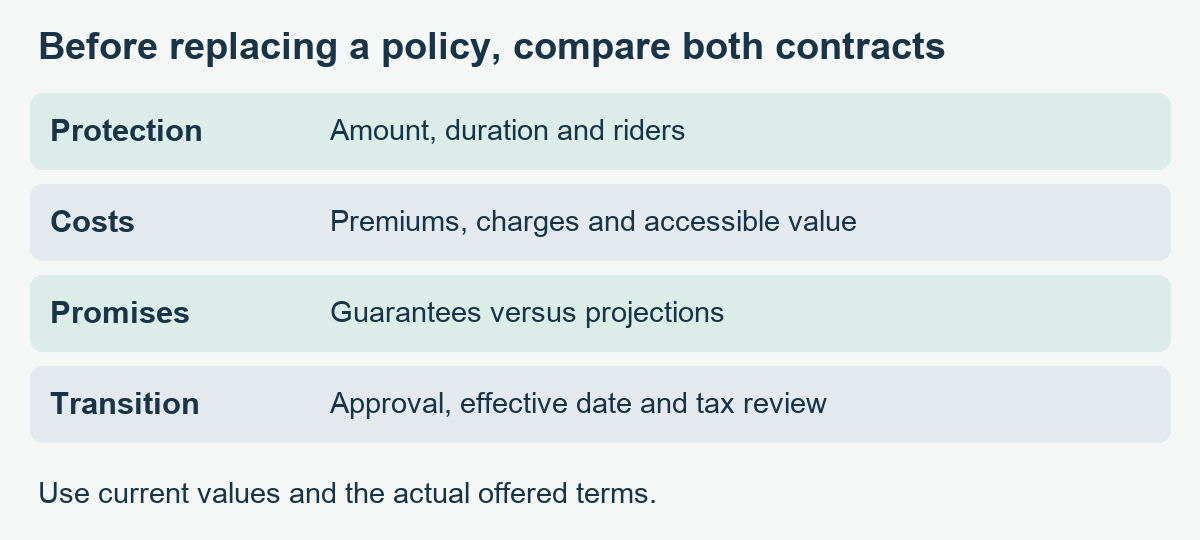
Record the death benefit, duration of protection, required premiums, current accessible value, surrender schedule, loan provisions, and riders. Identify which amounts are guaranteed and what must happen to maintain those guarantees. If the proposed premium is described as flexible, ask how paying less affects future values and continued coverage.
Review the beginning of the new contract carefully. New contestability and suicide provisions may apply, subject to state law and the transaction’s terms. Contestability concerns the insurer’s ability to investigate and challenge certain claims under applicable rules; it does not mean every claim during that period will be denied. Obtain the actual language and any applicable replacement protections.
California’s consumer life insurance guide discusses the importance of evaluating changes and replacement costs. Its state-specific rules should not be assumed to apply everywhere. The practical comparison is useful across states, while the contract and applicable state requirements determine your rights.
A lower premium can still buy a different solution
Here is a hypothetical example, not a quote or recommendation. Suppose your existing policy costs $150 a month and a proposal costs $110. That is $40 less each month, or $480 over twelve months. Those calculations describe premium savings only. They do not establish the overall benefit of replacing the policy.
Perhaps the current policy has a guaranteed premium for fifteen more years and the new quote guarantees its price for ten. Perhaps the death benefit is smaller, a useful rider is missing, or the new premium depends on assumptions that can change. Any of those differences can matter more than the first year’s savings.
For a cash value contract, also compare the amount lost to any existing surrender charge and the new policy’s early accessible values. If $2,000 would be lost to a surrender charge, dividing that amount by $480 gives a little over four years of the illustrated premium difference. That simple arithmetic ignores benefit differences, policy charges, taxes, interest, and future changes; it is not a break-even analysis.
We prefer to ask, “What does the extra or reduced spending buy over the period we need protection?” That question makes room for both a worthwhile improvement and a good reason to keep the present policy.
Check alternatives inside your current policy
A life insurance replacement is one possible response to a problem, not the only response. Ask the existing insurer whether an allowed benefit reduction, rider change, payment adjustment, or other contractual option addresses your concern. Request the consequences in writing, including effects on guarantees and future flexibility.
Some permanent policies have nonforfeiture options, which are ways to use accumulated value for specified benefits when regular premium payments stop. Availability and results depend on the contract. Ask for a current quote rather than assuming a reduced paid-up option will preserve the original death benefit.
If you need more protection, compare supplementing the current coverage with replacing it. Our guide to multiple life insurance policies explains that separate coverage can serve different needs. Additional insurance still requires appropriate disclosure and the insurer’s approval.
If you need less protection, revisit the purpose before buying another large policy. The life insurance needs calculator can help organize debts, income needs, and available resources. It provides a starting estimate, not a product recommendation or replacement determination. Use it alongside a household budget and current policy information.
What Florida replacement paperwork is meant to do
Florida’s approved replacement forms rule identifies the Notice to Applicant Regarding Replacement Life Insurance and Comparative Information Form. The state’s replacement notice encourages applicants to obtain information from both companies and explains the option to request comparative information.
Treat that paperwork as part of the decision, not a stack to sign after the decision has already been sold. Identify the existing policies accurately, ask for missing comparisons, and keep copies. A completed form does not prove that replacement is beneficial; it helps bring the relevant facts into view.
Requirements vary by state and transaction. Tell the agent where you reside and who owns the current policy. If a trust, business, assignment, or another person’s ownership is involved, identify that early. The insured person is not automatically the person authorized to surrender or exchange the contract.
Never leave blanks for someone else to fill in later or describe a replacement as unrelated new coverage to avoid the process. Ask what the form means before signing. A careful explanation should make the decision easier to understand.
Coordinate the change before ending existing protection
Do not end the existing policy based on an application, preliminary quote, or reassuring email. Confirm the new policy has been issued, examine it, find it acceptable, and verify all requirements for coverage to take effect. Florida’s replacement notice specifically warns against terminating the old policy before issuance and examination of the new one.
Confirm the actual offer, initial payment, effective date, delivery requirements, and any remaining conditions. Ask how the new policy’s review or free-look period works under the applicable rules. If a 1035 exchange requires action on the old contract, get the sequence explained by both insurers before authorizing it.
Do not assume returning a new policy automatically restores the old one. Ask what happens to transferred values, fees, and prior coverage if you change your mind. Keep premium arrangements current as instructed during the transition, and confirm any final cancellation or transfer has actually been processed.
Review the issued contract’s owner, insured, beneficiaries, riders, and payment instructions. Then keep a concise record showing what ended, what began, and where future notices will go. The paperwork should tell one consistent story.
Keep the comparison useful when an offer changes
Underwriting can change the proposal you first reviewed. If the final premium is higher, the benefit is lower, or a rider is unavailable, update the worksheet before deciding. Do not carry forward a conclusion based on the original estimate. Ask whether the reason for life insurance replacement still holds under the actual offer.
Similarly, if the current insurer provides an updated option, put that in a separate column rather than mixing it into the old figures. Date each version and identify who supplied it. This keeps a reasonable comparison from becoming a collection of numbers that were never offered together.
Bring a clear question to the comparison
Before proceeding with life insurance replacement, ask yourself: Have we identified the problem, obtained current values, compared guarantees, understood underwriting, reviewed any 1035 exchange and other tax questions, and coordinated the coverage dates? If an important answer is missing, that is the next piece of work.
Changing insurers may improve your coverage. Keeping the existing contract may be the better decision. We want the reasoning to be clear enough that you can explain it in your own words. Send your general comparison question through The Ocala Insurance Guy Contact Form. Keep policy numbers, medical records, and other sensitive documents out of the initial inquiry; we can identify an appropriate next step.
About Jay A. Cohen, The Ocala Insurance Guy
Jay A. Cohen is a licensed health and life insurance agent based in Ocala, Florida, licensed in Florida, Virginia, Illinois, Utah, and California.
Our approach is educational: we listen to understand your needs, goals, and budget, then explain your options in plain language. We walk through the benefits, costs, and limitations, welcome your questions, and help you make an informed decision without pressure to buy a particular product.
To explore permanent coverage and available policy options, visit the Jay A. Cohen life-insurance information page. You can also learn more about Jay’s educational approach and insurance experience.
For questions about life insurance replacement, use The Ocala Insurance Guy Contact Form.
This article provides general educational information, not individualized insurance, legal, tax, or investment advice. Examples are hypothetical. Policy benefits, underwriting, guarantees, exchange eligibility, tax treatment, and replacement requirements vary by contract, insurer, state, and circumstances. Consult the insurers and qualified legal or tax professionals before replacing, surrendering, exchanging, or changing ownership of a policy. No approval, savings, or tax result is guaranteed.