

What happens when term life insurance expires? The answer depends on what is ending: your guaranteed price, your right to renew, or the coverage itself. Term life insurance renewal lets some policies continue at a higher premium. Others end unless you arrange new coverage. A conversion option, if your policy includes one, may have a deadline that arrives before either date. The next step starts with the life insurance coverage your household still needs, rather than the renewal bill alone.
That distinction matters. A notice about the end of a 20-year level premium does not always mean you become uninsured that day. It also does not mean the familiar payment will buy another 20 years. Before changing an automatic payment or putting the letter aside, find out exactly what your contract says.
We can help you organize the questions through The Ocala Insurance Guy Contact Form. Start with the policy type, the date on the notice, and what you still need the coverage to do. Please do not send Social Security numbers or medical records through a general inquiry form.
What happens when term life insurance expires: the short answer
Term life insurance provides a death benefit for covered deaths while the policy is in force. A level-premium period is the stretch during which the scheduled premium stays the same under the contract. The policy’s final termination date can be a different date. Your first task is to separate those two ideas.
The National Association of Insurance Commissioners’ life insurance overview explains that some term policies permit renewal even after health changes, with higher premiums and age limits that must be checked. A nonrenewable contract does not offer that same continuation right. Your actual policy determines which arrangement you have.
Picture two envelopes. One says the guaranteed premium period is ending and provides a renewal schedule. The other says coverage terminates on a stated date. Those messages deserve different responses, even if both get described around the kitchen table as “our term insurance is expiring.” Read the dates and provisions before comparing prices.
The useful question is not simply “Does it expire?” Ask: “What ends, on which date, and what choices remain before then?”
Find these three dates before you make a decision
Put the policy schedule, recent notice, and any riders together. A rider is an addition that changes a policy’s benefits or terms. Use the insurer’s current written confirmation if an amendment has changed something since the original contract was issued. An old sales summary is not enough.
End of the level-premium period
when the current guaranteed payment schedule changes.
Conversion deadline
the last date an eligible owner can exercise the contract’s conversion right.
Final coverage or renewal age limit
when the policy can no longer continue under its terms.
For term life insurance renewal, also record the next payment due date and the amount due. A decision deadline and a payment deadline may be different. If you are comparing alternatives, identify what payment keeps the current coverage active while you do that work. Do not assume an application elsewhere changes your existing obligations.
For an Ocala household with several policies, make one row for each contract. A policy on one spouse may have a different anniversary, conversion provision, and premium schedule from the other spouse’s policy. Treat each notice separately rather than making one cancellation decision for the whole household.
Term life insurance renewal: keeping the existing policy
Term life insurance renewal means continuing coverage under a renewal provision in the existing contract. It is different from applying for a brand-new level-term policy. The practical attraction is continuity. The practical question is whether the next payment, and the payments after that, fit your budget. Ask for the term life insurance renewal premium schedule in writing. Look beyond the first month or year. If payments increase annually, a manageable first renewal payment may be followed by much larger payments later. Compare the full period during which you expect to need insurance, rather than judging one bill in isolation.

Florida’s Department of Financial Services life insurance FAQs specifically identify the end of a guaranteed term period and renewal at a higher rate as a possible reason for a sudden premium increase. That explanation helps you recognize the issue; it does not establish the price or options in your policy.
Term life insurance renewal may deserve particular attention when health has changed or you need a temporary bridge while another application is evaluated. That does not make it automatically affordable or the best long-term choice. Confirm eligibility, duration, benefits, and all required payments before relying on continuation.

THE OCALA INSURANCE GUY · HOUSE AD
Still expecting cover?
An old premium does not tell us whether life insurance coverage continues. Before the next storm, check the policy dates and any term life insurance renewal rights. A higher renewal bill and an actual termination notice mean different things. The tiny umbrella makes the point: know what protection you still have.
Term life insurance renewal or a new policy?
A new policy starts with a new application. The insurer evaluates the information its process requires, which may include health, prescriptions, finances, occupation, and other factors. A quote is an estimate based on stated assumptions. It is not the same thing as an issued policy with an accepted premium.
Compare the amount you need now and the years you need it. You may no longer need the same benefit you bought when your children were young. On the other hand, a later mortgage, a dependent parent, or a business obligation may have extended the period during which someone relies on you. Put a new-policy quote beside the full term life insurance renewal schedule for the years you need protection. Compare accepted coverage and contractual rights, keeping any tentative price clearly labeled.
New life insurance coverage can involve current-age pricing, underwriting, exclusions, and different contractual rights. Even a policy advertised without an exam still has eligibility rules. Our guide to life insurance with no medical exam explains why skipping a physical examination does not mean automatic acceptance.
Keep the existing coverage in force while exploring replacement. Before ending it, verify that the new policy is issued, accepted, paid as required, and actually effective. Review the replacement’s advantages and disadvantages, including applicable new contestability or suicide provisions. Our life insurance replacement guide covers that comparison in more detail.
Conversion: a separate route with a separate deadline
A conversion privilege may let you exchange eligible term life insurance coverage for an eligible permanent policy without new evidence of insurability, subject to the contract. Permanent life insurance is designed for longer-lasting protection when its funding and other requirements are met. Conversion does not mean that premiums disappear or every available permanent product becomes an option.
The important word is eligible. Ask which products are available, whether partial conversion is allowed, what premium applies, and what must be received by the deadline. Do not assume the conversion window lasts as long as the term policy. Our existing term life insurance conversion guide walks through that process.
Here, the broader decision is whether a lasting need exists. A family might need a smaller permanent benefit for a lifelong dependent while retaining temporary protection for income replacement. Another household may need only a few more years of coverage. Those needs point to different comparisons; neither makes conversion a universal answer.
Protective’s explanation of options at term expiration discusses new coverage, combinations of policy types, and possible partial or full conversion. It also emphasizes checking dates before expiration. These are general possibilities, not a statement that any particular carrier or contract offers all of them.
Recalculate the life insurance coverage you still need
Before choosing the next product, calculate the financial gap a death would leave today. Life insurance coverage is useful when it addresses a real obligation or a deliberate legacy goal. Buying the original amount again simply because it looks familiar skips the most important part of the review.
List ongoing household expenses, debts you want addressed, dependent support, education goals, and final expenses. Then identify resources genuinely available to survivors. Be careful with assets that are jointly needed for retirement, difficult to sell, or already committed to another purpose. Counting the same money twice makes a plan look stronger than it is.
Our Life Insurance Needs Calculator can help organize those assumptions. Treat the result as a starting estimate, not a guaranteed recommendation or an insurance quote. Change the inputs to see which assumptions matter most, then review the reasoning rather than focusing only on the final number.

Who replaces the unpaid work?
Include unpaid work, too. If someone handles child care, transportation, caregiving, or household management, replacing that work may cost money or reduce another person’s work hours. A household’s need for life insurance coverage does not depend only on whose name appears on the larger paycheck.
Life insurance coverage: a household example
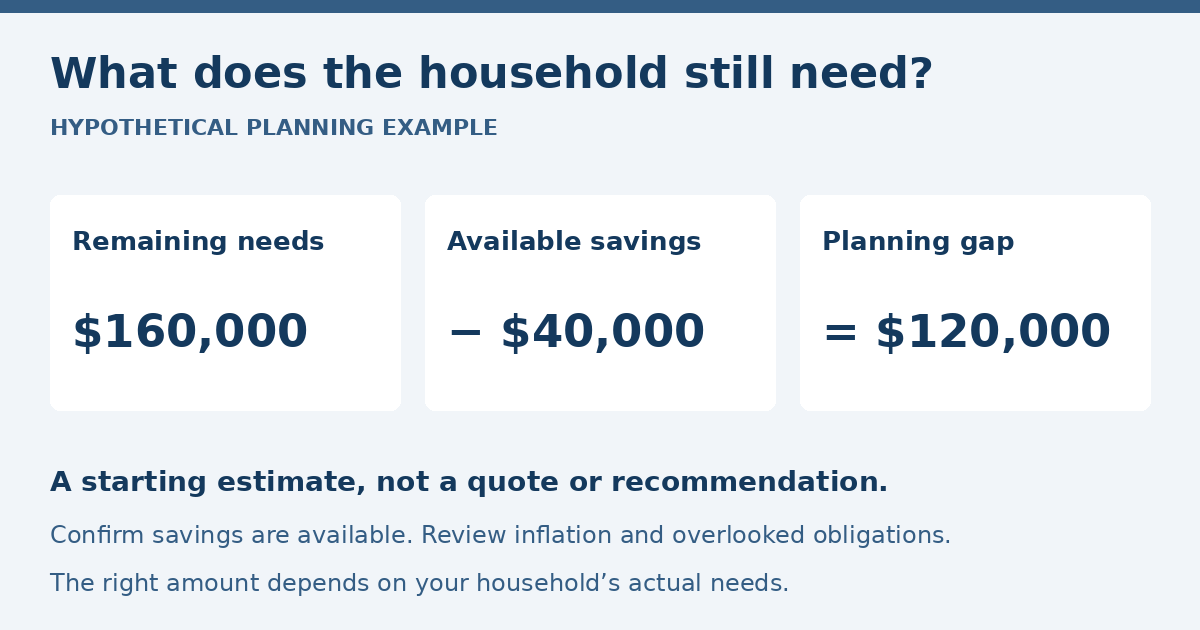
Suppose a household originally bought $500,000 of term coverage to support a young family. Years later, the children support themselves and the mortgage is smaller. For this hypothetical example, the household identifies $160,000 in remaining support and final-expense needs, with $40,000 of savings specifically available for those purposes.
The arithmetic suggests a $120,000 planning gap: $160,000 minus $40,000. That is an illustration of the method, not a recommendation, market quote, or promise of eligibility. The household would still need to examine whether the savings are really available, whether inflation matters, and whether important obligations were overlooked.
Next, compare ways to address that gap. Would term life insurance renewal cover the remaining years at a sustainable cost? Would a new policy match those years of need? Does a smaller permanent need justify considering conversion? Are the premiums sustainable? Comparing those questions is more useful than automatically replacing $500,000 with another $500,000.
A different household could reach the opposite conclusion. If a spouse relies on income for many more years or a dependent needs lifelong support, the original amount might be inadequate. What happens when term life insurance expires is partly a contract question and partly a household planning question. Both deserve an answer.
Can you simply let coverage end?
Yes, allowing life insurance coverage to end may be reasonable when the financial need has ended and you understand the consequences. Insurance is a tool, not a subscription you must keep forever. The decision should come from a review of survivor needs and available resources, rather than frustration with a renewal notice.
Ask what happens to the surviving household’s budget after one person’s death. Retirement income may change. Some expenses remain almost unchanged. Assets that look sufficient for two people today may have a different role for one survivor. Check the actual benefit arrangements instead of assuming every income source continues at the same amount.
Standard term insurance generally does not accumulate cash value or return premiums merely because you outlive the term. A return-of-premium feature, if purchased and applicable, has its own contractual conditions. Confirm the policy type before expecting a check. Ending coverage is not the same transaction as cashing out a permanent policy.
Document the choice and the effective date. If you decide coverage is unnecessary, make sure anyone who relies on the household plan understands that the death benefit will no longer be available. A deliberate decision should not leave a spouse searching for a benefit everyone assumed still existed.
Life insurance coverage after health changes
Begin with existing contractual rights before assuming a new application is the only path. Health changes can affect new underwriting, but an eligible renewal or conversion provision may work differently. Confirm those rights directly against the current contract. Do not discard an option before understanding what you already own. Compare the written term life insurance renewal premiums with any remaining conversion option before deciding which life insurance coverage you can sustain.

Be candid on new applications. Guessing at dates, minimizing treatment, or leaving questions incomplete can create problems. If a question is unclear, ask how to answer accurately and obtain the necessary records. A faster-looking application is not useful if important information has been omitted.
Compare affordability over time. Preserving a benefit through conversion may be valuable, but a premium you cannot sustain can create a later problem. Ask about guaranteed requirements, values that depend on assumptions, policy charges, and lapse risk for any permanent option. An attractive illustration is not a guarantee that the illustrated result will occur.
If deadlines are close, identify the immediate decisions separately from the long-term plan. You may need a written explanation of continuation rights and the next payment before finishing a broader comparison. Do not assume that discussing options with an agent extends any carrier deadline.
Build a calendar that leaves room for decisions
Start reviewing well before the earliest relevant deadline. Several months can give you more room to locate documents, ask questions, compare options, and complete underwriting where needed. That is a planning suggestion, not a promise about how quickly an insurer will act. Some situations require substantially more time.
Work backward from the actual contract dates. Record when a completed conversion request must arrive, when the next premium is due, and when a new policy would need to be effective. Ask whether the insurer requires additional forms or payment with an election. Sending an inquiry is not necessarily exercising a contractual right.
Keep copies of submitted forms and written confirmations. If ownership has changed, confirm who is authorized to act. The insured person, policy owner, premium payer, and beneficiary can be different people. Good intentions do not substitute for the owner’s signature when the insurer requires it.
Once the decision is complete, review beneficiaries and household records. A new policy should not disappear into an inbox nobody else knows about. Keep insurer information and policy location accessible to the people who need them, while protecting sensitive identifying information.
Keep life insurance coverage active while you compare
An automatic bank draft can make a premium change easy to miss. Compare the insurer’s notice with the next scheduled withdrawal, and check that your payment authorization still works as intended. Do not reduce or stop a payment merely because an online quote looks better. First establish what that action would do to current coverage.
Review attached benefits separately. A child rider, waiver benefit, or other addition may have an earlier ending age or different continuation terms. Keeping the main policy does not necessarily keep every rider. Ask for a written explanation of what remains, what ends, and whether any separate election is available.
If the notice has already passed, obtain the current status immediately. Do not assume the policy is active because money recently left your account, or assume it has ended because an anniversary passed. Ask the insurer to confirm the effective dates of your life insurance coverage, payment status, and any remaining contractual choices. The response determines which decisions are still available.
THE OCALA INSURANCE GUY · HOUSE AD
A quote is not a parachute.
An empty box marked “new parachute” is a poor substitute for the packed one. A new-policy quote is only a possibility, too. Keep existing life insurance coverage in force while you confirm that its replacement is issued, accepted, paid as required, and effective. Then compare the actual benefits and limitations.

Questions about term life insurance renewal
- Is the level-premium period ending, or is the policy itself terminating?
- What will term life insurance renewal cost this year and in later years?
- What is the final renewal age or date?
- Does any conversion right remain, and what exactly must arrive by its deadline?
- How much life insurance coverage does the household still need, and for how long?
- What changes if a new application receives a different price or is declined?
- What payment keeps the existing policy active while we compare choices?
- Which guarantees, benefits, and limitations would change under a replacement?
Request answers tied to the actual policy, rather than a general product description. If an answer depends on underwriting, say so in your notes. If a price is only a quote, label it that way. Clear labels prevent tentative possibilities from turning into assumptions that guide a cancellation.
Make the next step fit the need
What happens when term life insurance expires should not be a last-minute surprise. Separate the dates, check existing rights, and measure today’s need. Term life insurance renewal, new coverage, conversion, or a planned end to coverage may each deserve consideration depending on the contract and household.
We can help you compare the questions through The Ocala Insurance Guy Contact Form. Tell us what the notice says and what you want your life insurance coverage to accomplish. We will help you understand the options and the information needed for a useful review, without assuming that a new policy is the answer.
About Jay A. Cohen, The Ocala Insurance Guy
Jay A. Cohen is a licensed health and life insurance agent based in Ocala, Florida, licensed in Florida, Virginia, Illinois, Utah and California.
Our approach is educational: we listen to understand your needs, goals, and budget, then explain your options in plain language. We walk through the benefits, costs, and limitations, welcome your questions, and help you make an informed decision without pressure to buy a particular product.
To explore permanent coverage and available policy options, visit the Jay A. Cohen life-insurance information page. You can also learn more about Jay’s educational approach and insurance experience.
For help with your questions, use The Ocala Insurance Guy Contact Form.
Educational information only; not individualized insurance, legal, tax, or investment advice. Availability, renewal and conversion rights, underwriting, premiums, benefits, exclusions, and deadlines depend on the actual contract, insurer, and applicable state rules. Guarantees depend on the issuing insurer’s financial strength and claims-paying ability. Review the current policy and obtain written confirmation before changing coverage.