

How much does an IUL actually cost? Indexed universal life insurance cost involves more than the premium you send each month. That payment supports life insurance protection, policy charges and potential cash value. To judge whether a proposal fits, we need to know what is deducted, what remains available and how long the funding plan is expected to work.
We’d start with three questions: What job should this coverage do? What can you comfortably pay over time? And what happens if the illustrated results don’t arrive? Those questions connect indexed universal life insurance cost with your household’s actual needs. They also keep an attractive projection from becoming the whole conversation before you understand the contract.
An IUL is permanent life insurance with interest crediting linked in part to an external index under the policy’s formula. It isn’t direct ownership of stocks. There isn’t one useful price for everyone: age, underwriting, coverage amount, design and funding all matter. We’ll walk through the comparison without pretending a generic online number is your quote.
Have a question about your own coverage while you read? Use our Contact Form and we’ll help you sort through it.
Indexed universal life insurance cost: beyond the monthly payment
Think about the difference between putting gas in a car and paying for the whole trip. Fuel is a visible payment; maintenance and other costs still matter. The analogy has limits, but it helps explain indexed universal life insurance cost: the amount going in is different from the amounts deducted inside the policy.
Your premium is the money you pay the insurer. A planned premium is a funding schedule used for the proposed design. It doesn’t automatically mean that amount guarantees coverage for life. Ask which payment requirements are contractual, which depend on assumptions, and what could require additional funding later. We can help separate those answers.
Two proposals can show the same payment and different protection, charges or projected duration. One may assume more favorable interest credits. Another may include different benefits. Indexed universal life insurance cost only becomes a useful comparison when the underlying job and assumptions match. A smaller number on the first page doesn’t settle the decision.
Instead of asking for an average, ask for a written proposal based on your circumstances. Identify the insured person, requested benefit, underwriting assumptions, premium schedule and intended coverage duration. Keep a copy of the full illustration. A quote subject to underwriting can change; the insurer’s eventual offer and contract determine the available terms.
Start with the protection you need
Before reviewing indexed universal life insurance cost, tell us who needs the death benefit and for how long. Is the goal income replacement while children grow up, a lasting family responsibility, or another legitimate insurance need? Different jobs can justify different coverage. Buying permanent protection deserves a reason beyond an appealing cash-value picture.
Would you still want the death benefit if the illustrated cash value grew more slowly? That question helps separate an insurance need from enthusiasm about a projection.
Our life insurance needs calculator can help organize income, obligations and available resources. Its output is a planning starting point, not an underwriting offer. Use it to frame the amount you want to discuss, then check the assumptions against your family and existing benefits before choosing coverage.
A couple wants enough life insurance to get their kids through school, and every dollar in the monthly budget already has a job. They should compare suitable term protection alongside permanent options. That doesn’t prejudge the answer. It makes indexed universal life insurance cost part of a real choice about protection, duration and affordability, rather than a contest between illustrations.
Can that payment survive an ordinary month?
A grocery budget has to work during an ordinary expensive week, not just the week everything is on sale. The same practical test belongs in an indexed universal life insurance cost review. Consider your reserve, other essential insurance and existing commitments. We can help identify a sustainable premium range before comparing proposals, so the policy doesn’t crowd out money you need readily available.

Policy charges are the deductions that support the contract and its benefits. Ask for a clear explanation of each category in the actual proposal. Don’t assume every IUL has the same fee schedule or that a charge with a familiar name works identically across insurers. The written policy and illustration deserve the attention.
Common categories include deductions from premiums, administrative expenses, coverage-related charges and cost-of-insurance charges. Optional riders and certain account features may add costs. As an example of product-specific disclosure, Pacific Life’s client guide lists several such charges. It illustrates what to look for rather than quoting your situation. Your proposed contract may use different names, amounts and conditions.
The useful indexed universal life insurance cost question is where each deduction appears and whether it can change within contractual limits. Ask which charges apply now, which may apply later and where maximum charges are shown. Have the insurer’s documents open while discussing them; a broad description of fees is no substitute for the specific schedule.
Policy charges: follow the money inside the policy
Cost of insurance is a particular charge for the death-benefit protection. It is not another name for the entire premium. Its calculation can depend on the insured’s age, underwriting and the amount at risk under the policy. Ask how it develops over time and how the chosen death-benefit design affects the calculation.
That distinction matters because a level planned payment doesn’t imply level internal deductions. A policy can draw on accumulated value to help meet ongoing costs. In your indexed universal life insurance cost review, ask what happens when deductions and credited interest differ from the original assumptions. The answer needs to extend beyond the early policy years.
Also distinguish a charge deducted today from a surrender charge that may apply when you end coverage during a specified period. Both matter, but they affect different decisions. Compare continuing the policy, reducing coverage and leaving it using the insurer’s current figures. Don’t add unrelated numbers together and label the result an annual fee.
If a rider sounds useful, ask what qualifies for its benefit, what it excludes and how its cost is reflected. A rider is a provision that changes or adds benefits. Some features have separate charges; others affect benefits differently. Indexed universal life insurance cost should include the options actually proposed, not a stripped-down version you wouldn’t buy.
Ask for a walkthrough rather than a claim that charges are negligible because illustrated values look large later. You should be able to identify what you pay, what is deducted and what could be available at meaningful dates. We can help organize those questions and request the relevant carrier information for the proposal being considered.

THE OCALA INSURANCE GUY · HOUSE AD
That’s just the brush.
A tiny paintbrush may be inexpensive, but it doesn’t tell you what finishing the wall will take. A small starting payment can leave the same unanswered question about insurance funding. We can review indexed universal life insurance cost across the intended coverage period, explain the proposed schedule and identify which future outcomes depend on assumptions before you commit.
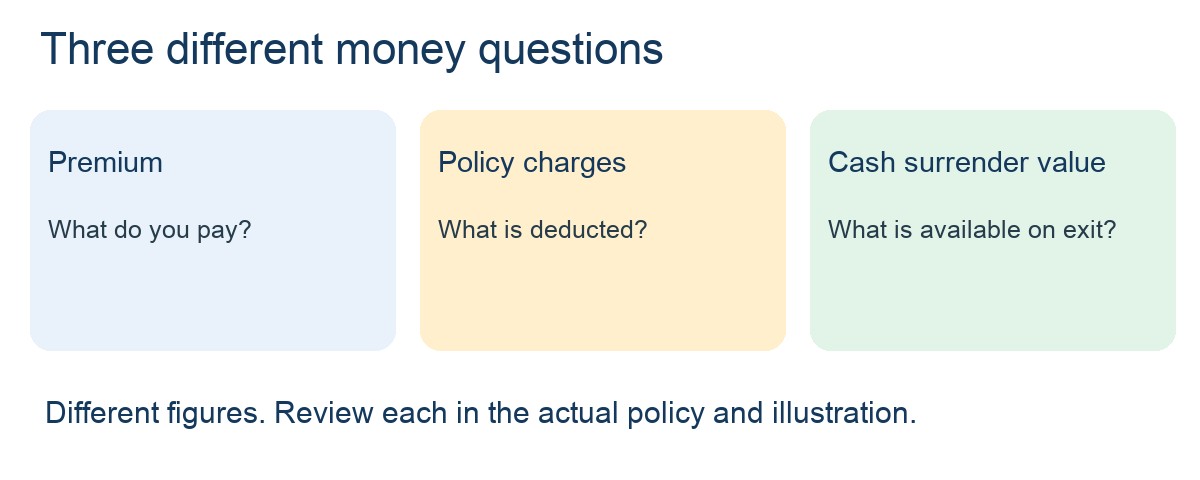
The premium is what you send. Policy charges are what the contract deducts. Ask to see both.
Why the same death benefit can produce different costs
Underwriting is the insurer’s evaluation of an applicant and requested coverage. Age, health history, tobacco use and other application factors can affect the offer. We can help coordinate accurate information and explain the process. We can’t promise a particular classification, approval or price, and an illustration based on an assumed class is not a final offer.
Say you and a friend are the same age and apply for the same amount of coverage. The insurer puts you in different underwriting classes. Their indexed universal life insurance cost may differ even before funding choices enter the discussion. Comparing one person’s price with a friend’s premium misses that difference. Use proposals based on your own application facts and clearly identified assumptions.
Design matters, too. A proposal emphasizing a death benefit may use a different funding approach from one seeking substantial cash value alongside protection. Our fully funded IUL guide examines funding labels and limits in detail. Here, the cost question is what your particular design asks you to pay and what that commitment is intended to support.
More premium is not automatically better. It must fit the insurance purpose, budget, contract and applicable tax limits. Changes can affect the policy’s tax treatment, so request carrier calculations and appropriate tax guidance before making major funding changes. We can explain the insurance proposal while your tax professional addresses your individual tax position.
Promises and projections belong in different folders
Payment timing also belongs in the comparison. A plan funded over several years and one funded for decades are different commitments, even if a selected illustration year looks similar. Ask about total planned outlay and the effect of missed or delayed payments. Indexed universal life insurance cost should be understood as a schedule, not an isolated first installment.

Keep the guaranteed and nonguaranteed parts of the illustration separate, much as you would keep a signed commitment separate from a hopeful forecast. Ask which benefits and values the contract promises, subject to its conditions, and which are illustrations. Indexed universal life insurance cost deserves that distinction even when the projected column looks reassuring. The NAIC’s illustration overview explains why both types of elements appear.
An illustration shows values under stated assumptions. It is useful for understanding how a proposed design behaves, but it is not a forecast of your actual results. In an indexed universal life insurance cost comparison, ask for a less favorable illustrated scenario as well as the proposed one. Then discuss the practical consequences of the differences.
Ask a direct question: if credited interest is lower than illustrated, what changes? Depending on the contract and circumstances, additional premium, a benefit adjustment or another action may be needed. Don’t assume the original payment schedule solves every future condition. Have the agent identify any no-lapse guarantee separately and explain its precise payment and timing requirements.
A no-lapse guarantee, where offered, may keep coverage in force under specified conditions even when policy value is insufficient. It is not permission to disregard the contract’s requirements. Ask how late payments, withdrawals, loans or benefit changes affect it. When reviewing indexed universal life insurance cost, distinguish the premium supporting that guarantee from other suggested funding amounts.
What a zero-percent floor actually protects
The index-crediting formula determines how an index’s performance influences interest credited to the policy. Caps, participation rates and spreads can limit the calculation, depending on the account. A cap limits an included gain; participation determines the portion used; a spread subtracts an amount in the formula. Ask which terms can change and what limits apply.
A floor in the crediting formula doesn’t erase policy charges. Picture a doorway that keeps one kind of weather out while the household bills still arrive. It’s a limited analogy, but useful: a zero-percent index credit is not a promise that net policy value stays level. Indexed universal life insurance cost continues to matter during a year with little or no credited interest.
Suppose your account earns zero index interest for the year. The policy can still make its usual deductions, and the value can go down. That is different from losing money through direct stock ownership, but it is still a reduction you need to understand. Ask the insurer to demonstrate that situation using the proposed contract, without assuming every account or crediting period works alike.
Don’t compare a gross illustrated crediting rate with an investment’s net return and assume they mean the same thing. Our IUL IRR report guide explains another way to examine illustrated cash flows. For this indexed universal life insurance cost review, keep payments, deductions, available values and protection visible together before interpreting a percentage.
Cash surrender value: what could you take home?
Cash surrender value is generally what remains available on ending the policy after applicable surrender charges and policy debt are accounted for. Confirm the insurer’s exact definitions. It can differ from the account value displayed elsewhere. That difference belongs in an indexed universal life insurance cost discussion whenever there is a chance you may need the money early.
Say you open your statement and see the account value. How much of that could you actually walk away with? Before you count on that money, ask what you’d receive if you surrendered the policy and what that could mean at tax time. This is why an emergency reserve outside the policy matters: access to insurance value has conditions and may affect protection.
Think of the difference between the advertised price of a house and the amount a seller would receive after settling the mortgage and transaction expenses. Insurance mechanics are different, but the basic question is familiar: what would actually be available? Cash surrender value answers a more practical exit question than an attractive account-value figure alone.
Don’t assume a policy can serve as both long-term protection and unrestricted short-term spending money. Identify when you might need access, how much flexibility the contract permits and how a distribution changes the plan. If early liquidity is essential, that fact can alter the coverage choice before you ever compare projected later-year values.

Give the contract a regular checkup
Loans and withdrawals are separate ways of accessing policy value, with separate effects. Policy loans accrue interest and can reduce the benefit payable; withdrawals can reduce values and protection. Heavy use may increase lapse risk. Before relying on future distributions, request an updated illustration and tax guidance. Indexed universal life insurance cost includes understanding those consequences, not just the original premium.
Routine maintenance is easier to plan than a surprise repair. A long-term insurance plan deserves regular attention, too. Review the annual statement, actual payments, deductions, credited interest and current benefit. We can help identify questions for an updated in-force illustration, meaning a projection based on the policy already in force, so indexed universal life insurance cost is reviewed using current information.
Don’t wait for a warning notice to open the statement. The Wisconsin insurance regulator’s universal-life alert explains how changing experience can create funding problems and recommends ongoing review. Its general explanation is useful beyond Wisconsin; your policy and issuing state’s requirements still govern. Ask what payment supports your intended duration under current assumptions.
Before comparing indexed universal life insurance cost across proposals, align the insured information, death benefit, benefit option, payment schedule and intended duration. Identify riders and crediting assumptions. Ask each insurer for comparable information rather than comparing one policy’s most favorable illustration with another policy’s guarantee. If the bases differ, label the difference instead of declaring a winner.
Compare indexed universal life insurance cost on the same footing
Choose several dates that matter to you, such as the end of planned payments or a likely need for access. At each date, compare cumulative premiums, available cash surrender value and coverage under the illustrated and guaranteed conditions. You aren’t trying to predict every future outcome; you’re checking whether the plan remains understandable when viewed from more than one angle.
Put two proposals side by side. One asks for a smaller monthly payment. The other assumes the policy will earn less interest. Neither label proves which is suitable. Ask both insurers to explain comparable scenarios and any guarantees. An indexed universal life insurance cost decision improves when you can see whether the apparent savings come from different coverage, different funding or a more optimistic assumption.
Ask how agent compensation is handled and whether a separate fee applies to the service being proposed. Don’t infer a uniform commission or discount across products. We can discuss the documented compensation arrangement relevant to available coverage. Cost transparency should help you understand the transaction without pretending that one expense figure measures every benefit or limitation.
If the need is temporary protection and the budget is limited, compare appropriate term coverage. If a long-term guarantee is the priority, ask about suitable alternatives and their contractual requirements. The NAIC’s consumer guide distinguishes term from cash-value insurance. Indexed universal life insurance cost should be evaluated alongside the kind of protection you actually need.
When another kind of coverage may fit better
Our term and whole life comparison can help frame that conversation. No category wins for everyone. A policy with features you won’t use may be a poor fit even if its illustration is attractive. Conversely, a legitimate lasting need deserves more consideration than simply picking the smallest first-year payment.
If you already own coverage, don’t cancel it to make room for a new proposal before reviewing the consequences. Existing guarantees, surrender charges, new underwriting and effective dates can materially change the comparison. We can help organize the insurance questions. Confirm any replacement’s acceptance and terms before giving up protection, and obtain tax advice when appropriate.
Be especially careful when a proposal assumes you’ll be able to increase contributions later. Your future income is not a contractual promise. For an indexed universal life insurance cost review, test the plan against what you can maintain now and discuss what happens if that changes. An honest smaller solution may fit better than an ambitious plan dependent on everything going right.
You don’t need to become an actuary before asking a good question. Start with your coverage purpose, a realistic premium range and any existing policy’s current statement. Tell us when you might need access to funds. Those facts let us connect indexed universal life insurance cost with an actual decision instead of reciting a list of features.
THE OCALA INSURANCE GUY · HOUSE AD
Does it fit the job?
The tiny umbrella makes the point: something can look economical and still be the wrong tool for the job. We can compare the protection you need with the commitments you can maintain, including keeping suitable existing coverage. Indexed universal life insurance cost is worth examining carefully, but the aim is a workable insurance decision rather than finding a clever way to justify a product.

What to bring to a useful cost review
A qualified agent adds value by spotting mismatched assumptions, explaining contract language and coordinating accurate applications or carrier requests. Jay can help compare suitable private coverage he is authorized to offer and identify questions the insurer must confirm. We’ll confirm the options available for your state and circumstances before discussing an application.
Useful questions include: Which payment is guaranteed to accomplish what? What could require more funding? Where are policy charges shown? What is the cash surrender value at the dates that matter to me? How do loans or missed payments change the plan? An indexed universal life insurance cost review should leave you able to explain those answers in your own words.
- What protection am I trying to maintain, and for how long?
- What payment can I maintain without using emergency reserves?
- What is guaranteed, and which outcomes depend on assumptions?
- What would be available if I needed to end coverage early?
- When should we review the policy again?
If you want help sorting a proposal’s payments, policy charges and cash surrender value, use our Contact Form and mention the decision you’re weighing and your state. Keep medical records, account details and policy numbers out of the initial message. We’ll identify what information belongs in an appropriate secure process.
Choose a plan you understand and can maintain
Indexed universal life insurance cost makes more sense when we separate the money going in, deductions inside the contract and money available on leaving. Then compare the protection and funding under realistic conditions. A premium you understand, supported by a plan you can maintain, is a stronger starting point than an unexplained promise attached to a small monthly number.
Your next step is simple: ask for the full illustration and a plain-language walkthrough of policy charges, cash surrender value and any guarantees. We can help put those pieces beside your needs and budget. The right indexed universal life insurance cost conversation may lead to an IUL, another policy, or keeping suitable coverage you already have.
About Jay A. Cohen, The Ocala Insurance Guy
Jay A. Cohen is a licensed health and life insurance agent based in Ocala, Florida. He is licensed in Florida, Virginia, Illinois, Utah, and California.
Our approach is educational: we listen to understand your needs, goals, and budget, then explain your options in plain language. We walk through the benefits, costs, and limitations, welcome your questions, and help you make an informed decision without pressure to buy a particular product.
To explore permanent coverage and available policy options, visit the Jay A. Cohen life-insurance information page. You can also learn more about Jay’s educational approach and insurance experience.
Want help comparing an IUL proposal’s payments, policy charges and cash surrender value with your needs and budget? Use The Ocala Insurance Guy Contact Form. Please leave medical records, account details, and policy numbers out of the initial message.
General education only, not individualized insurance, investment, legal or tax advice. Examples are hypothetical, not client experiences, quotes or recommendations. Availability, underwriting, costs, benefits and guarantees vary by insurer, state and contract. Guarantees depend on the issuing insurer’s claims-paying ability and applicable contract conditions. Policy loans, withdrawals, lapse or surrender may have tax consequences. Photographs are AI-generated illustrations; house-ad scenes are fictional.