
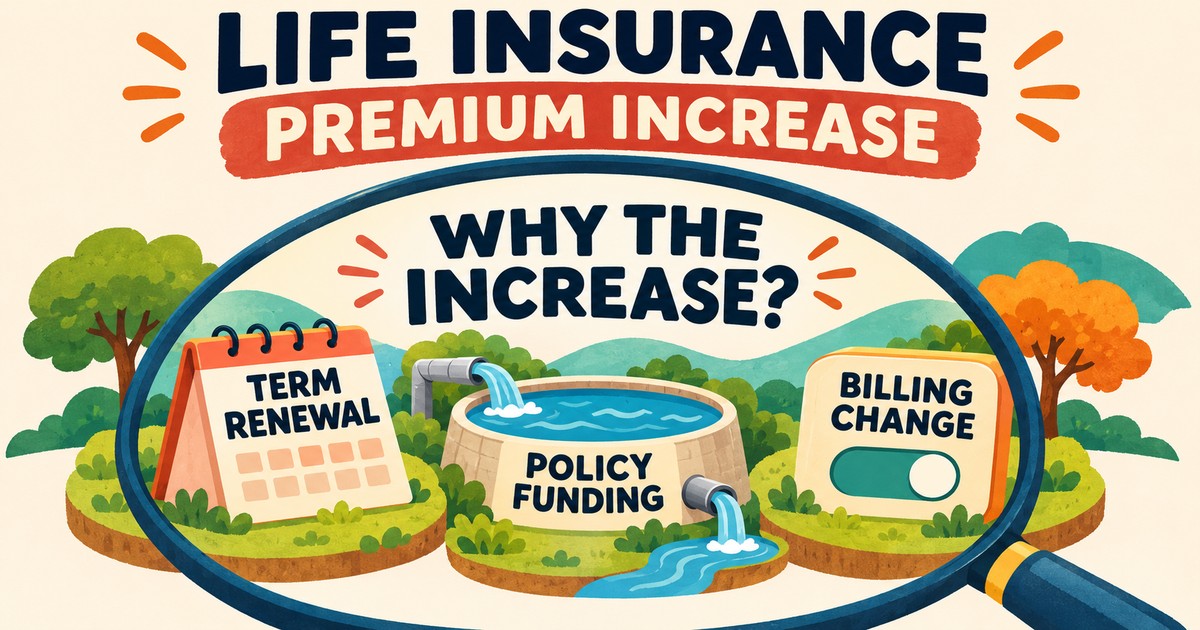
A life insurance premium increase can be an unwelcome surprise, especially when the payment has looked the same for years. The reason may be a term policy moving into renewal, a flexible-premium policy needing more funding, or a change in how the bill is collected. Those situations need different answers.
Before you decide whether to pay more, change the coverage, or shop elsewhere, ask one question: What exactly changed, and where does our contract explain it? We want an explanation that connects the notice to your actual policy—not just to the statement that insurance gets more expensive with age.
This guide focuses on existing individual life insurance. An employer’s payroll deduction needs a separate benefits review. We’ll walk through the documents, the differences among policy types, and the questions that can turn a confusing notice into a manageable decision.
Start with the notice, the policy, and the deadline
Put the new bill beside the previous bill. Compare the payment period, coverage amount, policy number, riders, and effective date. A rider is an extra policy provision that changes or adds a benefit. Make sure you are comparing the same coverage over the same length of time.
Next, find the policy’s schedule or data pages. Look for the product name, issue date, premium schedule, renewal provisions, and any guarantee period. Keep the latest annual statement nearby. If the notice refers to an amendment or earlier letter, locate that too.
Write down the date by which action is required. If the notice mentions termination, a grace period, or insufficient policy value, find out whether coverage is active and what is due. Our guide to a life insurance lapse explains that more urgent situation. Reviewing the price does not extend a payment deadline.
Three different changes can look like a life insurance premium increase
First, the contract’s scheduled premium may have changed. This can happen when a level-premium term period ends and renewal begins. Second, a flexible-premium policy may need a larger payment to support coverage, even though the amount you originally planned to send was smaller. Third, the amount collected may reflect billing or benefit changes rather than a change to the base rate.
Ask the insurer to put the difference into one of those categories and show the calculation. “Your payment changed” describes the result. It doesn’t explain the reason.
We would also separate an amount needed to keep coverage active now from an amount projected to support it over many more years. A payment that addresses an immediate shortfall may not solve a long-term funding problem. Ask which problem the requested payment would solve.
Did your level-premium term period end?
A level-premium term policy keeps its scheduled premium the same during a stated period. That period has an ending date. The right to continue coverage afterward, the renewal price, and the final renewal age depend on the contract.
The NAIC’s consumer explanation of life insurance notes that some term policies can renew even after health changes, but renewal premiums may be higher. Ask for the actual renewal schedule rather than assuming the original payment continues.
For a carrier-specific example, State Farm’s term-renewal explanation describes policies that become annually renewable after their initial period, with premiums increasing each year. That explains one design; it does not establish how another company’s contract works.
If renewal caused your life insurance premium increase, compare the next several scheduled years. A temporarily affordable payment can look different when you see the full sequence. Keep any separate conversion deadline on the same calendar.
Renewal, conversion, and a new application are separate choices
Renewal continues coverage under the contract’s renewal terms. Conversion uses an eligible policy provision to move to permanent coverage. A new application asks an insurer to issue a different policy under its current underwriting rules.
Those choices should not be compared on the first payment alone. Put the benefit amount, intended duration, guarantees, eligibility requirements, and deadlines alongside the cost. Ask which options remain available under your existing contract and which require a new approval.
If conversion is relevant, our term life insurance conversion guide provides a separate checklist. You do not need to convert simply because a renewal letter arrived. You do need enough time to understand the available choice before its deadline.
Start with the reason you still need coverage. A family with ten more years of income replacement needs a different comparison from someone planning for a lifelong dependent. The product discussion becomes more useful once that purpose is clear.
With universal life, the planned payment is only part of the picture
Universal life generally separates the premium you send, policy charges, and cash value. Cash value is value held inside the policy; it is not the same as the death benefit. The planned premium is the payment pattern selected for the policy, subject to its terms.
The Maryland Insurance Administration’s universal life explanation describes how premiums and cash value support insurance and administrative charges. When the planned payment does not cover those charges, policy value may supply the difference. Age-related costs and interest credited below earlier assumptions can change how long that arrangement lasts.
Think of the payment and the internal cost as two separate lines to inspect. A familiar bank draft does not prove that the policy’s funding position stayed the same. Ask for the current values, actual deductions, and the explanation behind the proposed payment.
This helps explain why a life insurance premium increase can appear after years of steady payments. It does not establish whether the amount requested is correct for your contract.
Ask what is guaranteed—and what was projected
An illustration shows how a policy could work under specified assumptions. It is useful for comparison, but its nonguaranteed columns are not promises. An in-force illustration updates the picture for a policy already in existence.
The NAIC’s explanation of life insurance illustrations distinguishes guaranteed elements from nonguaranteed elements and describes in-force updates. Ask for both kinds of information to be explained in ordinary language.
For your review, request comparisons using the same benefit and intended coverage horizon. Have the insurer identify the assumptions behind each payment and the year or age through which coverage is projected to continue. Then ask how the guaranteed information differs.
Some policies include a separate no-lapse guarantee with its own requirements. If yours does, request its current status and the precise payment and timing conditions. A projected cash-value result and a contractual guarantee are different things to verify. Do not use one as proof of the other.
Could loans, withdrawals, or earlier payment changes matter?
Bring the policy’s transaction history into the conversation. Have premiums been reduced or skipped? Were withdrawals taken? Is there an outstanding loan? What amounts and dates appear in the insurer’s records?
Ask for a written explanation of how each transaction affected today’s values and any guarantee. This is especially useful when more than one person has handled the household finances or when automatic payments changed during a bank transition.
The Texas Department of Insurance’s life insurance guide discusses cash-value policies, loans, and the risks of inadequate funding. Use general guidance to form questions, then use the actual contract and current records to answer them.
Borrowing from the policy to address a higher bill is a separate financial decision, not a routine billing fix. Request an explanation of loan interest, policy values, death-benefit effects, and potential tax consequences before choosing that approach. A qualified tax professional should address any individual tax issue.
Does whole life always have a fixed payment?
Traditional level-premium whole life is designed around a level contractual premium. But the words “whole life” alone do not identify every payment feature. Read the exact product name and premium schedule.
Florida’s life insurance overview describes modified-premium and interest-sensitive whole life, among other designs. Modified-premium coverage can have a scheduled increase after an initial period. That is a useful reason to check the contract before concluding that a higher bill must be an error.
Ask whether the base contractual premium changed or whether your out-of-pocket payment changed. If dividends or other policy values have been applied toward payments, request the history of those amounts and the current arrangement. Nonguaranteed support should not be mistaken for a guaranteed premium reduction.
Our term versus whole life comparison explains the broader product distinction. Here, the job is narrower: reconcile the payment you expected with the payment the insurer is now requesting.
Check billing and benefit changes before assuming a rate change
Sometimes the fastest useful step is a line-by-line comparison. Ask whether the new amount includes more than one installment, a missed payment, a change in billing frequency, a different benefit, or an optional feature. Treat those as possibilities to investigate, not conclusions about your account.
If the payment frequency changed, request the annual total under each available schedule. Comparing one monthly amount with one quarterly amount can create confusion even when both bills are accurate.
If a rider or coverage amount changed, ask when it was requested, who authorized it, and where the insurer recorded the change. Keep the response with your policy documents. If nothing was authorized, ask the insurer to investigate the discrepancy.
A life insurance premium increase review should end with a clear explanation: what changed, when it changed, how the amount was calculated, and what happens next. If those pieces still do not fit, keep the question open.
A hypothetical example: the same surprise, different answers
Imagine two unrelated policyowners who both receive a larger bill. This is a hypothetical teaching example, not a client story, quote, or prediction.
The first owner has a term policy nearing the end of its level-premium period. The renewal schedule explains the new amount. That owner’s next task is to compare the remaining protection need with the available continuation choices and their deadlines.
The second owner has a flexible-premium policy. The notice asks for additional money because the current funding position will not support coverage as expected. That owner needs current values, an in-force illustration, and an explanation of any applicable guarantee.
The headline problem sounds identical: “Our payment went up.” But the documents and decisions differ. Giving both people the same recommendation would skip the most important part of the review.
Neither owner has to make a new purchase just to obtain an explanation. Start by identifying the policy, the change, and the choices actually available. Then compare them against a real coverage goal and a sustainable budget.
Build a one-page explanation you can use
Before choosing a response, summarize the life insurance premium increase in your own words. If the explanation requires several unexplained abbreviations, ask for a clearer version.
- Current status: Is coverage active, and is a payment deadline approaching?
- Reason: Is this renewal, a funding need, a scheduled product feature, or billing?
- Evidence: Which contract page, statement, or transaction supports that explanation?
- Amount: What is due now, and what is expected or required later?
- Choices: Which changes are available, and what would each change give up?
- Confirmation: What written record will establish that the selected action is complete?
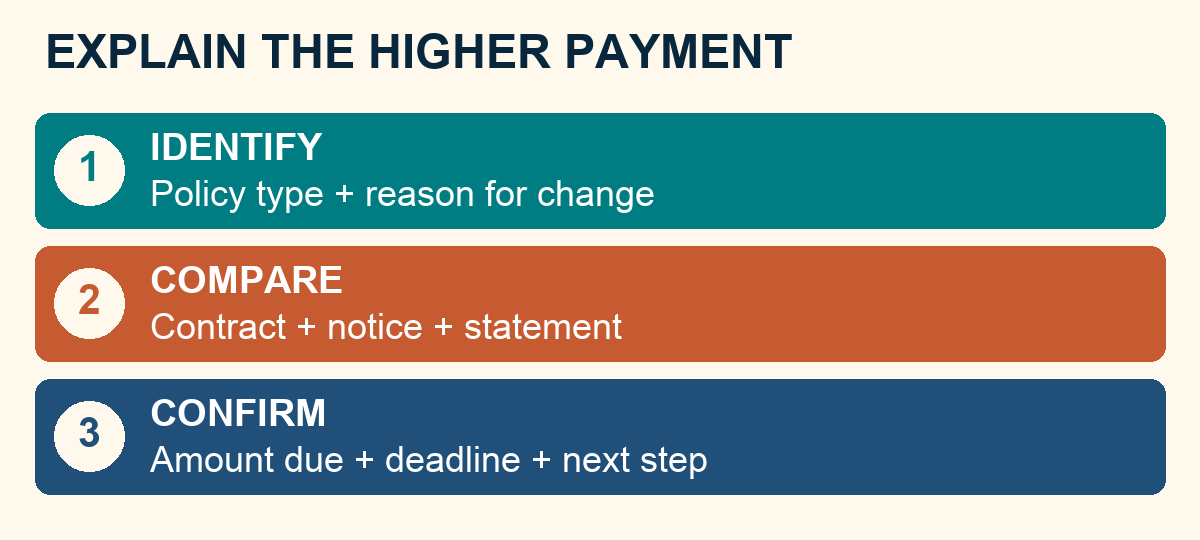
Keep the original notice and the dated answer. If a later explanation differs, you have something concrete to reconcile. A useful review should leave you able to explain the change to another household decision-maker without relying on memory.
Compare options against the protection you still need
Once the increase makes sense, revisit the reason for the insurance. Who depends on the benefit? For how long? Which debts, income gaps, or continuing responsibilities would remain if the insured died?
Our Life Insurance Needs Calculator can help organize an initial estimate. Its result is a planning aid, not a premium quote, underwriting decision, or reason to reduce coverage automatically.
Ask for written comparisons of the realistic choices. Depending on the policy, those might include continuing as scheduled, changing the funding pattern, requesting a benefit reduction, or considering another eligible coverage option. Ask what each choice changes about guarantees, duration, and affordability.
For a hypothetical household whose mortgage is nearly paid off, the current need may differ from the original need. A household supporting a dependent adult may have a continuing obligation. We would want that distinction understood before treating a smaller death benefit as an easy solution.
Put the change into a yearly household budget
After you understand the cause, translate the new payment into a yearly amount. A monthly difference can sound small until you compare it with the rest of the household budget. Use the insurer’s actual billing schedule, including any charges it identifies.
Here is a hypothetical arithmetic example only: a monthly payment changing from $50 to $70 would change twelve equal payments from $600 to $840 a year. The difference is $240 annually, or a 40% increase. These are invented teaching figures, not market rates, an insurer’s offer, or an estimate for your policy.
The percentage explains the size of the change; it does not tell you whether the coverage is worth keeping. Write the yearly difference beside the benefit and the length of protection you still need. If the schedule changes again next year, add that next year separately instead of assuming today’s amount lasts forever.
Then test the payment against the budget you actually have. Include months with irregular expenses or lower income. If an option requires stretching beyond that budget, ask for a comparison that reflects what you can maintain and clearly explains any protection you would give up.
Replacing coverage deserves its own review
A lower initial quote can be appealing after a life insurance premium increase. Compare it with the current contract, not just with the new bill. New coverage may involve underwriting, new restrictions, different guarantees, and transition costs.
Our life insurance replacement guide covers those questions separately. Do not surrender existing protection merely because an application or estimate looks promising. Verify the new policy’s actual terms and effective status before making a transition decision.
If health has changed, make sure the comparison accounts for the value of existing contractual options. If the budget has changed, be candid about what you can maintain. An arrangement that looks attractive on paper still needs to work during an ordinary difficult month.
The right outcome may be a change, or it may be understanding and maintaining the policy you already own. We would judge the review by whether it answers your needs, costs, and trade-offs clearly.
What if the explanation still does not add up?
Ask the insurer to identify the specific contract provision and provide a dated written response. Point out the exact conflict: a different amount, an unexpected effective date, a missing payment, or a guarantee that appears inconsistent with the notice.
Florida’s life insurance FAQs directly address higher payments after years of steady premiums and explain why the policy type matters. That background can help you organize the question, but it cannot decide whether a particular notice follows your contract.
If a deadline is close, resolve current status and required action while the explanation is being reviewed. Do not assume that disputing the bill suspends payment obligations. Keep copies of notices, transaction records, and written responses for any appropriate insurer or regulatory review.
Turn the higher bill into a clear next step
A life insurance premium increase deserves an explanation you can follow. Identify the reason, verify the deadline, separate guarantees from projections, and compare the available choices against the protection you still need. That sequence gives you a sounder basis for a decision than reacting to the new amount alone.
About Jay A. Cohen, The Ocala Insurance Guy
Jay A. Cohen is a licensed health and life insurance agent based in Ocala, Florida. He is licensed in Florida, Virginia, Illinois, Utah, and California.
Our approach is educational: we listen to understand your needs, goals, and budget, then explain your options in plain language. We walk through the benefits, costs, and limitations, welcome your questions, and help you make an informed decision without pressure to buy a particular product.
To explore permanent coverage and available policy options, visit the Jay A. Cohen life-insurance information page. You can also learn more about Jay’s educational approach and insurance experience.
For help understanding a life insurance premium increase, use The Ocala Insurance Guy Contact Form. Begin with your general question; we can identify the appropriate next step for reviewing policy information.
This article provides general educational information, not individualized insurance, legal, tax, or investment advice. The examples are hypothetical. Premium schedules, funding requirements, guarantees, renewal and conversion rights, charges, and availability vary by contract, insurer, state, and circumstances. Nonguaranteed illustrations and dividends are not promises. Confirm your policy’s current status and requirements with the insurer and obtain appropriate professional advice before replacing, surrendering, borrowing from, or materially changing coverage.