

Can life insurance companies look at your medical records? Yes, they may request health information as part of an application, generally with the appropriate authorization. But a request for life insurance medical records deserves more than a quick signature. You should understand what you are permitting, what information the insurer needs, and how to question something that is inaccurate.
“Does applying mean someone can just open my entire medical history?” That is a fair question. We would start with what the forms actually authorize and how the insurer reviews an application. There is no single file request used by every insurer, and “no medical exam” does not necessarily mean no records are checked.
Let’s walk through the process from the applicant’s side. Our focus is individually underwritten U.S. life insurance. Workplace benefits and other products can follow different procedures. Your carrier’s current application, authorization, privacy notice, and policy documents matter more than an advertising headline.
Who receives life insurance medical records?
Start with the insurer reviewing your application. Its underwriting staff may need medical information to evaluate the requested coverage, and authorized services may help obtain records. That does not tell you exactly who can see your file. Check the recipients and permitted uses in the authorization and the insurer’s privacy notice.
For example, Guardian’s customer privacy notice says employee access is restricted to those who need the information to service a policy or account. It also describes separate authorization for health information and exceptions when disclosure is permitted or required by law. This is one insurer’s notice, not a substitute for the documents that apply to your application.
What about your agent? Don’t assume the agent receives the same medical file as the insurer’s underwriter. Ask the carrier what information the agent can access and how questions about the records should be handled. We can help you understand the process without asking you to put detailed medical information in our general Contact Form.
Why would an insurer want my medical records?
Underwriting is the insurer’s process for deciding whether to offer coverage and at what price. Health information can help it understand the risk it is being asked to insure. A short application answer sometimes needs context: what happened, when it happened, how it was treated, and what follow-up showed.
Guardian’s underwriting explanation describes an application process that can include permission to access medical and prescription information. Requirements vary with the applicant, product, amount requested, and insurer. A process described by one company is an example, not a promise that every company will request the same material.
Think about how you would describe an old knee injury. “Had surgery” tells only part of the story. The date, recovery, and current limitations answer different questions. That doesn’t predict an insurance result; it illustrates why a brief answer may prompt a request for more detail.
When the insurer asks for life insurance medical records, ask what remains unresolved. Does it need a particular specialist’s report, a recent test result, or a longer history? Understanding the request helps you identify the right office instead of sending a pile of unrelated documents.
Read the permission before signing it
Before signing a medical-record authorization, give yourself time to read it and ask questions. Look for who may release information, who may receive it, what information is described, the purpose, and when the authorization expires. Keep a copy of the version you sign, including any accompanying disclosures.
The U.S. Department of Health and Human Services explains that a HIPAA authorization specifies information and recipients, among other required elements. Ordinary consent and a valid authorization are not interchangeable when the rule requires authorization. This is why the actual wording matters.
Useful questions include: Which organizations are covered by this permission? Is the request for a particular date range? Does it allow a records service to obtain information for the insurer? Where can I find the privacy notice? What happens if I do not sign, or want to withdraw permission? Ask for the process and consequences rather than assuming a crossed-out sentence will be accepted.
If you are uncomfortable, pause and seek an explanation before signing. The insurer may be unable to complete the application without information it requires. You can discuss other available underwriting approaches, but there is no guarantee that another product will provide the same benefit, price, or eligibility.
Here is an important distinction: HIPAA generally applies to covered healthcare providers and health plans, but life insurers are not covered entities simply because they offer life insurance. HHS lists life insurers among organizations outside those HIPAA rules. Other privacy requirements may still apply. Ask how the insurer and its service providers protect and share information under their notices and applicable law.
Medical records, prescription history, and MIB are different
The phrase “records check” can describe several things. A physician’s chart may contain visit notes, diagnoses, test results, and treatment history. A prescription-history report concerns medication information. An insurance consumer report serves another purpose. Ask which source is involved before deciding what an entry means.
An attending physician statement, often shortened to APS, is information obtained from a treating provider for underwriting. The name can sound like a single letter, but the requested material may include records. An electronic health record is a digital medical record. Electronic access can change how information travels without eliminating the need to understand permission and scope.
MIB’s consumer guide distinguishes its coded underwriting information from actual medical charts. Its underwriting database does not store the physician reports, laboratory results, X-rays, and similar records described in that guide. A code can lead an insurer to investigate further; it is not a complete clinical explanation.
Don’t confuse that database with every service a company offers. A separate electronic-record retrieval service is a different function. When someone says “MIB,” ask whether they mean the consumer underwriting file or a medical-record retrieval process. The answer affects where you direct a question or correction.
A medication name also needs context. If the application asks why a prescription was used, answer that question accurately. Don’t invent a diagnosis because you recognize a drug’s common use, and don’t leave out a requested medication because you think it is irrelevant. Have the prescribing office clarify details you don’t know.
Does no-exam coverage still use life insurance medical records?
It can. Skipping a new physical examination is one feature of an application process. It does not establish that the company will skip health questions, prescription checks, or authorized third-party information. New York Life’s AARP program explains that no-exam underwriting can use application answers and authorized records.
Ask four separate questions: Is an exam required initially? Can one be requested later? Which records may be checked? What happens if the application cannot be completed through the faster process? That gives you a clearer comparison than simply asking whether the policy is “easy to get.”
Simplified issue generally uses fewer health questions than a more extensive process. Guaranteed issue generally avoids traditional health qualification within its eligibility rules. These labels still require a close look at benefit limits, price, and any graded death benefit period. A graded period can limit what is paid for certain early deaths under the contract.
Our no-medical-exam life insurance guide compares those coverage routes. Here, the narrower point is privacy: do not choose a policy on the assumption that no exam means no information review. Ask what the particular application actually requires.
Preparing for a life insurance medical records request
You do not need to print your entire patient portal before an initial discussion. Start with an organized list of providers, approximate visit dates, medications, and significant tests or treatment relevant to the questions asked. Use it as a memory aid, not as a substitute for reading the application.
Pay attention to the time period in each question. “Have you ever” and “within the past five years” ask different things. An answer suitable for one question may be incomplete for another. If a date is uncertain, identify it as uncertain and ask how to clarify it instead of presenting a guess as a fact.
Check the final application even if someone helped enter the answers. Names, dates, medication details, and yes-or-no selections deserve attention. Ask for corrections before signing. If you discover an omission afterward, promptly ask the insurer how to submit a written amendment and retain its acknowledgment.
For life insurance medical records, the practical goal is a consistent, accurate explanation. That does not mean making everything sound favorable. It means the application, requested records, and any clarification should describe the facts as clearly as possible.
A coverage discussion should also begin with what you want to protect. Our life insurance needs calculator can help organize household obligations and available resources. Its estimate is not an underwriting decision or premium quote. Separate the amount you need from the evidence required to apply for it.
Getting life insurance medical records corrected
First identify where the problem lives. A provider’s chart, a consumer reporting agency’s file, and an insurer’s underwriting decision are separate things. Correcting one may supply useful evidence for another, but don’t assume every system updates automatically.
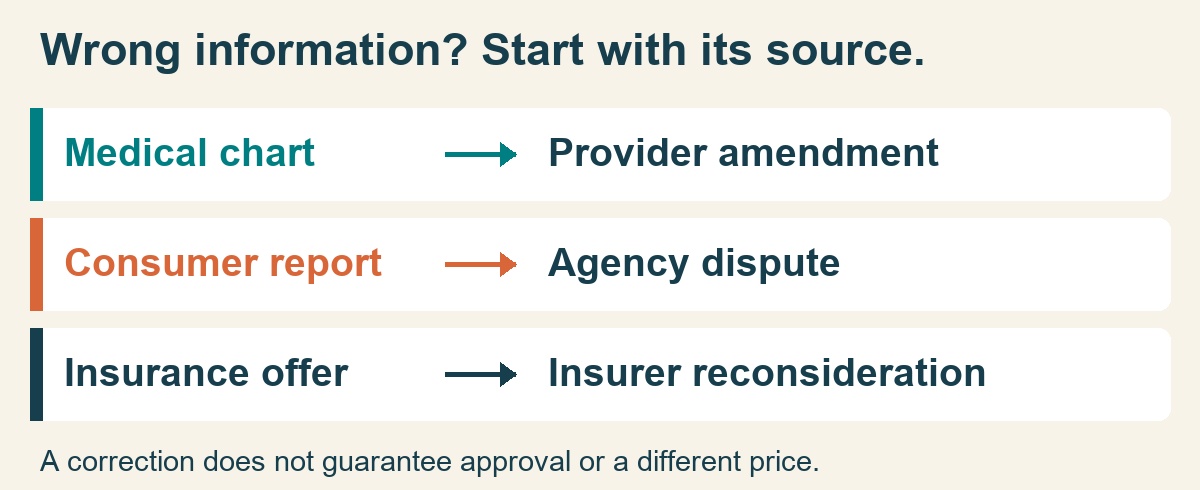
HHS describes rights to access and seek amendments to medical records held by covered providers and plans, with exceptions. If you believe a chart contains inaccurate or incomplete information, ask the organization about its amendment procedure. If it disagrees, a statement of disagreement may be available under the rule.
An amendment request is not a request to erase accurate history so an application looks better. Be specific about the entry, date, and correction you believe is needed. A later result that resolves an earlier concern is useful context even when the earlier note accurately recorded what was known at the time.
For a disputed MIB entry, use MIB’s reinvestigation process. Its instructions explain how to identify inaccurate or incomplete information and provide relevant support. Keep a private copy of the disputed item, your explanation, and the response. Use the organization’s official secure process for identifying and medical information.
Then ask the insurer what it needs to reconsider the application, whether it can remain open, and whether a deadline applies. A corrected report does not guarantee a particular rate or approval. The important distinction is between fixing a fact and asking the insurer to reassess its decision using accurate facts.
Can I see my MIB file?
MIB provides a consumer-file request process and a free annual disclosure for U.S. consumers. Not everyone has a file. Its guidance ties file existence to qualifying member-company applications within the past seven years and information of underwriting significance. A “no record found” response is not an insurance approval.
MIB also explains that member carriers cannot make underwriting decisions from its consumer file without further investigation. It is sensible to distinguish the reporting agency’s information from the insurer’s final decision. Ask which source prompted a question rather than assuming a file entry decided everything.
If you request a disclosure, follow the current identity-verification instructions on the official site. There is no reason to place your identification documents in a general website inquiry to an insurance agent. We can explain the steps without collecting information needed only by the reporting agency.
What if a consumer report affects the offer?
The Federal Trade Commission’s insurer guidance explains adverse-action notices when a decision is based partly or completely on a consumer report. Examples include denial or increased rates. The notice identifies the reporting agency and explains rights to dispute information and request a free report within 60 days.
The agency supplying the report did not make the insurer’s decision. That is why it helps to pursue the information question with the agency and the offer question with the insurer. Read the actual notice and act within its stated deadlines rather than waiting until you have assembled a perfect explanation.
For your own notes, record the application reference, date of the decision, source named in the notice, and what you are questioning. Separate “this isn’t my record” from “this is my record, but the current follow-up is missing” and from “the information is accurate, but I want to understand the offer.” Each requires a different explanation.
When the issue concerns life insurance medical records, ask the insurer how medical reasons can be explained to you or an authorized clinician. An agent should not guess at a medical interpretation. Your treating professional can help explain clinical facts; the insurer explains its underwriting requirements.
A hypothetical example: an unfinished story in the chart
Imagine an applicant whose earlier visit note mentions a recommended follow-up test. The test was completed at a different facility, but that result is absent from the records the insurer received. This hypothetical example illustrates a records problem; it does not describe an actual client or predict an insurance outcome.
The applicant asks which information is missing, identifies the facility, and follows the insurer’s authorized submission process. The result may complete the timeline. It does not establish that the insurer must offer coverage, lower a premium, or finish by a particular date.
Notice what makes the response useful: it supplies the missing event and its documentation. Arguing that the first doctor’s note “looks bad” would not answer the question. Neither would submitting unrelated years of records without identifying the follow-up.
Now change the example: suppose the note actually belongs to another patient. That is a record-accuracy problem to raise with the organization maintaining it. The applicant should also tell the insurer what is disputed and how correction is being pursued. The same frustrating application delay can have very different causes.
Why are my medical records taking so long?
Ask for a concrete status update: which request is outstanding, where it was sent, and whether the authorization or provider details need correction. A clinic may have changed names, a specialist may use a separate records service, or the insurer may need a particular missing report.
If you are asked to help, confirm the exact destination and acceptable submission method. Sending the same records to several people can create confusion without moving the application forward. Keep a simple private log of dates and responses so you can distinguish a request that was sent from information that was actually received.
Ask whether a quoted premium is preliminary and what remains before coverage can begin. An application, records request, or favorable preliminary discussion is not itself a policy in force. Any temporary coverage depends on the actual receipt and its conditions. Get that explanation from the insurer.
Continue medically recommended care while this is happening. Don’t skip appointments, stop medication, or postpone needed testing to influence an application. For condition-specific questions, our guides to life insurance with diabetes and coverage after cancer discuss the importance of a clear treatment history.
Keep sensitive information in the right place
Before uploading records, confirm the recipient, purpose, and secure method through a known carrier or provider channel. Be cautious with an unexpected request that arrives by message, especially if it asks for a portal password or unrelated identifying information. Ask the organization to verify the request.
Use our Contact Form to ask about the process, not to send medical charts, Social Security numbers, patient-portal credentials, or identification documents. A useful first message can be simple: “We are considering coverage and want to understand the medical authorization before applying.” We can help identify an appropriate next step.
If you already own coverage, keep it in place while reviewing alternatives. Records needed for a new application do not establish that replacing the old policy is beneficial. Compare guarantees, premiums, benefits, and replacement implications before acting. Our policy review guide helps organize that separate decision.
What should I ask before applying?
Start with the authorization: what will be requested, from whom, for what purpose, and for how long? Then ask which underwriting route is proposed, whether a medical exam may be required, and how outstanding information will be tracked. Keep copies of the signed application and disclosures.
Next, ask what you should do if information is wrong or incomplete. Identify the process for a provider amendment, a consumer-report dispute, and insurer reconsideration. You don’t need to expect a problem to know where a question belongs.
Questions about life insurance medical records deserve clear answers before you decide how to proceed. Accurate answers, clear permission, and a practical follow-up plan make the process easier to understand. If you’d like help sorting out those questions, use The Ocala Insurance Guy Contact Form. We will start with what you want to understand and what you want the coverage to do.
About Jay A. Cohen, The Ocala Insurance Guy
Jay A. Cohen is a licensed health and life insurance agent based in Ocala, Florida. He is licensed in Florida, Virginia, Illinois, Utah, and California.
Our approach is educational: we listen to understand your needs, goals, and budget, then explain your options in plain language. We walk through the benefits, costs, and limitations, welcome your questions, and help you make an informed decision without pressure to buy a particular product.
To explore permanent coverage and available policy options, visit the Jay A. Cohen life-insurance information page. You can also learn more about Jay’s educational approach and insurance experience.
Send your process or coverage questions through The Ocala Insurance Guy Contact Form.
This article provides general educational information, not individualized insurance, medical, legal, tax, or investment advice. Underwriting, privacy procedures, eligibility, benefits, and policy availability vary by insurer, product, state, and circumstances. Examples are hypothetical. Consult the current application, authorizations, privacy notices, and contract, and seek qualified professional advice for your situation. Approval and pricing are determined by the insurer.