

A higher health insurance deductible can make sense when the premium savings are meaningful, the coverage fits your needs, and you can comfortably handle the extra cost when care is needed. But a lower monthly premium, by itself, is not enough reason to choose it. We would look at the whole year and ask where the money for an early medical bill would come from.
Maybe your employer offers two plans, including one with a higher health insurance deductible. One takes less from each paycheck but asks you to pay more before certain benefits begin. The other costs more every month and starts sharing those expenses sooner. Would the higher health insurance deductible work for you? That is a fair question, especially when groceries, housing, and everything else already have a place in your budget.
We would start with a conversation: What are you trying to protect? Is it your monthly cash flow, the savings you have built, or your ability to get care without worrying about the next bill? Those goals can point in different directions. Let’s put some numbers beside a higher health insurance deductible, then talk about what would feel comfortable for your household.
How much does a higher health insurance deductible save in premiums?
To evaluate a higher health insurance deductible, start with the amount you pay, not the employer’s total premium. Turn each payroll deduction into an annual figure using the actual number of deductions. Then compare the same coverage tier. Employee-only coverage and family coverage are different comparisons. A $150 monthly difference means $1,800 over a full year; a $150 difference every paycheck means something else.
The HealthCare.gov total-cost guide encourages comparing premiums and the costs of using care together. Its examples concern Marketplace plans, but the budgeting question also helps when comparing workplace choices. When considering a higher health insurance deductible, what leaves your paycheck is one part. What you might owe a provider is another.
Here is a fully hypothetical employee-only comparison showing how a higher health insurance deductible changes the numbers. These are invented plan designs, not quotes, available products, or estimates for any particular person. Assume both options cover the same services with the same network, use the same deductible period, and charge 20% coinsurance after the deductible for the claims below. No copays, separate prescription deductible, employer account contributions, or tax differences are included.
| Hypothetical plan feature | Plan A: lower deductible | Plan B: higher health insurance deductible |
|---|---|---|
| Employee monthly premium | $400 | $250 |
| Employee annual premium | $4,800 | $3,000 |
| Individual deductible | $1,500 | $4,000 |
| Coinsurance after deductible | 20% | 20% |
| Individual in-network out-of-pocket maximum | $6,000 | $7,500 |
Plan B saves $150 each month in premiums. In exchange, Plan B’s higher health insurance deductible is $2,500 above Plan A’s, and its out-of-pocket maximum is $1,500 higher. That does not automatically make either plan better. It tells us which questions to ask next: How much care might you use, and how much money could you access if something happened soon?
Does a higher health insurance deductible cost less across three medical-spending scenarios?
We do not have a crystal ball. Rather than pretend we know next year’s claims, we can compare several spending scenarios under a higher health insurance deductible. In every example below, assume a full year of premiums and covered in-network allowed charges subject to the deductible and coinsurance. There is no earlier spending or other cost sharing. Real benefit rules can produce different results.
A year with no deductible-governed claims: Assume there are no other patient charges. Plan A costs $4,800 in annual premiums; Plan B costs $3,000. The plan with the higher health insurance deductible leaves $1,800 more in your budget. If you put that money aside, it can help build your reserve. If it disappears into other spending, it will not be waiting when you need it.
A year with $5,000 in allowed claims: Under Plan A, you pay the first $1,500, then 20% of the remaining $3,500, or $700. Your medical share is $2,200. Add $4,800 in premiums, and your combined annual cost is $7,000.
With Plan B’s higher health insurance deductible, you pay the first $4,000, then 20% of the remaining $1,000, or $200. Your medical share is $4,200. Add $3,000 in premiums, and the annual total is $7,200. In this particular example, the lower-deductible plan costs $200 less for the year, even though its premiums are higher.
A year in which both plans’ applicable out-of-pocket maximums are reached: Plan A’s $4,800 premium plus $6,000 maximum equals $10,800. Plan B’s $3,000 premium plus $7,500 maximum equals $10,500. With these invented designs, Plan B’s combined total is $300 lower. A higher health insurance deductible does not necessarily mean a higher annual total, even in a major medical year.
Those last totals cover only the premiums and qualifying in-network cost sharing in our assumptions. They exclude noncovered care, out-of-network charges outside applicable protections, and other expenses. They are not a promise about your maximum household spending. Change the premiums, benefit rules, or limits, and the comparison can change.
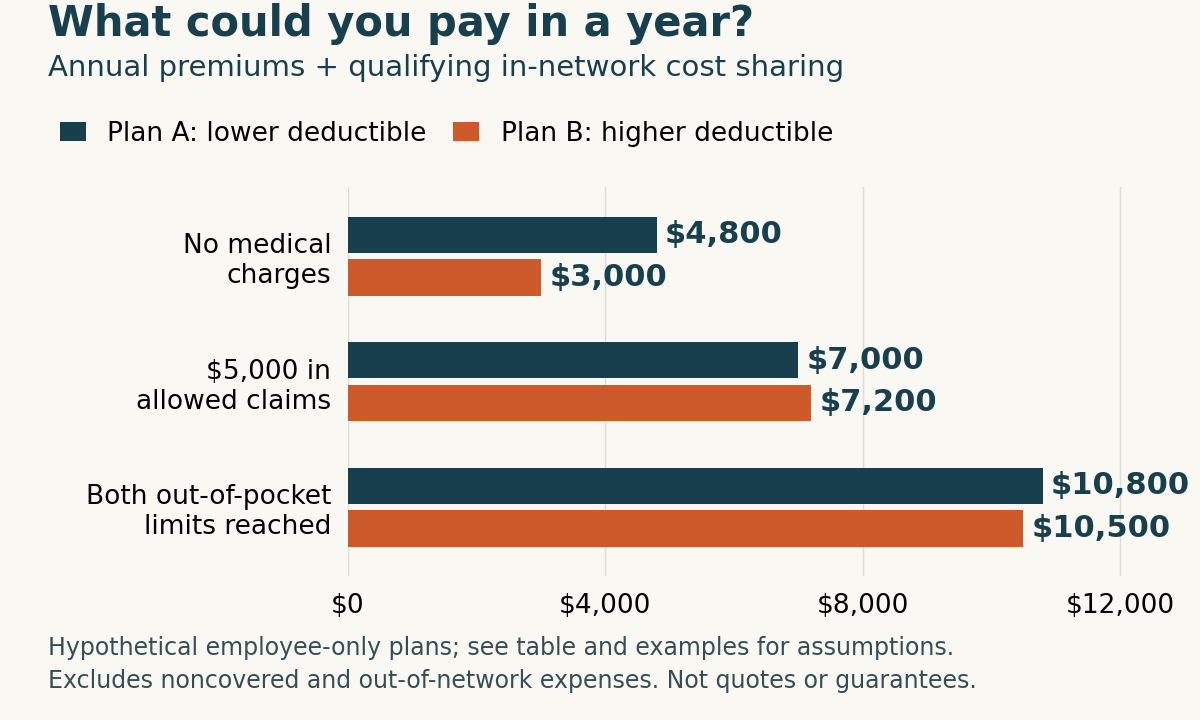
The chart compares the same two hypothetical plans, including annual premiums and qualifying in-network cost sharing. Plan B costs less in the no-charge and maximum-spending scenarios, while Plan A costs less in the $5,000 claim scenario. The result depends on the actual plan design and care received; these are examples, not predictions.
Could you handle a higher health insurance deductible before the savings build up?
Now move the medical bill to the beginning of the year. After one month, Plan B has saved you only $150 in premiums. Choosing the higher health insurance deductible still raises that threshold by $2,500. At $150 a month, it would take almost 17 months to save that difference, assuming you save every dollar and do not use the money along the way.
That calculation is about building a cushion, not predicting your bill or a break-even point for the plans. The $5,000 example already showed that annual costs depend on coinsurance too. The practical question is simpler: If you needed care next month under a higher health insurance deductible, could you handle the amount you owed without missing other important payments?
Two people can look at the same higher health insurance deductible and reasonably make different choices. Someone with a comfortable reserve might accept more cost sharing for lower premiums. Someone rebuilding savings might value paying more each month to reduce the amount needed at once. Neither decision should be made by looking at the premium alone.
If you share finances with a spouse or partner, sit down together and walk through that early-year possibility with a higher health insurance deductible. What money is already committed to the mortgage, repairs, or another goal? How much is actually available for medical expenses? A reserve can be a security blanket, but only if it is there when you reach for it.
What money could help you meet a higher health insurance deductible?
Before choosing a higher health insurance deductible, make a short list of resources you already have. Cash savings may be one source. An existing Health Savings Account may be another. Ask about employer contributions, reimbursement arrangements, and when funds become available; different accounts have different rules. Do not count money twice or assume a promised future contribution is available today.
A Health Savings Account, or HSA, has specific eligibility and tax rules. A deductible that looks high does not, by itself, establish your personal eligibility to contribute. Confirm the plan designation and your other coverage and circumstances. The IRS guidance on HSAs and other health accounts is a starting point; ask a qualified tax professional about your situation.
Ask what job each pot of money should do before committing it to a higher health insurance deductible. If your emergency fund also covers a job loss or a major home repair, using all of it for one medical bill affects those other goals. If your plan depends on a credit card, include the potential interest and repayment burden. Being able to borrow is different from being comfortable with the repayment.
Can existing life insurance cash value help with medical bills?
Possibly, if you already own a permanent life insurance policy with accessible cash value. Depending on its terms, a loan or withdrawal may provide money you can use toward expenses. The medical provider is not being paid by your health plan through that transaction. You are accessing value under a separate life insurance contract.
Start with the amount available today after existing loans, charges, and restrictions. A death benefit is not the same as spendable cash value. A projection for a future year is not money available this month. Ask the insurer for current values and an updated illustration showing how the proposed access could affect the policy.
There are trade-offs. Loan interest can accumulate, and access can reduce policy values or the benefit remaining for beneficiaries. Excessive borrowing can threaten coverage, and taxes may arise depending on the transaction and policy circumstances. The Florida life-insurance overview explains loan effects; Lincoln Financial explains loans and withdrawals and recommends individual tax review. Your own contract governs.
We would ask whether using that value toward a higher health insurance deductible solves today’s expense while preserving the protection you still need. If someone depends on the death benefit, that matters. If an existing loan is already putting pressure on the policy, another loan deserves particular care. Accessing cash value should be a deliberate decision, with a plan for keeping coverage in force.
Buying a new policy is a separate conversation. Life insurance is protection, and a new contract is not an immediate substitute for money needed for this year’s deductible. Underwriting, premiums, policy charges, and early accessible values must be examined. Premium dollars do not automatically become equally available cash.
If longer-term accessible value is one of your goals, the comparison should address that goal directly rather than automatically maximize the death benefit. Examine early-year surrender values, funding requirements, guarantees versus nonguaranteed projections, and the protection your household needs. We would explore that separately, not assume premium savings make a new policy suitable.
What does a higher health insurance deductible actually apply to?
Once the budget conversation makes sense, check which services the higher health insurance deductible applies to. A deductible applies to covered services governed by that deductible. It is not a fee you pay just to turn coverage on. Some visits or prescriptions may have different arrangements, and an excluded service does not become covered because you met the deductible.
Ask for the current Summary of Benefits and Coverage, or SBC. The SBC explanation describes its comparison purpose, including job-based plans. Find the deductible, benefits available before it, coinsurance, copays, and out-of-pocket maximum. Read the rows for care you expect to use, not just the first number on the page.
A copay is a fixed amount for a covered service; coinsurance is a percentage of the applicable amount. Read any ‘after deductible’ condition. Do not assume a listed $40 visit costs $40 from the first day if the plan requires you to meet the deductible first. Ask for a specific example using your benefits.
With a higher health insurance deductible, which amount counts?
The provider’s original charge and your plan’s allowed amount can differ. The allowed amount is the amount recognized under the plan for a covered service. HealthCare.gov’s allowed-amount explanation also discusses negotiated rates and balance billing. Network contracts and applicable protections affect what a provider can collect.
For a routine covered in-network service, a negotiated adjustment can reduce the charge even when a higher health insurance deductible leaves you owing the deductible portion. That adjustment is one reason “the insurer paid zero” does not necessarily mean your insurance had no effect. Review the claim explanation before deciding what happened.
A simple hypothetical illustrates the point. Suppose an in-network provider bills $400, the allowed amount is $250, and all $250 applies to your remaining deductible. Assuming no other benefit rule applies, your responsibility would be $250 rather than $400. The $150 adjustment would not also become deductible credit. This is an invented illustration, not a price estimate.
If the provider requests a deposit before care, ask whether it is an estimate and how it will be reconciled after the claim processes. Save the receipt. Compare the final bill with the claim explanation and any payment already made. Paying an estimate and then paying the entire final balance again would make an unpleasant bill considerably worse.
What happens after you meet a higher health insurance deductible?
Usually, the plan starts sharing costs for services governed by that deductible. You may still owe coinsurance or copays until you reach the applicable out-of-pocket limit. Meeting the deductible does not, by itself, mean your remaining covered care is free. Check the actual benefits and remaining out-of-pocket limit.
Does the out-of-pocket maximum include everything?
No. The out-of-pocket maximum limits qualifying spending for covered in-network benefits during the applicable period. Premiums, noncovered services, and certain other charges are outside that protection. A maximum printed on a benefit summary is not a ceiling on every dollar your household might spend on health care.
Ask which deductible payments, copays, and coinsurance accumulate toward your limit. Also ask whether prescription spending shares that limit and whether out-of-network expenses have separate treatment. If you cover family members, identify the individual and family limits. Even when comparing a higher health insurance deductible, keep those limits separate from the deductible figures.
In the $5,000 claim comparison above, neither person has reached the plan’s out-of-pocket maximum. Plan A’s $2,200 medical share is below its $6,000 limit, and Plan B’s $4,200 share is below its $7,500 limit. A later covered claim could create additional cost sharing. Confirm what the plan pays after the applicable limit is actually met.
For budgeting, keep two lines: your annual payroll premium contribution and your potential qualifying cost sharing. Add room for known expenses outside coverage. That is more informative than calling the deductible your “worst case.” We would rather see a realistic spending plan than a comforting number that leaves out half the question.
Can a plan with a higher health insurance deductible pay for care sooner?
Yes, depending on the service and plan. Certain benefits may have coverage before the deductible. Most health plans must cover specified preventive services without cost sharing, generally when provided in network and when applicable requirements are met. HealthCare.gov’s preventive-services guidance explains that $0 treatment is not guaranteed for every service or circumstance.
An appointment described casually as a “checkup” can include both preventive and diagnostic work. Ask the provider and plan how the anticipated services are covered. A new symptom, additional test, or service outside the applicable preventive recommendations may have different cost sharing. Avoid assuming the entire appointment is free from its informal name.
The SBC should also identify other services covered before the deductible. Look at primary care, urgent care, mental health visits, and medications individually. There may be copays, visit limits, network requirements, or other conditions. “Before deductible” means a particular benefit can begin earlier; it does not necessarily mean “no charge.”
If a plan advertises no deductible, examine what remains. Copays, coinsurance, exclusions, networks, and premiums still matter. That directly answers a common concern behind searches for group health insurance with no deductible: removing one cost feature does not remove every cost of receiving care. Compare the complete benefit design.
How does a family group health insurance deductible work?
A family group health insurance deductible requires another question: can one member satisfy an individual deductible, or must the family collectively satisfy the family amount first? Plans can structure this differently. Ask for the explanation in writing and have it applied to a one-person claim as well as several smaller family claims.
With an embedded design, an individual deductible sits within the family deductible. A member may move to the plan’s post-deductible benefits after meeting that individual’s amount, while other members continue accumulating toward their own or the family’s requirement. With an aggregate design, the family amount generally must be met before deductible-governed benefits begin. Other protections and benefit exceptions still apply.
When considering a higher health insurance deductible for a family, do not infer the design from two dollar figures alone. Ask, “If only one covered family member needs substantial care, when does cost sharing change for that person?” Then ask separately about that person’s out-of-pocket limit. Deductible structure and out-of-pocket protections are related questions, but they are not interchangeable.
For a spouse or dependent, also confirm the enrollment tier and eligibility. Having access to family coverage does not automatically enroll everyone. Our guide to health coverage for part-time employees addresses eligibility questions; this article focuses on costs once coverage is in place. Keep enrollment and payment mechanics separate in your comparison.
Are prescriptions and out-of-network care counted the same way?
Do not assume they are. A plan may combine medical and prescription deductibles or use separate arrangements. The drug formulary, the plan’s list of covered medications, identifies coverage and tiers. The pharmacy benefit may also require prior authorization, a preferred pharmacy, or other conditions. Check your exact medication rather than only its general category.
Write down the drug name, dose, frequency, and pharmacy when requesting a benefit estimate through the plan’s secure process. Ask whether the deductible applies and what changes afterward. Do not put personal medical details into a general website inquiry. An initial question about understanding prescription benefits is enough to start an educational conversation.
Before choosing a higher health insurance deductible, check out-of-network coverage and any separate accumulators. Some plans offer limited or no routine out-of-network benefits. Where benefits exist, a different deductible or percentage may apply, and additional charges may remain. A familiar hospital name does not establish that every clinician or location participates in your specific network.
Before planned care, verify the facility and relevant providers using the exact plan network. Ask about authorization requirements and estimates. Emergency and surprise-billing protections involve additional rules that deserve their own explanation; do not use this general deductible guide to decide a disputed bill. Request a written explanation of how the plan applied the claim.
When does a higher health insurance deductible reset?
Check the deductible period shown in your documents. Many arrangements use a calendar year, but an employer’s plan can operate on another schedule. A renewal date, enrollment deadline, coverage effective date, and deductible reset date should not be treated as the same date unless the plan confirms they are.
If you join partway through the year, ask whether the full annual deductible applies and how much time remains before the reset. Do not assume the deductible will be divided by the months you are enrolled. A seemingly affordable midyear choice can feel different if a new deductible period begins soon afterward.
When changing plans, ask whether any accumulated spending transfers. Obtain written confirmation before relying on a credit; the same carrier name alone is not enough. Our group health insurance cancellation guide covers transition questions. Never end existing coverage based solely on an assumed deductible transfer or an incomplete enrollment request.
Keep timing in perspective. Understanding a reset can help you plan approved, medically appropriate care, but cost considerations should not determine whether you delay needed treatment. Discuss medical timing with your clinician. Ask the plan how claims are assigned to the benefit period when an episode of care crosses dates.
What should you ask before choosing the higher health insurance deductible?
Put the actual options side by side and walk through a quiet year, expected ongoing care, and a major covered event. Confirm your doctors, facilities, and exact prescriptions under each plan. Our group benefits information explains workplace options, while our small-business health insurance cost guide addresses the employer’s broader budget.
Then ask the question the spreadsheet cannot answer for you: Could we comfortably pay what this plan might require, when it might be required? A higher health insurance deductible may be a reasonable choice with meaningful savings and an adequate reserve. A lower deductible may provide useful predictability. The right answer depends on both the numbers and your household.
If the comparison still feels confusing, use The Ocala Insurance Guy Contact Form. Tell us what you are trying to compare and which part is unclear. We can help you identify the questions to ask without pressure to select a particular plan. Keep personal medical details out of the initial website inquiry.
About Jay A. Cohen, The Ocala Insurance Guy
Jay A. Cohen is a licensed health and life insurance agent based in Ocala, Florida, licensed in Florida, Virginia, Illinois, Utah, and California.
Our approach is educational: we listen to understand your needs, goals, and budget, then explain your options in plain language. We walk through the benefits, costs, and limitations, welcome your questions, and help you make an informed decision without pressure to buy a particular product.
To explore permanent coverage and available policy options, visit the Jay A. Cohen life-insurance information page. You can also learn more about Jay’s educational approach and insurance experience.
For help understanding workplace coverage choices, visit our group benefits information page. Send questions through The Ocala Insurance Guy Contact Form.
This article provides general educational information, not individualized insurance, medical, tax, legal, or investment advice. Examples are hypothetical and are not quotes or benefit guarantees. Benefits, eligibility, networks, cost sharing, and availability vary by plan and state. Consult your current plan documents and plan administrator for the rules that apply to your coverage, and your clinician for medical decisions.