

Can you get your money back if you outlive your life insurance? With return of premium life insurance, you may be able to—if you meet the policy’s conditions. You get protection during the stated period and a possible premium refund at the end. Sounds appealing. But what will that refund cost you along the way?
We understand the appeal. You pay for term life insurance for years, stay healthy, and receive no check when the term ends. It can feel like you paid for nothing. Except the protection was there all those years. If your family had needed the death benefit, that would have been the policy doing its job. The refund is another feature to consider alongside that protection.
So before we get excited about the check, let’s ask three questions. How much protection does your household need? What payment can you comfortably keep making? And what, exactly, does the insurer promise to return? We’ll work through all three. A slogan about getting your money back won’t answer them for us.
Have a question about your own coverage while you read? Use our Contact Form and we’ll help you sort through it.
Which life insurance can pay you back?
The National Association of Insurance Commissioners’ life insurance overview identifies return of premium, often shortened to ROP, as a feature that refunds part or all of premiums when the insured outlives the term and no death benefit is paid. The actual policy determines eligibility, timing, and the amount returned.
Let’s keep the two benefits straight. Term life insurance protects you for a defined period under the contract. The death benefit is what would be paid for a covered death; the premium is what you pay to keep the coverage. The return feature adds a possible payment if you’re still living at the specified date. It doesn’t make the conditions for those two payments identical.
ROP may be built into a policy or added through a rider, an extra contractual provision. Don’t assume it can be attached to a policy you already own. Ask whether the particular insurer offers it, whether you qualify, and whether it is available with the amount and duration you need in your state.
And when you say “pays you back,” which kind of payment do you mean? Money returned at the end of a term, cash available from a permanent policy, and a refund after returning a new policy are three different things. Here we’re discussing return of premium life insurance. It isn’t a promise to hand back every payment whenever you decide you’re done.
Start with protection, then consider the refund
Before comparing refund features, write down what your family would need after a death: income replacement, unpaid caregiving, debts, education goals, and final expenses. Subtract resources genuinely available for those purposes. Our Life Insurance Needs Calculator helps organize assumptions; its result is an estimate, not a quote or a coverage recommendation.
Would the same monthly budget buy enough protection with the refund feature, or would you have to reduce the amount your family actually needs?
That’s where we would start. Suppose the refund sounds terrific, but fitting it into the budget means buying less protection than your family needs. We haven’t solved the original problem. First compare the same death benefit over the same protection period. If the higher price forces you to reduce coverage, make that gap part of the conversation.
Then ask how long the protection needs to last. You might need more while children depend on your income and less once they’re independent. A lifelong support responsibility is a different situation. Let that responsibility guide the term. A refund arriving near a particular birthday may sound convenient, but the birthday isn’t the reason you need insurance.
Could the higher payment fit an ordinary month?
The insurance payment has to share your budget with groceries, housing, repairs, and the month when everything seems to break at once. Could you keep paying for return of premium life insurance through that kind of year? That matters. A check twenty years from now won’t help you keep suitable protection today if the payment is already a stretch.

How much more would you pay if you changed the coverage amount, the term, or an optional benefit? Get the figures in writing. “It only costs a little more” means different things to different households. Your price depends on the applicant, underwriting, insurer, product, and state. What your neighbor pays won’t answer the question for you.
We would ask another question: where is the extra money coming from? Would paying more delay your emergency savings or keep expensive debt around longer? Include that in the comparison. If you have plenty of room in the budget, the decision may look different. Either way, let’s be clear about what you give up today to get the refund feature later.
Leave some breathing room, too. Income changes. Caregiving responsibilities grow. Benefits at work can change. We can’t predict every expensive year, but we can ask which payment you could still manage if money got tight. You want a plan you can keep, not one that needs everything to go right for twenty years.
The best refund feature still needs a payment your household can maintain.
What counts toward the premium refund?
“You get one hundred percent back.” All right—one hundred percent of what? Before we put a dollar amount on the premium refund, we need the policy’s definition of returnable premium. Which payments count? Which fees don’t? What could reduce the check? Those answers tell us much more than the percentage by itself.
For a concrete product example, Illinois Mutual’s public ROP description excludes additional premiums for riders, rated policies, policy fees, and modal administrative fees from returnable premium. It also identifies reductions for outstanding loans or liens, accelerated death benefits, and accrued interest. Those are that product’s provisions, not universal rules for every insurer.
Some of those terms sound more complicated than they need to. A rated policy has an extra charge based on the insurer’s risk assessment. Modal fees relate to how often you pay, such as monthly instead of annually. An accelerated death benefit can pay eligible benefits before death under specified conditions. Ask what each charge or adjustment would mean in dollars for your policy.
Ask to see the numbers year by year: what you would pay, any guaranteed amount available if you surrender, and the refund at the qualifying date. Then ask where those figures come from in the policy. A conversation gets us started. The written schedule lets us check that we’re both talking about the same thing.
We would also separate what the contract guarantees from what an illustration merely assumes. What has to happen for that refund to be paid? The conditions still matter, as does the insurer’s ability to meet its obligations. A figure printed on an illustration isn’t an unconditional promise to send that check regardless of what changes later.

THE OCALA INSURANCE GUY · HOUSE AD
The refund has a finish line
Our fictional runner likes the look of that envelope. The route to it? Less appealing. A refund at the end of a term can require years of continued payments and other conditions. Before planning what to do with the money, find out what it takes to reach it—and what happens if you need to stop along the way.
Put two actual offers beside each other
Let’s put two comparable offers on the table: standard term life insurance and a return-of-premium design, with the same death benefit, the same duration, and the same applicant information. List optional riders separately. If one assumes a different health class or annual payments instead of monthly, sort that out before comparing the totals.
A quote is a starting point. Underwriting—the insurer’s review of your eligibility and price—can change the offer. Check the final classification, payments, effective date, and exclusions. We want to compare the coverage you can actually buy, not a favorable example that still needs the insurer’s approval.
Include conversion and renewal provisions in the comparison. Conversion may allow a move to eligible permanent coverage under specified conditions without new health evidence. Renewal may continue term coverage at a different cost. Neither feature should be assumed, and their deadlines may differ. Our guide to expiring term coverage explains the broader transition questions.
Now add up the extra dollars you would pay for the return feature. Keep that total beside the possible refund. A big check at the end can catch your attention, but it doesn’t settle the question. What would you pay to get it? What would you give up? And what conditions would you have to meet?
Term life insurance should match the years of need
The young adult moving into a new room today may be supporting herself well before a long policy term ends. Another family member might depend on you much longer. Who needs your help now, how might that change, and when could savings cover part of the need? Give your term life insurance a job and a time frame that make sense for your household.

A hypothetical comparison, with no investment guesswork
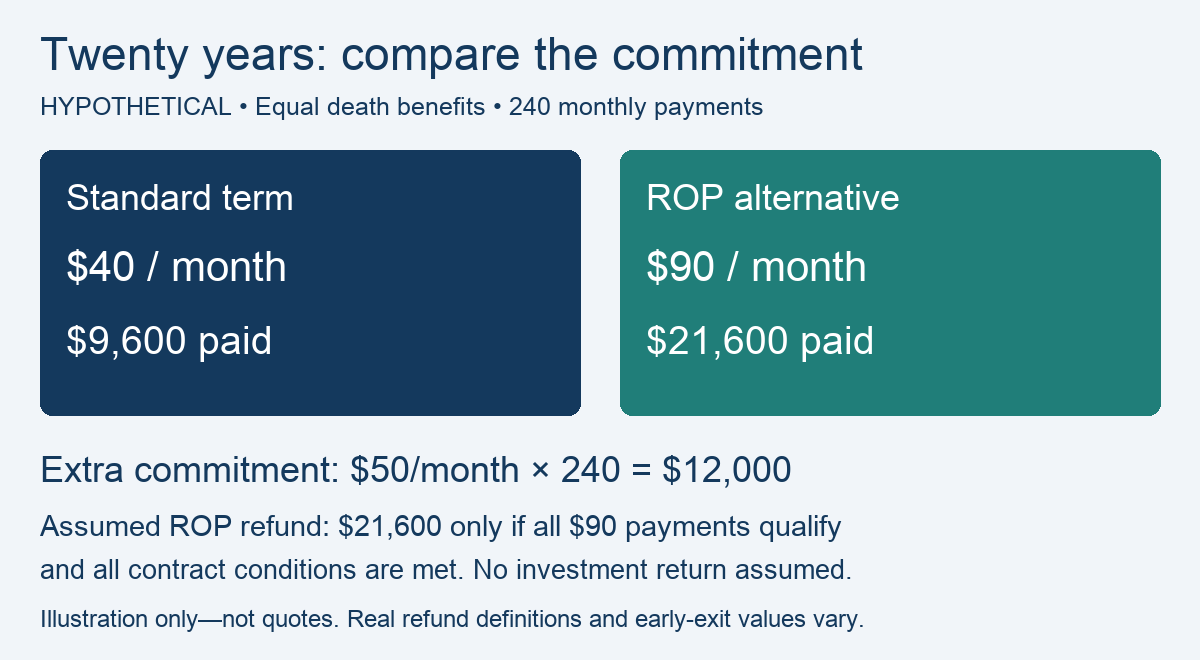
Let’s use a made-up comparison so we can follow the arithmetic. Both policies have the same death benefit and a twenty-year term. Standard coverage is $40 a month; the ROP option is $90. These are invented numbers, not current quotes, carrier offers, or estimates of what you would pay.
Over 240 monthly payments, the standard policy costs $9,600 and the ROP alternative costs $21,600. The additional commitment is $12,000: $50 more each month for twenty years. For this example only, assume the full $90 monthly payment qualifies for the end-of-term refund and that all conditions are met.
Meet those assumptions and the qualifying premium refund would be $21,600. That sounds like a substantial check. Just remember what it represents: the eligible payments coming back, not $21,600 of investment profit. The standard policy’s $9,600 bought protection during the term. We need both sides of the comparison before deciding what fits.
What if you bought the standard coverage and set aside the extra $50 each month yourself? Your contributions would total $12,000. That figure includes no interest or investment return, and makes no allowance for taxes, fees, or withdrawals. We aren’t predicting which approach would leave you with more spendable money. We’re showing where the payments go.
Keep the assumptions beside the numbers: equal coverage, equal terms, every required payment made, and all of the hypothetical $90 eligible for the refund. A real policy may use a different definition of returnable premium. Before deciding about return of premium life insurance, replace our made-up figures with two actual offers.
There’s a practical side to setting the money aside yourself. Depending on where you keep it, it may be easier to reach in an emergency. It may also be easier to spend. A contractual refund arrangement can encourage you to stay with the plan, but changing course may cost you. How you handle the money belongs in this discussion, too.
Be careful when a comparison adds investment growth on one side. Is that growth guaranteed? Could you lose money? Have taxes, fees, and access limits been included? A market investment, an insurance contract, and a savings account don’t carry the same risks. Putting an assumption into a tidy spreadsheet doesn’t make it certain.
And ask the uncomfortable but necessary question: what if you die during the term? What would your beneficiaries receive for a covered death? Does this particular design add anything to the stated death benefit? Don’t assume they get that benefit plus every premium you paid. Ask to see the provision before adding the two together.
What happens if you stop early?
Leaving before the refund date can change the comparison considerably. Some designs may have little or no early value; others have a surrender schedule. Ask for the guaranteed amount at specific years and what missed payments, reduced coverage, or ending a rider would do to it. The final refund is not necessarily money you can collect today.
If you needed to leave in year seven, what exact amount could you receive—and what protection would end?
Already own the policy? Get its current values rather than relying on the original sales material. We can’t change what you paid in the past. We can compare what keeping it would cost from here with what leaving would mean—including any protection you would still need to replace. That’s the decision in front of you now.
Do not cancel existing protection while a replacement is merely being quoted or underwritten. Changed health, new policy terms, and new contestability provisions may matter. Confirm that any replacement is issued, accepted, paid as required, and effective before making a change. Our life insurance replacement guide covers the comparison in more detail.
Ask what happens after the refund date
The refund arrives. Terrific. But do you still need life insurance? Ask what happens to the death benefit after that date, whether coverage can continue, what it would cost, and which deadlines apply. Spending a premium refund and arranging continued protection are separate decisions. Your household may need to consider both.
If your children are independent and the debts are paid, you may need less protection later. If someone will depend on you for life, you may still need substantial coverage. Have that conversation well before the refund date. Waiting until the last payment leaves less time to consider conversion, continuation, or a new application.
Who gets the refund is another question worth asking. The policy owner generally controls decisions under the contract; a beneficiary is designated to receive a covered death benefit. Those roles aren’t interchangeable. Check who would receive a living refund under your actual ownership arrangement rather than assuming every policy payment goes to the same person.
Keep the qualifying date, payment instructions, ownership details, and any required forms together. Update your contact information if you move. This doesn’t have to become a filing project. You just want the records somewhere you can find them, without reconstructing twenty years of insurance history from old bank statements.
A refund is different from cash value or a dividend
A premium refund under an ROP provision isn’t the same as cash value in permanent life insurance. Cash value has its own rules for access, charges, and effects on coverage. Buying a refund feature doesn’t automatically give you an account you can dip into whenever you need cash. Ask what is available before the final date, not just at it.
Dividends are another separate subject. A participating policy may pay nonguaranteed dividends according to its provisions and the insurer’s results. Those payments should not be confused with a specified end-of-term refund. Our cash value guide explains permanent-policy values, while the refund comparison here concerns a different design and decision.
And a free-look period is something else again. That’s your opportunity to examine a newly issued policy under the applicable rules. Returning a new contract during that period is different from keeping an ROP policy for years to qualify for its refund. Check the actual deadlines and conditions so you don’t mix up the two.
If taxes could change your decision, check with your accountant or another qualified tax adviser. Ownership, policy transactions, and the amount received can matter. We don’t need to promise you tax-free money to have a useful discussion about the protection, the payments, and the refund conditions.
When could return of premium life insurance fit?
Return of premium life insurance may be worth a closer look if the coverage meets your needs, the payment fits comfortably, and you expect to keep it for the required period. You may simply like having a defined refund arrangement. That’s a reasonable preference. Let’s still compare the actual cost, the payments that qualify, and what happens if your plans change.
Standard term life insurance may make more sense if the priority is an affordable payment or the larger death benefit your family needs. It may also suit you if you prefer to keep extra savings separate. Outliving a policy doesn’t mean it failed. You had protection during the years you bought it to cover.
We would slow the conversation down if there’s no room left in the budget, your income is unpredictable, or you may need those extra dollars before the term ends. We would also ask more questions if the presentation skips early-exit values or calls the refund “free insurance.” An appealing feature shouldn’t need its costs hidden to make sense.
Already have workable protection? Don’t replace it just because the refund sounds appealing. And don’t keep an unsuitable policy only because you’ve already put money into it. Bring the contract, current values, and future payments into the comparison. Then look at the choices available now, including any new underwriting or charges.
THE OCALA INSURANCE GUY · HOUSE AD
Same dollars. Smaller groceries.
That enormous cart with one loaf of bread is an exaggeration. The buying-power question is real: the same number of dollars years from now may buy less. Inflation can change what a refund buys. Start with the protection your family needs, then consider when the refund could arrive, what conditions apply, and where it would fit in your budget.

Questions to settle before signing
Before signing, could you explain the comparison back to us in your own words? That’s a useful check. Keep the death benefit, term, payment, refund conditions, and early-exit values together. If an answer depends on a policy provision, ask where to find it. Signing faster won’t make an unclear answer any clearer.
Take these questions with you, whether you’re buying new coverage or reviewing what you already own. If you hear “that’s how these policies work,” ask how it works in your actual contract, state, and ownership arrangement. The final underwriting offer matters, too. We want answers about your proposed policy, not a general description of someone else’s.
- Do the death benefit and term meet our actual protection need?
- What additional payment buys the return feature?
- Which premiums and fees qualify for the refund?
- What could reduce or eliminate the refund?
- What guaranteed value is available if we leave early?
- What happens to protection after the qualifying date?
- Which amounts are contractual guarantees, and which are assumptions?
Bring the questions even if you do not have every answer. Through The Ocala Insurance Guy Contact Form, we can help organize an insurance comparison around needs, goals, and budget. General information is enough to begin; keep medical records, account numbers, and policy documents out of the initial message.
Make the insurance decision before spending the refund
Is return of premium life insurance worth it? Start with whether the term life insurance gives your household the protection it needs at a payment you can keep making. Then look at the premium refund: what counts, when it’s payable, and what happens if you leave early. The future check is only one part of that decision.
You should understand the choice before you feel excited about it. If the extra payment is comfortable and the conditions and trade-offs fit your priorities, the refund feature may deserve consideration. If they don’t, suitable standard coverage can still do an important job. We want you to leave knowing what you’re buying, why it fits, and what it takes to keep it.
About Jay A. Cohen, The Ocala Insurance Guy
Jay A. Cohen is a licensed health and life insurance agent based in Ocala, Florida. He is licensed in Florida, Virginia, Illinois, Utah, and California.
Our approach is educational: we listen to understand your needs, goals, and budget, then explain your options in plain language. We walk through the benefits, costs, and limitations, welcome your questions, and help you make an informed decision without pressure to buy a particular product.
To explore permanent coverage and available policy options, visit the Jay A. Cohen life-insurance information page. You can also learn more about Jay’s educational approach and insurance experience.
Want to compare the refund feature with suitable standard coverage? Use The Ocala Insurance Guy Contact Form. Please leave medical records, account details, and policy numbers out of the initial message.
This article provides general education, not individualized insurance, legal, tax, or investment advice. Availability, premiums, benefits, exclusions, guarantees, and refund rules depend on the insurer, state, underwriting, and actual contract. Examples are hypothetical and are not quotes or forecasts. Guarantees depend on the insurer’s claims-paying ability and contractual conditions. Photographs are AI-generated illustrations, not actual clients or documented events.