

If you already have health insurance, do you still need life insurance? That’s the question behind life insurance versus health insurance. Health insurance helps with covered medical costs when you need care. Life insurance generally pays a death benefit to the people or organizations you name if you die while the policy is in force and the claim is covered.
Here’s where we’d start. If you landed in the hospital, what would you owe for the care? If your family lost your income, how long could they keep up with the bills? Asking both questions makes life insurance versus health insurance a lot easier to sort out. It also gives us a place to start with the coverage you already have.
Maybe you have a medical plan at work and a small life policy through the same employer. Great. Pull up both benefit summaries and see what each one would pay and when. Once we know what you’ve got, we can talk about whether there’s a gap worth spending money on.
Have a question about your own coverage while you read? Use our Contact Form and we’ll help you sort through it.
Life insurance versus health insurance: two different jobs
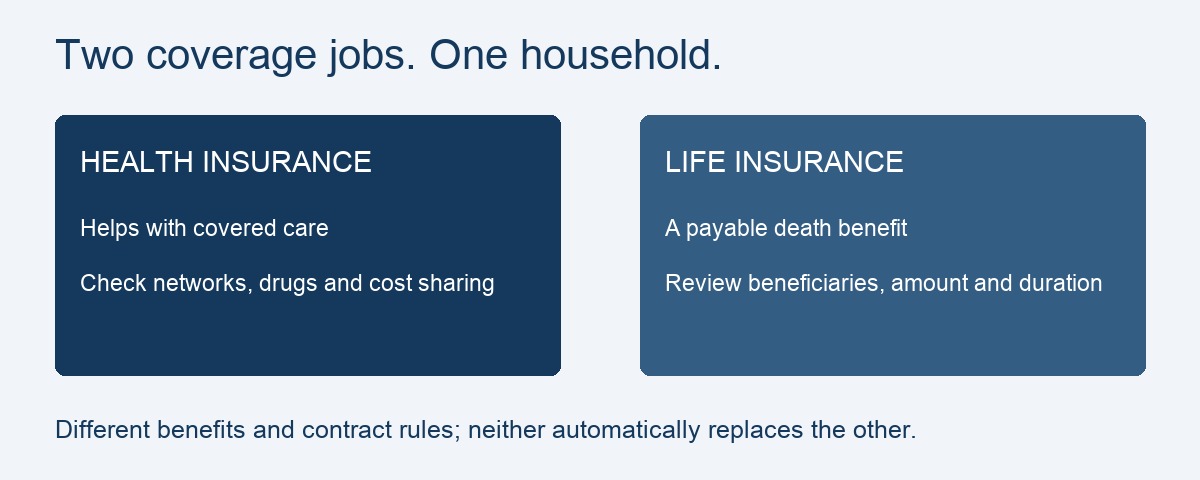
Health insurance helps pay for covered care under a plan’s rules. Life insurance generally pays a death benefit to the named beneficiary when a covered death occurs. That’s the basic life insurance versus health insurance distinction. The trigger for payment, the person receiving it and the purpose of the money are different.
An insurance card tells you where to start when you need care. Now picture the bills that would still show up at home if someone died. The mortgage, the groceries and the after-school care still need paying. That’s the part of the conversation we’d have with the life policy in front of us.
Here’s a hypothetical situation: a parent needs surgery, recovers and returns to work. Their health plan may help with covered treatment, subject to its terms. A standard life policy doesn’t pay a death benefit merely because surgery occurred. The household should also consider how it would cover bills during time away from work.
Now suppose the parent dies and the life policy pays a death benefit. The family could use that money for rent, groceries or another month of childcare. That’s where life insurance versus health insurance gets real. Who would be left paying those bills, and what money would they have to work with?
What would your household need help paying?
Grab a piece of paper and make two lists. On one, put the doctors you see, the prescriptions you fill and the medical bills you might have to pay yourself. On the other, put what someone would have to cover if you died. Start with housing, childcare, income and final expenses. That’s a practical way to work through life insurance versus health insurance at your own kitchen table.
If your health plan helped with a hospital bill, what would still need paying at home? And if your income stopped permanently, who would be carrying those expenses? We can talk through both questions before we ever get to a quote. A few bills and a rough idea of who depends on you will get the conversation started.
A hypothetical single adult with no dependents may place particular emphasis on usable health coverage and a manageable reserve. A parent supporting children may also have a substantial life coverage need. Dependents, debts, existing assets and the value of unpaid work can change the conversation.
Our life insurance needs calculator can help organize protection needs and existing resources. It doesn’t quote a policy or compare health plans. Use its estimate as a starting point, then discuss the assumptions. In life insurance versus health insurance planning, each side needs its own suitable tool.
Medical costs: look beyond the monthly premium
Your premium keeps coverage active; it isn’t the full healthcare budget. Medical costs may also include deductibles, copayments and coinsurance. A deductible is an amount you pay toward certain covered services before the plan pays its share. Copayments are fixed amounts; coinsurance is a percentage. Check which applies to the care you actually use.

An out-of-pocket maximum can limit certain covered spending during a plan year. It isn’t a ceiling on every dollar connected with healthcare. Premiums, noncovered services and some out-of-network spending can fall outside it. HealthCare.gov explains the protection against high medical costs; your plan documents supply the applicable details.
Start with your own routine. Is your doctor in the network? How much would you pay to fill the prescription you take every month? A lower premium can look good on the enrollment screen. The picture can change when you add up what it costs to keep getting the care you count on.
For life insurance versus health insurance, compare prices within each coverage’s job first. Match health plans against doctors, drugs and expected use. Match life proposals against benefit amount, duration and contract conditions. Putting two unrelated premiums next to each other won’t tell you whether either policy solves the problem you need it to solve.
Who receives the money?
Health-plan payments commonly go to providers or reimburse eligible care, with the member responsible for their share. A life policy’s payable death benefit goes according to its beneficiary and ownership arrangements. The NAIC life insurance overview explains the basic role of named beneficiaries and the difference between term and cash-value coverage.
Receiving a life benefit generally doesn’t mean beneficiaries must submit grocery receipts or prove how each household dollar was spent. Ownership arrangements, trusts and other circumstances can affect access. The important life insurance versus health insurance point is that a death benefit isn’t a health-plan reimbursement account. It serves a different financial purpose.
In a hypothetical family, a surviving spouse might use available life proceeds to keep housing stable, arrange childcare or reduce working hours temporarily. That doesn’t make every proposed coverage amount appropriate. We’d discuss the responsibilities, available resources and desired time frame before comparing suitable policy options and a premium the household can maintain.
Review beneficiary names and any backup beneficiaries. A backup, often called a contingent beneficiary, matters if the first person cannot receive the benefit. Special arrangements involving minors or trusts deserve professional guidance. Our beneficiary rules article provides a useful starting point for the questions to raise.
Don’t assume the person listed as a health-plan dependent is automatically the beneficiary of your life coverage. They are separate designations. This is an easy life insurance versus health insurance mix-up to prevent: check each record directly. Ask the insurer or benefits administrator to confirm what is currently on file rather than relying on memory.

THE OCALA INSURANCE GUY · HOUSE AD
Different jobs. Different coverage.
A rain boot and a dress shoe. Which one would you grab to take the dog out in a downpour? The answer depends on the job. We’d ask the same kind of question about life insurance versus health insurance. What do you need the coverage to do, and what would you still have to pay for yourself?
Death benefit: decide who needs protection and for how long
A death benefit amount should have a reason behind it. Consider the income or services that would need replacing, existing obligations and resources that could realistically be used. Avoid treating a familiar income multiple as a finished recommendation. Life insurance versus health insurance planning starts with your circumstances, not a number somebody else used.
Term coverage provides protection for a specified period under the contract. Permanent coverage is designed for longer-lasting needs, subject to its funding and policy requirements. Some permanent policies have cash value. Deciding between them is a separate question from deciding whether you need health coverage; owning permanent insurance doesn’t eliminate medical costs.
Our term and whole life comparison explores that choice in more detail. For this discussion, keep the purpose visible: who needs financial support, for how long, and at what sustainable cost? We can help compare the available coverage without making cash value or a particular policy category the automatic goal.
Here’s what we’d ask when we look at a proposal together. If the family needs help until the kids are out of school, how many years does that take? If someone may need support for longer, how would we account for that? A life insurance versus health insurance review is easier when you can put a reason next to each benefit you’re paying for.
Protection includes the work nobody invoices
Unpaid household work has financial value, too. In a hypothetical household, one parent manages childcare, transportation and care for an older relative. Losing that person could create new expenses even without losing a salary. A death benefit review should consider those tasks; the coverage question deserves more thought than checking whose name appears on a paycheck.

Can life insurance help while you’re alive?
Some life policies include riders that allow access to benefits during life if specific conditions are met. A rider is a provision that adds or changes coverage. These benefits have definitions, limits and consequences. Life insurance versus health insurance still matters: an eligible rider payment does not turn a life policy into comprehensive medical coverage.
An accelerated death benefit may permit access to part of the benefit under qualifying circumstances and can reduce what remains for beneficiaries. It is not an automatic payment for any illness. Read the actual rider. Our living benefits explanation can help you prepare questions about eligibility and trade-offs.
Cash value also needs careful explanation. It isn’t the same as a checking account, and not every life policy has it. Taking money out may involve loans, withdrawals, charges or reduced protection. Ask for the contract-specific effect before using policy value for medical costs, and seek tax advice about consequences where appropriate.
A hypothetical policyholder hears that their life policy includes a living benefit and assumes they can drop health coverage. Before any decision, they need to know exactly what qualifies, how much is payable and what remains excluded. A narrow benefit may leave substantial care needs unanswered. Similar words on a brochure don’t establish equivalent protection.
Does health history affect both applications the same way?
What if you have a health condition and you’re shopping for both? A life insurer may ask about your health as part of underwriting, the process it uses to decide whether to offer coverage and at what price. Marketplace health plans must cover pre-existing conditions. Which kind of coverage you’re looking at matters here.
HealthCare.gov describes health-plan rights and protections, including protections involving preexisting conditions. Check the applicable coverage category. Limited-benefit and other products can work differently. In life insurance versus health insurance shopping, first identify the product accurately; the word insurance alone doesn’t establish the benefits or protections.
An exam-free life application also isn’t necessarily question-free or guaranteed approval. Answer application questions accurately and use the insurer’s appropriate process for sensitive information. If you have existing life coverage, new underwriting can affect the feasibility of replacing it. We can explain available application paths without promising an offer or a particular rate.
For a hypothetical adult managing an ongoing condition, the useful next step is to separate health-plan enrollment questions from a life application. Review doctors and prescriptions on one side; discuss accurate underwriting information on the other. Life insurance versus health insurance becomes less intimidating when we stop assuming one application result determines all other choices.
Life insurance versus health insurance: when can coverage start?
Timing differs, too. Health-plan enrollment may depend on an employer’s rules, annual enrollment or a qualifying event. Life insurance generally involves its own application and effective-date process rather than Marketplace enrollment dates. Neither a submitted form nor a premium estimate alone proves coverage has begun. Obtain confirmation of the actual start date.
Marketplace special enrollment opportunities may follow qualifying changes, with conditions and deadlines. Confirm the rule for your situation through the appropriate Marketplace or administrator. Avoid assuming that voluntarily ending a policy creates an enrollment opportunity. We can help identify the questions and coverage options to review before you act.
Put the dates on one page. When does the old health plan end? Is there an enrollment deadline? Has the life insurer confirmed when the new policy takes effect? In life insurance versus health insurance planning, even writing down who still owes you an answer can spare you a scramble later.
Ask for written confirmation when a new plan or policy is issued or enrollment is completed. Check any initial-payment requirements and what remains pending. If you’re considering a change, compare the existing terms and replacement carefully before surrendering coverage. Insurer and administrator records matter more than an assumption that someone has already handled everything.

Check both coverages when life changes
A move, marriage, new child or job change can affect both sides of the protection plan. In a hypothetical move, a family needs to confirm their health network and enrollment choices while updating life-policy contact and beneficiary information as appropriate. Life insurance versus health insurance is worth revisiting when the household changes, even if no new policy is needed.
Workplace benefits can include both health and life coverage, but one benefit’s rules don’t establish the other’s. Ask for the actual benefit descriptions, current amounts and conditions. A summary on an enrollment screen is a starting point. We can help organize the documents and identify which answers need confirmation from the employer or insurer.
Employer life coverage may have limits or change when employment ends. Portability and conversion, when offered, have their own terms and deadlines. Health continuation or replacement choices are separate. Our job-change life coverage guide explains why it pays to investigate before the final day of work.
Say you’re changing jobs and have already picked your new medical plan. Before your last day, ask what happens to the life insurance from your old job. Does it end? Can you keep it or convert it, and how much time do you have to decide? Those are easy questions to miss when you’re focused on the new doctor network. Put them on your life insurance versus health insurance checklist.
How do we choose when the budget is tight?
When money is tight, start with the consequences you can least afford and the protections already available. We wouldn’t recommend dropping usable health coverage to buy a life policy on the strength of a comparison article. Nor would we assume a health card resolves a family’s need for a death benefit. Review the whole picture.
What can you keep paying in a month when the car needs work and a prescription costs more than you expected? We’d look at premiums and what you need to set aside for medical costs and other bills. When we talk about life insurance versus health insurance on a tight budget, we want the plan to work in an ordinary month, surprises and all.
For health coverage, compare premiums alongside likely use, providers, prescriptions and potential cost sharing. For life coverage, compare like amounts and durations, underwriting assumptions and guarantees. Ask what would change the payment or benefit. It’s possible to improve clarity without immediately changing a contract, especially when existing coverage already fits the need.
Suppose a couple can afford some additional coverage, but the quote includes extras they’re unsure about. We’d go through each one and ask when it would pay and whether it addresses a concern they actually have. Then we’d compare the cost of the coverage they need with what they can comfortably pay month after month.
Compare the benefit before the price
Before you compare two quotes, write down what you’d want each one to do. If you need a plan that covers a particular prescription, look that up first. If you want a death benefit to help carry the household through the next 20 years, check how long the policy lasts. Those details make a life insurance versus health insurance review more useful than looking at premiums alone.
Be careful with products that pay a fixed amount for a specified event or service. That benefit may help with expenses but may not provide the same protection as comprehensive major medical coverage. Ask exactly what is covered, how payment is determined and what remains your responsibility. We can help distinguish product categories before comparing prices.
Also keep income protection separate. Neither ordinary health coverage nor a standard life death benefit should be assumed to replace wages during every illness or injury. Other benefits may address that need, depending on the circumstances. Identifying this third question prevents life insurance versus health insurance from being asked to solve a problem neither contract necessarily handles.
When two plans look similar on price, pick a service you actually use and see what each plan would pay. With life insurance, put the same death benefit and coverage period side by side, then check what each policy guarantees. That gives you a better idea of what you’re getting for the money.
THE OCALA INSURANCE GUY · HOUSE AD
Check the job first.
We have to give her credit for persistence. That garden’s going to be there a while. When we review life insurance versus health insurance with you, we start with the job you need done and the coverage you already have. Sometimes you’ve already got what you need and just need help figuring out how it works.

What a useful coverage conversation looks like
Jay can help you organize existing coverage, discuss who depends on you, and compare suitable private insurance options he is authorized to offer. For life insurance, that includes benefit purpose, beneficiaries, duration and underwriting. For health coverage, it includes plan availability, costs, networks and prescriptions, with insurer or administrator confirmation where needed.
This is where a second pair of eyes can help. Are those two life quotes for the same number of years? Did we check the prescription you fill every month? When we talk through life insurance versus health insurance, we’ll help you get those details on the table so you can explain what you’re buying and why.
- What care, doctors and prescriptions must a health plan accommodate?
- Who would need financial support if someone died?
- What death benefit and coverage duration serve that need?
- What medical costs would remain outside the premium?
- Which enrollment, termination and effective dates need confirmation?
If you’d like help separating your protection needs from your healthcare budget, use our Contact Form. Mention your state, current coverage types and the decision you’re weighing. Leave medical records and policy numbers out of the initial message. We’ll explain what information belongs in the appropriate secure process.
Build a plan around both questions
Life insurance versus health insurance comes down to two useful questions: how would you handle covered medical costs, and how would people manage financially if you died? A death benefit and a health plan answer different parts of that picture. Understanding the difference helps you review both without forcing an either-or decision.
Start with what you have today. Pull the benefits from work, any policies you bought yourself and a rough list of the bills your household would still have to cover. We can sit down with those details and talk through life insurance versus health insurance around the people who count on you and the budget you’re working with.
About Jay A. Cohen, The Ocala Insurance Guy
Jay A. Cohen is a licensed health and life insurance agent based in Ocala, Florida. He is licensed in Florida, Virginia, Illinois, Utah, and California.
Our approach is educational: we listen to understand your needs, goals, and budget, then explain your options in plain language. We walk through the benefits, costs, and limitations, welcome your questions, and help you make an informed decision without pressure to buy a particular product.
To explore permanent coverage and available policy options, visit the Jay A. Cohen life-insurance information page. You can also learn more about Jay’s educational approach and insurance experience.
Want help reviewing life insurance versus health insurance around your family’s needs, existing benefits and budget? Use The Ocala Insurance Guy Contact Form. Please leave medical records, account details, and policy numbers out of the initial message.
General education only, not individualized insurance, legal, tax or investment advice. Scenarios are hypothetical, not client experiences or recommendations. Coverage, underwriting, eligibility, benefits, costs and availability vary by product, insurer, state and contract. Insurer and plan documents govern; confirm enrollment and effective dates before ending existing protection. Photographs are AI-generated illustrations; house-ad scenes are fictional.