

How does indexed universal life insurance work? It combines life insurance protection with policy value that may receive interest linked to an index. You do not buy the index itself. Premiums, expenses, crediting rules and the death benefit all work together inside an insurance contract. If you’re looking at a proposal, start by asking where your premium goes and what could change after you buy.
If you have heard that indexed universal life insurance gives you market growth without losses, slow down for a minute. A floor can limit the downside of an index-credit calculation. It does not erase insurance charges or guarantee that your total policy value will stay level. We want you to understand both the useful flexibility and the commitments behind it.
This guide follows the money through a policy, then looks at the questions worth asking before buying or changing one. We’ll keep the examples hypothetical and the language practical. Our goal is for you to explain how indexed universal life insurance works in your own words, including what could require attention years after the application is approved.
Have a question about your own coverage while you read? Use our Contact Form and we’ll help you sort through it.
How indexed universal life insurance works for your household
Start with the insurance job. Who would need money if you died, what responsibilities would remain, and how long would those responsibilities last? A permanent insurance need may involve lasting family support or a legacy goal. A temporary need may be addressed differently. The product’s features should follow that decision rather than make it for you.
Indexed universal life insurance, or IUL, is designed for long-term coverage when sufficiently funded and maintained under its terms. It can build cash value alongside a death benefit. Neither the words permanent nor flexible mean the policy is guaranteed to continue regardless of payments, charges, loans or other activity.
We can begin with our life insurance needs calculator to organize household responsibilities. Its estimate is a discussion tool, not a carrier quote or an instruction to buy a particular policy. Before comparing crediting strategies, decide how much protection belongs in the conversation and what payment fits comfortably alongside your other priorities.
Understanding how indexed universal life insurance works also means knowing the people involved. The owner controls policy rights, the insured is the person whose life is covered, and beneficiaries receive the payable death benefit. Those roles can belong to different people. Ownership or beneficiary arrangements involving trusts, businesses or children deserve additional legal guidance.
Where does your premium go?
Your indexed universal life insurance premium is the money you pay the insurer. It does not all become immediately available cash value. Depending on the contract, deductions may apply when a payment arrives, while insurance and administrative charges continue over time. The balance available for interest crediting follows the contract’s rules. Ask for the actual expense pages rather than a verbal estimate.
Think of learning how indexed universal life insurance works as opening a machine’s cover before deciding whether it belongs in your home. You want to see what moves, what needs maintenance and what the controls actually change. An attractive outside label cannot tell you whether the inner workings fit the job you need done.
Cash value and death benefit answer different questions. Cash value is the amount that builds inside an indexed universal life insurance policy after applicable deductions and credits. On an illustration, compare the account value with the cash surrender value for the same policy year. They answer different questions about what has accumulated and what you could receive if you surrendered the policy. The death benefit addresses what beneficiaries may receive when the insured dies while coverage is in force, subject to policy terms and claim review. Do not assume beneficiaries automatically receive the stated benefit plus the entire cash value as a separate bonus.
Cash surrender value is another figure: generally the amount available when you end the policy after applicable surrender charges and debt are considered. Early surrender values may be substantially below total premiums. If you may need the money soon, ask about that before committing. Our indexed universal life insurance cost guide examines payment and expense questions in more detail.
See how the moving parts connect
To understand how indexed universal life insurance works, separate the moving parts. Your premium helps support protection and policy value. The insurer applies the contract’s deductions and crediting provisions. Values then change with those transactions. Before comparing proposals, ask how a change to one part affects the others: a smaller payment, for example, may change the future support available for coverage.

In indexed universal life insurance, the index is a reference used in an interest-crediting formula. It is not an account of stocks held in your name. Different strategies may reference different indexes, measuring periods or methods. Ask what is being measured and whether dividends are excluded. A familiar index name does not mean your policy earns the same return an investor in an index fund receives.
Indexed universal life insurance policies do not all use the same crediting menu. A cap limits a crediting rate. A participation rate determines how much of a measured index change enters a calculation. A spread subtracts an amount under the strategy’s rules. Some strategies combine features, so one number rarely tells the full story.
Consider three separate hypothetical calculations, not actual quotes. A 10% measured gain with a 70% participation rate produces 7% before other adjustments. A strategy with an 8% cap might limit an otherwise eligible 10% credit to 8%. A 2% spread applied to a 10% gain could leave 8%. These illustrate possible indexed universal life insurance formulas, not an actual policy.
Index credits: can zero still mean a lower policy value?
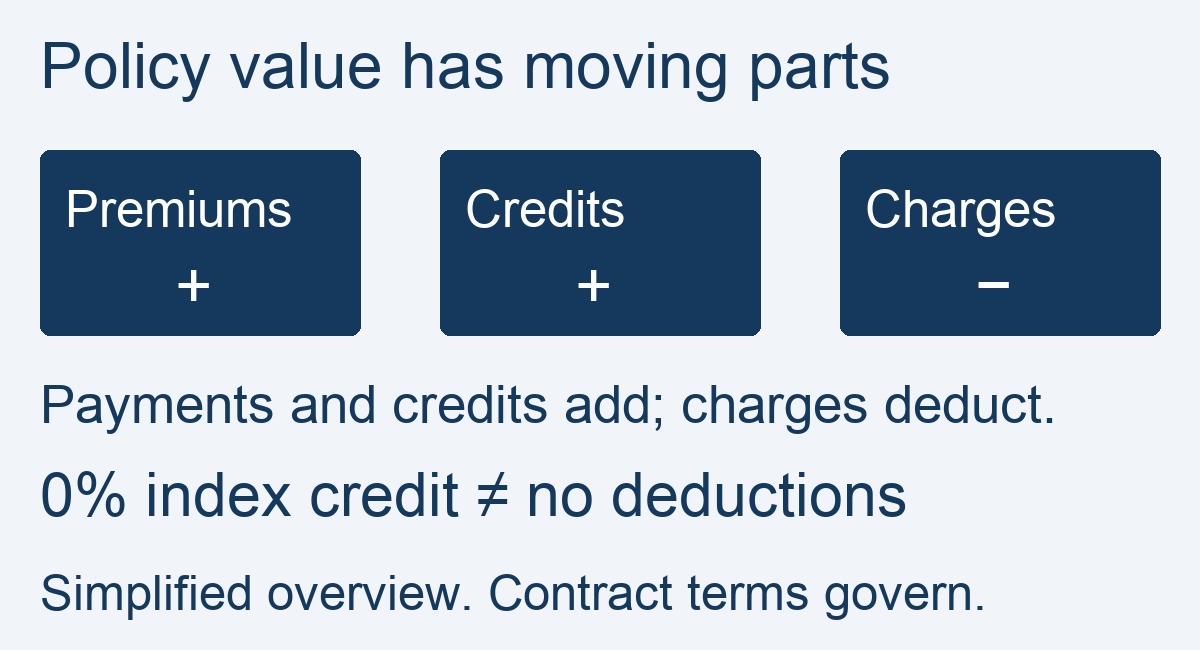
A floor sets the minimum credit under a particular strategy. Many indexed accounts use a 0% floor for the index-credit calculation. But policy deductions continue. If no index interest is credited and charges are deducted, policy value can decrease. That’s one of the most important parts of how indexed universal life insurance works. When you read a statement, look for index credits and policy charges on separate lines.
Here is another hypothetical example, simplified to isolate the issue. An account begins with $20,000, receives no additional premiums or index interest, and has $1,200 deducted in charges. Ignoring other activity, the ending value is $18,800. The index credit stayed at zero; the account did not. These assumed amounts are arithmetic teaching figures, not representative policy charges.
The floor does useful work within the formula, but it is not a guarantee of your net result. Pacific Life’s indexed-account guide shows how specific indexed universal life insurance products use a 0% crediting floor while policy charges and other activity can still reduce cash value. Ask for the contract and illustration that apply to your own proposal.
Timing matters in indexed universal life insurance, too. An indexed account may measure change over a defined segment, meaning a specified crediting period. Premium arrival, allocation dates, withdrawals and segment maturity can affect which money receives a credit and when. A rising market headline today does not tell you the credit your policy will receive on its next statement.
Ask which crediting terms are guaranteed and which the insurer may change within contractual limits. A current cap or participation rate need not remain unchanged indefinitely. When reviewing how indexed universal life insurance works, compare the actual formula, index method and adjustment rights instead of assuming the largest displayed participation rate must be the best offer.

THE OCALA INSURANCE GUY · HOUSE AD
The floor is not the finish
The escalator can stop while the charges keep moving. If you’re comparing indexed universal life insurance proposals, ask to see what happens to cash value after a year with zero index credits. Then ask what several low-credit years in a row could mean for the premium you planned to pay.
Flexible premiums still need a funding plan
Indexed universal life insurance may allow payment flexibility, but flexibility has boundaries. Available value can sometimes support deductions when a payment is reduced or missed. That does not make premiums optional forever. Coverage can lapse if required support is insufficient and no applicable guarantee protects it. Lapse means the insurance ends after the contract’s required notice and grace procedures.
The premium shown on an illustration may be a planned payment rather than a promise that the same payment sustains coverage for life. Ask what it accomplishes under guaranteed assumptions and under the illustrated assumptions. Learning how indexed universal life insurance works includes finding out what happens if index credits disappoint, not only what happens when the ledger looks comfortable.
If indexed universal life insurance includes a no-lapse guarantee, that guarantee has its own conditions. Payment amounts, timing, distributions or other policy changes may affect it. Obtain the insurer’s explanation of the actual guarantee rather than treating the product category as proof. Our fully funded IUL guide separately explains why an ambitious funding plan is not automatically paid-up insurance.
Before adding extra money to indexed universal life insurance, confirm the contract’s limits with the insurer. Tax qualification and modified endowment contract rules can affect funding and distribution treatment. A modified endowment contract, or MEC, is life insurance subject to different tax rules for accessing value. More premium is not automatically better if you have not checked how the actual contract handles it.
Read the conditions before choosing
Choosing long-term coverage deserves practical curiosity: what does it need, what can change, and what happens if circumstances become less favorable? Read the conditions before committing, just as you would check the care requirements for something you expect to maintain for years. We can walk through how indexed universal life insurance works alongside your sustainable budget before comparing available policies.

An indexed universal life insurance illustration is a structured demonstration of policy values under stated assumptions. It is not a forecast. The NAIC explanation of life insurance illustrations distinguishes guaranteed and nonguaranteed elements. Look at which figures fall in each category, then ask the insurer or agent to explain why the columns differ.
For a useful comparison, align the insured information, death benefit, benefit option, payment amount and timing, and any proposed distributions. Otherwise, one illustration may look better because it assumes more money or less protection. Understanding how indexed universal life insurance works gives you a way to ask better questions; it does not turn unlike designs into a fair comparison.
For indexed universal life insurance, request lower-crediting scenarios as well as the current illustration. Ask when coverage might need additional support and how stopping premiums changes the result. Look beyond a single chosen year. A policy that appears comfortable at the end of planned payments may face different conditions later, particularly when distributions or accumulated debt enter the picture.
Our indexed universal life insurance funding and illustration calculator can help organize assumptions and figures. It does not create an official carrier illustration, validate premium limits or determine suitability. Use it to prepare questions, then confirm the answers with actual carrier documents. Our IUL IRR report guide covers performance measurements in greater depth.
How to read an IUL illustration
Here is a useful pause before accepting an indexed universal life insurance proposal: can you point to the payment, expenses, guarantee conditions, available surrender value and projected coverage duration? If those pieces are still unclear, ask for another explanation. You should not need to pretend you understand a complicated chart to keep the conversation moving.
In indexed universal life insurance, the death-benefit option affects what is payable and can influence the relationship between value and insurance charges. A level option generally differs from an increasing option, but policy terms govern the details. Ask for the benefit payable at several future dates and after proposed loans or withdrawals. Do not assume all designs pass accumulated value to beneficiaries in the same way.
Beneficiaries also need clear, current instructions. Our beneficiary rules guide explains practical designation questions. The contract can be sophisticated while the family’s basic paperwork is out of date. Reviewing names and ownership is part of useful guidance, especially after marriage, divorce, a birth or a death in the family.
How indexed universal life insurance works for a household depends partly on when it needs protection and when it needs liquidity. Suppose two hypothetical households have identical incomes but different goals. One primarily needs coverage until children become independent. The other has a lasting support obligation. Matching the policy to the responsibility may lead them toward different types of insurance.
Benefits, ownership and the money available
If indexed universal life insurance develops sufficient value, a withdrawal may make some of it accessible, subject to contract provisions. It removes value and can reduce protection. There may be charges and tax consequences. Before taking one, ask for the amount available, the effect on the death benefit and the effect on the policy’s ability to meet future deductions.
An indexed universal life insurance loan is different: the insurer advances money secured by policy value, and interest accrues under the loan provisions. It is not free income and not simply taking your own deposit out of a checking account. Outstanding debt generally reduces available value and the benefit remaining for beneficiaries. Loan choices and crediting treatment vary by contract.
Ask whether loan interest is fixed or variable, whether you will pay it or add it to debt, and how borrowed value is treated. An indexed universal life insurance illustration may show favorable loan leverage, meaning assumed credits exceed borrowing costs. That result is not guaranteed. Lower index credits, higher interest or growing debt can make a distribution plan less sustainable.
Tax claims about indexed universal life insurance need the same care as crediting claims. Do not rely on an unqualified promise of tax-free retirement income. Contract status, transaction history, distributions and whether coverage remains in force all matter. The IRS discussion of life insurance surrender explains that proceeds above policy cost can be taxable. Obtain advice for your own transaction.

Keep the policy working over time
A long-term plan needs ongoing care. For indexed universal life insurance, that means opening the statement, checking actual index credits and deductions, and reviewing any debt. We can help identify what changed and request an updated in-force illustration, a projection for a policy already issued. That gives you a current view instead of relying indefinitely on the original sales ledger.
Your automatic payment can stay the same even when the cash value in your indexed universal life insurance policy falls behind what the original illustration showed. Compare actual values with prior expectations and ask what now supports the intended coverage duration. The Wisconsin regulator’s universal-life alert explains the importance of monitoring funding. Its general consumer lesson is useful; your contract and applicable state requirements still control.
Learning how indexed universal life insurance works does not require treating every disappointing year of index credits as a crisis. It requires a plan for responding. Possible questions include whether payments should change, distributions should be reduced or debt should be repaid. Ask the insurer to demonstrate alternatives before acting, especially when a change could affect guarantees or tax treatment.
Review after major life changes as well as on a regular schedule. A new dependent, changed income, retirement or a different legacy goal can change the insurance job. Keep emergency savings separate from assumptions about future policy access. An indexed universal life insurance commitment should not leave you unable to handle ordinary short-term surprises without borrowing against coverage.
IUL trade-offs and alternatives
Indexed universal life insurance offers potential flexibility in payments, benefits and crediting choices, along with complexity, expenses and continuing responsibilities. Those are meaningful trade-offs. If your main need is an affordable temporary death benefit, compare suitable term insurance. If contractual certainty is the priority, examine appropriate guaranteed alternatives and their required commitments rather than assuming indexed crediting is the deciding feature.
Our term and whole life comparison can help frame alternatives. There is no category that fits every household. Someone who dislikes ongoing monitoring may reasonably value a simpler arrangement. Someone with a lasting need, sufficient budget and realistic expectations may want to examine permanent options more closely with qualified help.
Watch for claims that combine all the attractive parts of different products into one description: stock-market returns, no losses, unlimited flexibility and unrestricted access. Ask which contract provisions support each statement. Understanding how indexed universal life insurance works should leave you more comfortable asking specific questions, even when the person presenting the proposal sounds certain.
If you already own indexed universal life insurance, a new illustration is not enough reason to replace it. Surrender charges, new underwriting, changes in guarantees and the terms of new coverage can matter. Review the existing contract first. Do not give up protection before confirming any replacement’s acceptance, effective date and terms, and obtain tax guidance where appropriate.
How Jay can help you compare the choices
We start by listening: what do you need the coverage to accomplish, what can you maintain, and what worries you about the proposal? Jay can help organize those answers, review existing protection and explain suitable private coverage he is authorized to offer. Available carriers and products must be confirmed for your state and circumstances; licensing alone does not establish every appointment.
The practical value of an agent is not making indexed universal life insurance sound effortless. It is making the decision understandable. We can identify mismatched illustration assumptions, explain benefit options, coordinate accurate application information and ask carriers to clarify provisions. The insurer decides underwriting and contract administration; tax and legal professionals address advice in their respective fields.
For a first conversation, bring your coverage purpose, a realistic premium range and the questions you cannot yet answer. If you own coverage, identify the type and the decision you face without sending sensitive records through an initial message. We can then explain how indexed universal life insurance works in relation to that decision rather than deliver a generic product pitch.
Working through an indexed universal life insurance illustration together also creates a useful checkpoint: can you describe what would make the policy need attention? That answer might involve weaker credits, reduced payments, distributions or a changed household need. A good explanation leaves you knowing what to watch and who confirms the answer, not merely which projection looked most appealing.
THE OCALA INSURANCE GUY · HOUSE AD
Set it. Forget it. Regret it?
That plant got ahead of her. When you see how indexed universal life insurance works, the same lesson applies to the annual statement. Check what the policy earned in index credits, what came out in charges, and whether the current payment still supports the coverage you need.

Questions to ask before applying
Before applying, ask for a clear statement of the insurance need, payment plan and alternatives considered. Confirm which figures are guaranteed, which can change and what would be available if you ended coverage early. Request the complete illustration and policy information rather than relying on screenshots or a promotional summary. Keep copies of the documents you receive.
Questions about how indexed universal life insurance works are welcome at any stage. You do not have to master actuarial calculations to ask what happens after a low-credit year or why one premium was chosen. We can explain the insurance pieces, compare appropriate available options and identify questions that belong with the insurer or an independent professional.
- What insurance responsibility are we protecting, and for how long?
- What payment can we maintain, and what could require more?
- Which crediting terms and benefit conditions are guaranteed?
- What happens after low-credit years, withdrawals or loans?
- What alternatives deserve comparison, and when should we review again?
If you want help reviewing an indexed universal life insurance explanation or proposal, use our Contact Form and tell us your state and the decision you are weighing. Leave medical records, account numbers and detailed policy documents out of the initial message. We’ll identify an appropriate process for information needed later.
Understand the policy before choosing it
How indexed universal life insurance works comes down to connected responsibilities: fund the protection, understand the crediting formula, account for deductions, distinguish guarantees from assumptions and review the policy over time. The potential benefits deserve consideration, and so do the limits. Before signing, try explaining the premium, the guarantees and what you would do after a few lean years in your own words.
Your next step can be a plain-language walkthrough rather than an application. Ask what you need, what the contract does and what could change. We can help compare those answers with your budget and existing protection. That conversation may lead to indexed universal life insurance, another form of coverage or leaving a suitable policy in place.
About Jay A. Cohen, The Ocala Insurance Guy
Jay A. Cohen is a licensed health and life insurance agent based in Ocala, Florida. He is licensed in Florida, Virginia, Illinois, Utah, and California.
Our approach is educational: we listen to understand your needs, goals, and budget, then explain your options in plain language. We walk through the benefits, costs, and limitations, welcome your questions, and help you make an informed decision without pressure to buy a particular product.
To explore permanent coverage and available policy options, visit the Jay A. Cohen life-insurance information page. You can also learn more about Jay’s educational approach and insurance experience.
Want help understanding an indexed universal life insurance proposal’s crediting rules, benefits and funding commitments before deciding? Use The Ocala Insurance Guy Contact Form. Please leave medical records, account details, and policy numbers out of the initial message.
General education only, not individualized insurance, investment, legal or tax advice. All numerical examples are hypothetical, not actual quotes, carrier illustrations or client results. Availability, underwriting, costs, benefits and guarantees vary by insurer, state and contract. Guarantees depend on the issuing insurer’s claims-paying ability and applicable conditions. Loans, withdrawals, lapse or surrender may have tax consequences. Photographs are AI-generated illustrations; house-ad scenes are fictional.