

Can you use life insurance to pay off debt? Usually, yes. When an adult beneficiary receives the money directly after the insured person dies, paying debts is generally one of the choices available. Before writing that first check, though, we would ask a very practical question: whose bill is this, and do you actually owe it?
Using life insurance to pay off debt can take a real weight off a household. Imagine opening the mail and knowing the car loan is gone. That sounds good. Now think about groceries, childcare, a broken air conditioner, or a few weeks away from work. The family budget still has to cover those things, even after the loan balance reaches zero.
So where do we start? With the people who would be left making those decisions. We look at the death benefit the policy may pay, who is legally responsible for each debt, and how much cash the household would still need. Once those pieces are clear, the coverage amount starts to mean something beyond a total at the bottom of a statement.
Wondering how this fits your own situation? Use our Contact Form and we’ll help you sort through it.
Can you use life insurance to pay off debt?
For an ordinary personal policy paying an adult beneficiary directly, the money generally is not restricted to one purchase. The beneficiary might reduce a mortgage, clear a car loan, hold cash for living expenses, or combine those choices. A policy assigned to a lender, payable to a trust, or designed as credit life insurance can work differently.
The death benefit is the amount payable under the contract after a covered death and an accepted claim. It is not a checking-account balance available whenever you wish. Coverage must be in force, the claim must meet the policy’s terms, and loans, assignments, exclusions, or other contract provisions may affect what is paid.
The NAIC Life Insurance Buyer’s Guide identifies debt repayment alongside income support and other household needs as uses to consider. That is a useful starting point for planning. It does not mean every family should devote the entire payout to debt.
If you are looking at coverage now, finish this sentence: ‘We want this policy to help someone…’ Stay in the house? Keep up the payments on a car they need? Replace income while the children are growing up? Those answers help us work out how much coverage you need and how long it should last. ‘We do not want to leave bills behind’ is a good starting concern. Let’s give it a practical plan.
First ask whose debt it actually is
A bill can arrive with your loved one’s name on it and make you feel that someone has to take care of it. That feeling is understandable. It does not automatically make the bill your personal responsibility. Separate debts handled through the estate, shared debts, and debts that are your own. The estate is the money and property handled through the legal process after a death; a beneficiary’s insurance proceeds are a separate question.
Being named on a life insurance policy does not, by itself, make you responsible for every debt the insured person owed.
The Consumer Financial Protection Bureau explains that debts generally are handled through the estate, with exceptions for shared responsibility and state law. Co-signing and joint ownership of a credit account matter. Being an authorized card user is different from being a joint account holder.
Before paying a disputed bill with personal insurance proceeds, have an estate or consumer-law attorney check the obligation and applicable protections. We can explain policy features and beneficiary arrangements; the legal determination belongs with counsel. That distinction can prevent a well-intended payment from becoming an expensive mistake.
A family budget includes more than loan payments
Suppose the house and car were paid off tomorrow. Would groceries be free? Would the electric bill stop coming? Of course not. Property taxes, insurance, repairs, transportation, and care responsibilities would still be there. We want the family budget to leave enough breathing room for those ordinary expenses and for decisions nobody should have to rush during a difficult time.

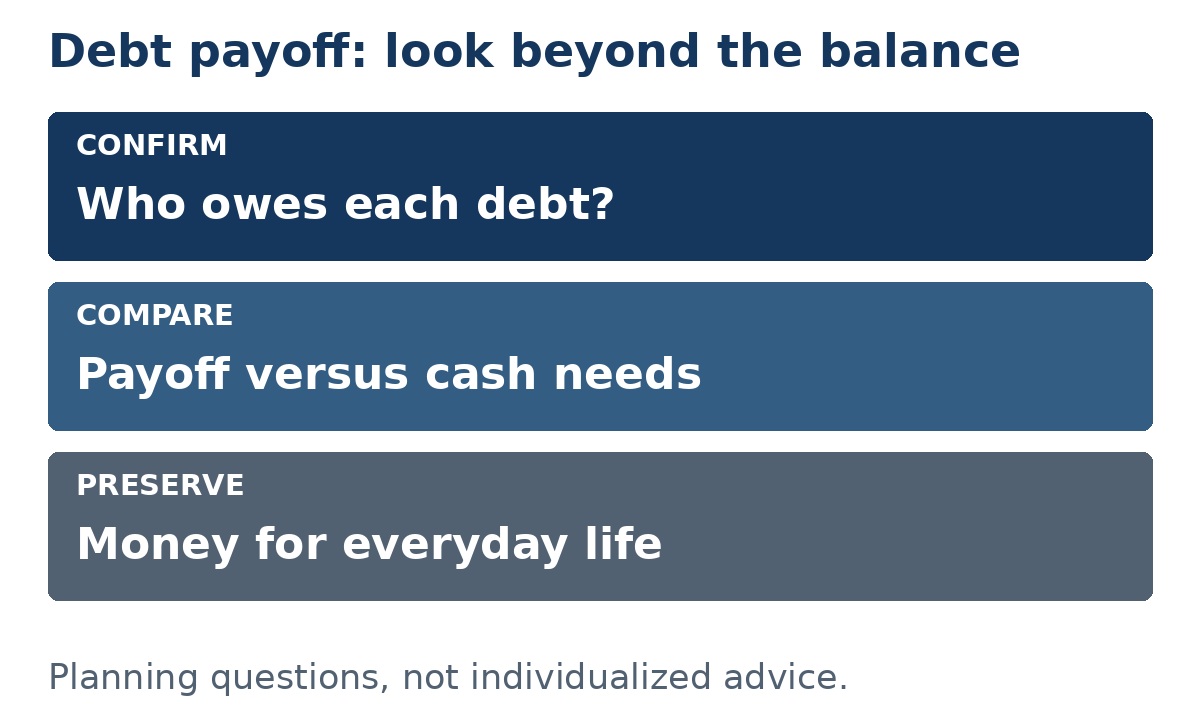
You do not need an elaborate spreadsheet to get started. Three headings on a piece of paper will do: debts, immediate expenses, and continuing support. Then add the work that never shows up on a pay stub. Who handles school pickups, meals, appointments, and household upkeep? Replacing that help can cost money or require someone else to reduce their work hours.
Keep the estimate grounded in the household you actually have. If the survivor would keep working, account for that income realistically. If work hours might fall for a while, model that possibility separately. Do not assume the same spending, the same schedule, or the same support network will automatically continue.
Our Life Insurance Needs Calculator can help organize the assumptions. Treat its result as a planning estimate, not an underwriting decision or a promise of coverage. A useful estimate shows which expenses you included and where you still need information.
Death benefit: who receives the money?
Who actually gets the check? Start with the beneficiary designation recorded by the insurer. The person paying the premium and the person receiving the death benefit can be different people. Check the names and backup beneficiaries on the current record. ‘We talked about that years ago’ is a reason to look, rather than a reason to assume the paperwork says what everyone remembers.
An adult beneficiary receiving money personally generally has spending choices. A trust beneficiary operates through a trustee and trust terms. Naming the estate can bring the proceeds into estate administration. These arrangements serve different purposes, and the consequences need review before you assume the family will have immediate, unrestricted access.
Do not name a lender as beneficiary merely because you want a loan covered without first understanding the alternatives. A collateral assignment can give a lender rights under an agreed arrangement. It is different from simply leaving money to a spouse and hoping that spouse pays the loan.
Our guide to using life insurance as collateral explains that specific lender arrangement. Here, the broader planning question is how to leave enough usable money for a household’s debts and continuing needs. Tell us which job you want the policy to do, and we can help identify the insurance questions the paperwork needs to answer.
Review life insurance beneficiary rules when family circumstances change. A birth, divorce, death, or new caregiving responsibility can make old instructions unsuitable. If a child or a person receiving needs-based benefits is involved, coordinate the designation with qualified legal advice.

THE OCALA INSURANCE GUY · HOUSE AD
The bills kept going.
The grocery receipt in our exaggerated house ad has the right idea about one thing: ordinary expenses keep arriving. Using life insurance to pay off debt should support the family budget, not empty it. Before choosing a coverage amount, we can help you put the debts and the continuing expenses on the same page.
Separate the bills before spending the benefit
Take one bill at a time. Who signed for this debt? What is the balance and monthly payment? Is there already payoff insurance attached to it? Keep the account agreement and current statement together, including the interest terms. The name on a marketing brochure will tell you less than the agreement about who borrowed, what secures the loan, and what is actually required.
Next identify secured debts. A secured loan gives the lender rights in an asset, such as a home or car. Even where a survivor has no personal obligation to repay, keeping the asset can require continued payments or another resolution. Ask the lender and legal adviser what choices apply before assuming the asset is safe to ignore.
Then separate bills owed only by the deceased person. Those may require estate handling rather than voluntary payment from a beneficiary’s own funds. Keep letters and account records for the estate representative. Do not sign a new promise to pay simply because you are trying to be helpful during a difficult week.
Finally, include the survivor’s own obligations. Their car payment, education expenses, or credit balances may still affect the family budget even if the insured never owed those bills. Insurance planning can consider that pressure without pretending every liability transfers from one person to another at death.
Paying off the house is a choice to examine
There is a lot to like about a paid-off house. Still, the roof does not know the mortgage is gone. Property taxes, homeowners insurance, repairs, and any association charges keep coming. Before putting most of a death benefit into the house, we would ask: how much cash will be left, what will living there cost, and does the survivor actually plan to stay?

For some households, getting rid of that mortgage payment is a clear priority. For others, the first question is whether they will keep the home at all. If a move is likely, cash on hand may deserve a closer look while that decision takes shape. We can compare both versions of the family budget before treating full repayment as the obvious next step.
Ask the loan servicer how a partial principal payment would affect the actual bill. A lower balance does not necessarily produce a lower required monthly payment. Recasting, refinancing, and ordinary extra payments are different actions, with different requirements. Get the terms in writing before building a monthly budget around an expected reduction.
The same thinking applies to a car. Would the survivor keep it, sell it, or replace it? Is there a co-borrower? What would transportation cost afterward? Paying off an asset that the family will immediately sell may serve a different purpose from protecting transportation someone needs every day.
Our mortgage life insurance guide compares coverage arrangements focused on the home. This article looks at the broader choice: using life insurance to pay off debt while leaving enough flexibility for the rest of the household. The house is a major line in the plan, but it is not the whole plan.
A hypothetical debt-and-cash comparison
Hypothetical illustration, not a recommendation: An adult beneficiary receives a $400,000 death benefit. The household has a $210,000 mortgage, an $18,000 car loan, and $12,000 of other debts that have already been confirmed as the survivor’s obligations. Paying all three would use $240,000 and leave $160,000 before any other spending.
What does the remaining $160,000 have to cover? In this hypothetical example, the household still expects a $2,500 monthly shortfall after the loans are paid and continuing income is counted. Two years of that gap adds up to $60,000. Set that aside and $100,000 remains, before final expenses, any applicable taxes, emergencies, or professional costs. Each step gives the money a purpose the household can examine.
Now change one assumption: the survivor plans to sell the home soon. Keeping more cash temporarily and paying the mortgage at sale could produce a different plan. It also leaves ongoing payments and market uncertainty. The comparison is about trade-offs, not a prediction that waiting or paying immediately will produce a better return.
We can all follow the subtraction. The useful conversation is about the numbers going into it. Is that debt really owed by the survivor? Will that income continue? Which payment goes away, and which new expense might take its place? If one uncertain answer changes the plan substantially, work through another version before relying on the result.
How much life insurance to pay off debt is enough?
A coverage estimate often begins with debts you want addressed, immediate expenses, and an amount for continuing support. Then subtract resources realistically available for those same purposes. Label restricted, uncertain, or shared assets clearly. A retirement account, a home, and money in an accessible savings account do not all function like cash available tomorrow.
How much life insurance to pay off debt would still leave your household able to live comfortably after the loans are gone?
Avoid counting the same expense twice. If you include a full mortgage payoff, the future support estimate should reflect a household without that mortgage payment. Keep taxes, insurance, repairs, and other housing costs. If you instead budget ongoing mortgage payments, do not also assume the entire loan is paid off from another line of the same payout.
Review both adults’ contributions where relevant. The person with the larger salary is not necessarily the only person whose absence creates financial strain. You can make separate coverage estimates with different debts, income assumptions, and care costs. Matching policy amounts is less useful than understanding the job each policy is intended to do.

What happens after the loans are gone?
The loans may be gone, but life keeps moving. Children outgrow beds. Cars need replacing. A relative may need help, or a job schedule may change. A workable family budget leaves room for those transitions. When we look at coverage, we want to understand what the household will need after the first round of checks has been written, too.
Build an immediate cash plan that does not depend on a claim being paid by a particular day. Beneficiaries generally need to submit claim documents, and the insurer may need additional information. Payment timing varies. An emergency reserve and organized records can help bridge ordinary bills while the claim is being handled.
Let beneficiaries know which insurer holds the policy and where the records are kept. They do not need a complicated presentation. They need a reliable way to identify coverage, find instructions, and reach the insurer securely. Keep access arrangements current without scattering sensitive documents or passwords through ordinary email.
The Florida Department of Financial Services life insurance overview encourages periodic policy and beneficiary review. We also suggest reviewing your debt worksheet after a refinance, a major purchase, a job change, or a meaningful shift in household income. The goal is an updated plan, not a new policy at every milestone.
Can you use a policy while you are alive?
What if you mean the bills on your desk right now? That is a different conversation. A death benefit is payable after a covered death; cash value, where a policy has it, may be accessible during life under the contract’s terms. Term insurance generally does not build cash value. Buying life insurance to pay off debt after death does not automatically give you money to use for today’s balances.
If you already own a cash value policy, request a current statement and an in-force illustration before considering a loan or withdrawal. An in-force illustration projects how the existing policy might behave under stated assumptions. Ask which values are guaranteed, which are not, and what happens under less favorable results.
A policy loan charges interest and can reduce the benefit available to beneficiaries. Withdrawals can reduce values and coverage. Taking too much can contribute to lapse, and surrender or lapse with outstanding loans can create tax consequences. Those risks belong in the comparison with any debt you hope to repay.
Our cash value life insurance guide covers those mechanics in more detail. A new permanent policy is not an instant debt-consolidation account. Compare actual available values, ongoing premiums, charges, and the effect on protection before moving an existing financial problem into an insurance contract.
Choose coverage you can actually keep
Term coverage may suit a need expected to last for a defined number of years, such as supporting children or covering a loan horizon. Compare the coverage period with the family need, not just today’s premium. The term versus whole life comparison is a useful place to explore the broader differences.
Permanent insurance may address a continuing protection need, but the funding commitment matters. A policy that stretches the household too far can be difficult to maintain. What payment can you keep making when an ordinary month turns expensive? That question deserves as much attention as the amount printed on the policy.
Check employer coverage separately. Confirm the actual amount, beneficiary, eligibility conditions, and what happens when employment ends. Do not count an assumed workplace benefit twice or treat portability as automatic. A personal policy and workplace coverage may complement each other, but each has its own terms.
If you already have coverage, compare it before replacing it. New underwriting, changed health, new charges, and restarted policy periods can affect the decision. Do not cancel existing protection while an application is merely pending. Verify the new policy’s effective coverage and requirements before making an authorized change.
THE OCALA INSURANCE GUY · HOUSE AD
Paid off. Still piling up.
Paying off a loan is satisfying. Discovering that laundry, groceries, and roof repairs did not receive the memo is less satisfying. Our fictional towel tower is a reminder to plan beyond balances. Use the calculator to estimate continuing support alongside debt payoff, then ask us about the assumptions that do not quite fit your situation.

Put the plan where someone can find it
Could someone else find the plan if you were not there to explain it? Keep a dated, one-page summary with your household records: the insurer, policy details, beneficiaries, debts, important advisers, and where the original documents are kept. A folder full of paperwork is more useful when the person opening it knows where to start.
Describe intentions as intentions. If you hope a beneficiary will pay a mortgage, discuss the goal, but do not assume an informal note controls an outright insurance payout. If you need enforceable conditions or coordinated management, ask an attorney about an appropriate structure before changing ownership or beneficiaries.
- Which debts would someone else remain responsible for?
- Which assets would the survivor want to keep?
- Who receives each policy’s benefit, and are there assignments?
- What monthly expenses remain after the proposed payoff?
- How much cash is available while a claim is processed?
- When should we review this plan again?
For an insurance conversation, general balances and goals are enough to start. Leave account numbers, medical records, and other sensitive material out of the initial Contact Form message. We can identify what is needed and arrange an appropriate way to discuss details as the review proceeds.
Make debt relief part of a workable family budget
Using life insurance to pay off debt can give a household real breathing room. Start with the bills someone would actually owe, confirm who receives the death benefit, and look at what remains for the family budget. Then ask the question that brings the whole conversation together: could the people you want to protect manage everyday life with the plan you have outlined?
You do not need a finished worksheet before talking with us. Bring the questions you have. We can help you compare coverage amounts, duration, affordability, beneficiary choices, and the policy’s limitations. Legal responsibility and tax questions belong with the appropriate advisers. Our part is to help you understand the insurance choices well enough to decide what fits.
About Jay A. Cohen, The Ocala Insurance Guy
Jay A. Cohen is a licensed health and life insurance agent based in Ocala, Florida. He is licensed in Florida, Virginia, Illinois, Utah, and California.
Our approach is educational: we listen to understand your needs, goals, and budget, then explain your options in plain language. We walk through the benefits, costs, and limitations, welcome your questions, and help you make an informed decision without pressure to buy a particular product.
To explore permanent coverage and available policy options, visit the Jay A. Cohen life-insurance information page. You can also learn more about Jay’s educational approach and insurance experience.
Want to understand how debt payoff fits your household protection plan? Use The Ocala Insurance Guy Contact Form. Please leave medical records, account details, and policy numbers out of the initial message.
This article is for general education, not individualized legal, tax, investment, or debt advice. Policy terms, underwriting, exclusions, assignments, and state law vary. Examples are hypothetical; coverage and claim payments are subject to the contract. Consult qualified advisers about your circumstances. Photographs are AI-generated illustrations, not actual clients or documented events.