

What life insurance does the VA offer, and which program could actually help your family? The names sound similar, but VA life insurance options serve different purposes. Some protect people leaving military service. Another provides guaranteed acceptance coverage for eligible veterans with service-connected disabilities. A mortgage program pays a lender rather than leaving flexible money to a family.
We would start with three questions: what coverage is active now, which application deadlines apply, and what would your household still need if your income or unpaid work stopped? Those questions are more useful than assuming that being a veteran automatically means having a particular policy.
This guide explains the main choices and the trade-offs worth putting beside a private policy comparison. The Ocala Insurance Guy is an independent insurance business, not the Department of Veterans Affairs, a government agency, or a VA benefits administrator. Program details below were checked against VA guidance on November 17, 2026.
Have a question while you read? Use The Ocala Insurance Guy Contact Form. We can help organize insurance questions; VA determines eligibility for its programs. Please keep sensitive military, medical, and policy records out of the initial message.
Start with the job the insurance needs to do
A life insurance death benefit is money payable after an insured person’s covered death. A premium is the payment required to maintain coverage. Before choosing a program name, identify who needs that benefit, what bills it must support, and for how long. A modest final-expense need and a young household’s income-replacement need are different assignments.

Think about the ordinary week. Who earns income, takes children to school, manages appointments, helps an older relative, or keeps the household running? Losing unpaid help can mean buying services or reducing someone else’s work hours. We should account for that contribution without pretending every family needs the same dollar amount.
Our Life Insurance Needs Calculator can help organize those assumptions. Its result is an estimate, not a quote, eligibility decision, or recommendation. Keep the inputs and adjust them when income, debts, dependents, or available savings change.
Three separate questions: Being eligible to apply, having an active policy, and having enough protection are different things. Confirm each one. A benefit available in principle cannot pay tomorrow’s bills if you never enrolled or coverage has ended.
VA life insurance options at a glance
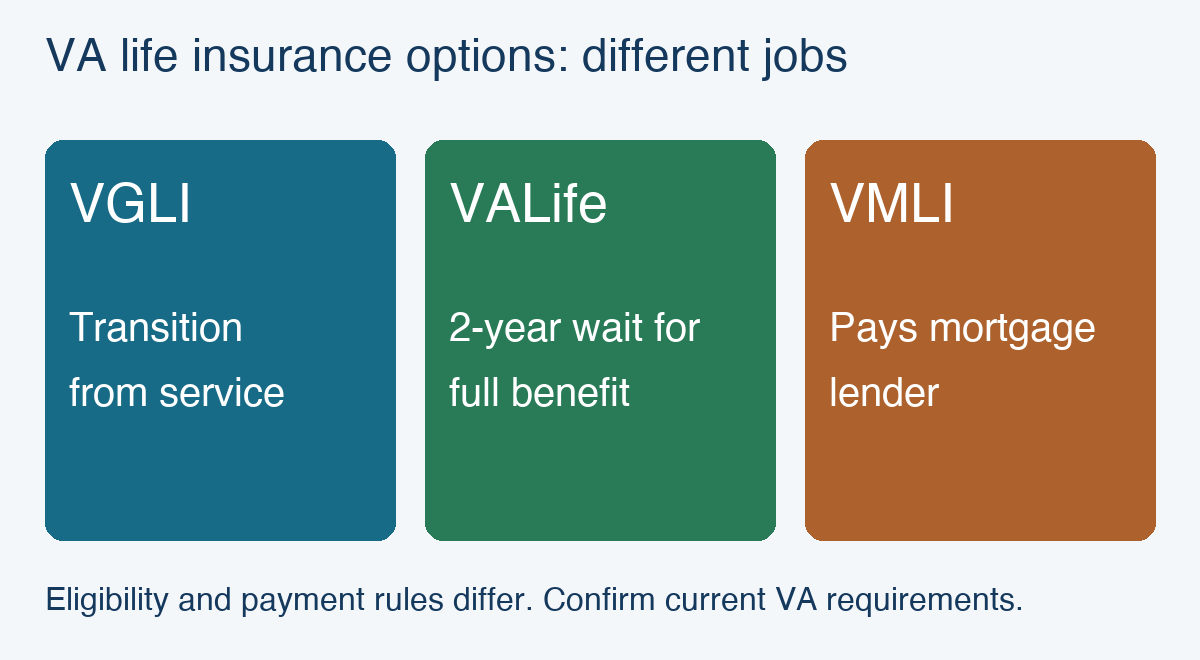
The VA’s insurance options and eligibility overview separates programs by the people and needs they serve. SGLI generally concerns eligible service members; FSGLI concerns eligible family members of covered service members; VGLI concerns eligible former service members. VALife addresses eligible veterans with service-connected disability ratings. VMLI serves a narrower adapted-housing mortgage need.
Those VA life insurance options are a starting map. They do not mean every veteran can choose every program at any time, or that a spouse receives an identical policy automatically. Write down the complete name of each policy you already have. An acronym remembered from discharge paperwork is easy to confuse with the insurance actually in force today.
Also separate life insurance from health care, disability compensation, and other survivor benefits. A VA health-care enrollment card does not establish a life insurance death benefit. When reviewing a household plan, list each resource separately and confirm its conditions before assigning it a job.
VGLI: watch the transition window
Veterans’ Group Life Insurance, or VGLI, is renewable group term insurance for eligible former service members. The VA’s VGLI guidance describes benefits from $10,000 to $500,000, with initial coverage tied to the SGLI amount held at separation. Eligibility includes specific separation and reserve-related circumstances; the full VA requirements matter.
For the usual separation pathway, the application window is one year and 120 days after leaving service. Applying within 240 days avoids a health review. After that earlier window, health evidence is required. Put both dates on the calendar rather than treating the final application deadline as the only deadline.
Imagine an applicant who wants to compare civilian coverage after separation. That comparison can be sensible, but waiting for a perfect quote could allow the no-health-review opportunity to pass. The practical task is to compare options while protecting available rights, not to discover those rights after the deadline.
Which date comes first: the end of your current protection, the no-health-review deadline, or the final application deadline? They may be different dates.
VGLI premiums depend on age and coverage amount. Continued coverage requires the required payments; an affordable starting bill does not establish lifelong affordability. Ask for the future age-band costs as well as today’s cost. A premium comparison should cover the years during which the household expects to need protection. That is a major consideration when weighing VA life insurance options against private coverage.
Temporary current notice: VA announces a VGLI premium holiday for eligible insureds from November 1, 2026, through January 31, 2027, with coverage continuing. Check the eligibility notice linked from VA’s page. This temporary holiday does not make the program permanently free or erase later payment obligations.
SGLI ending is a separate event
The VA’s SGLI information describes 120 days of free coverage after leaving service and a possible disability extension for qualifying people. That continuation period is different from the VGLI application window. Having time left to apply for new coverage does not by itself mean old coverage remains active throughout that time.
Before separation, obtain the actual coverage amount, beneficiary record, effective dates, and information about any extension that may apply. If a transition has already happened, work from the documented separation date rather than a rough recollection of the month. A calendar calculation deserves more care than “sometime this spring.”
Do not assume an application, acknowledgment email, or planned payroll deduction proves that replacement coverage is effective. Confirm acceptance, required payment, and the actual start date. Keep a copy where the household can find it. The goal is continuity people can verify, not simply another form submitted.

THE OCALA INSURANCE GUY · HOUSE AD
Deadlines don’t pack themselves.
The suitcase is fictional. The transition deadlines deserve real attention. Waiting until every other task is finished can leave too little time to compare coverage, complete an application, or preserve a no-health-review opportunity. Start with the earliest relevant date and work backward. We can help you organize the insurance questions while the VA confirms program eligibility.
VALife: guaranteed acceptance has a waiting period
Veterans Affairs Life Insurance, called VALife, is a different program. The VA’s VALife eligibility page describes guaranteed acceptance whole life coverage for eligible veterans with service-connected ratings, including a 0% rating. The usual eligibility route is age 80 or younger, with a narrow later-age exception tied to when disability compensation was requested and awarded.
Coverage is available in $10,000 increments up to $40,000. Full coverage begins after a two-year waiting period, during which premiums must be paid. A death during that period produces repayment of premiums plus applicable interest rather than the full face amount. Guaranteed acceptance is therefore not the same thing as immediate full protection. Among VA life insurance options, that waiting period is especially important when a family needs coverage right away.
The premium depends on application age and selected amount and stays level while the policy is maintained. VALife has no premium waiver and no policy loans. Cash value begins after two years. Confirm the current VA terms for your situation; a general description of whole life insurance does not establish this particular program’s features.
Make the waiting period visible: In a household coverage inventory, label the amount available now separately from the amount expected after a waiting period. Counting a future full benefit as present protection can hide a real gap.
What a smaller permanent benefit can—and cannot—solve
A lasting benefit can have a useful role when the goal is a defined final expense or a modest legacy. But choosing the maximum available amount is not a substitute for calculating need. A household may have several years of income support to fund, or it may already have resources set aside for that purpose.
Here is a hypothetical planning example, not an insurance recommendation. Suppose a household estimates $150,000 of remaining support and final-expense needs and identifies $30,000 of savings genuinely available for those needs. That leaves a $120,000 gap. A $40,000 benefit, once fully effective, would cover only part of that estimate.
During a waiting period, the picture is different again. The household should not subtract the future $40,000 as though it were already payable. Nor should it count the same savings once for ordinary retirement spending and again for survivor needs. Give each resource a clear purpose and avoid spending the same dollar twice on paper.
That exercise may point toward combining existing protection with another policy, reducing a planned amount, or revising assumptions. It does not prove that a particular person qualifies for additional coverage. We would compare eligibility, timing, cost, and the actual need together before discussing a recommendation.
Already have S-DVI? Pause before changing it
Service-Disabled Veterans Life Insurance, or S-DVI, closed to new applications after December 31, 2022. Existing policyholders may retain their policies. The VA’s S-DVI guidance explains a consequential rule for people applying for VALife on or after January 1, 2026: existing S-DVI ends when VA approves the VALife application, while full VALife protection still has a two-year wait.
That includes policies with premium waivers, and the waiver does not transfer to VALife. An older article describing temporary overlap for earlier applicants could therefore lead a current applicant astray. Check the rule for the actual application date and ask VA to explain the effect on the existing policy before making the change.
“Newer” and “larger” do not automatically mean “better for this household.” Put existing benefits, present premiums or waivers, lost rights, waiting-period exposure, and future costs in writing. A comparison should show what disappears as clearly as what is added. Do not surrender useful coverage simply because the replacement’s headline amount is higher.
VMLI protects a qualifying mortgage
Veterans’ Mortgage Life Insurance, or VMLI, is narrower than general family protection. The VA’s VMLI requirements include a qualifying severe service-connected disability, a Specially Adapted Housing grant, home ownership and a mortgage, and application before age 70. This is not an automatic feature attached to every veteran’s home loan.

VMLI can pay up to $200,000 directly to the mortgage lender. Coverage follows the eligible outstanding mortgage balance and decreases as that balance falls. It has no cash or loan value. A mortgage payoff can help a household considerably, but it does not provide the same flexibility as money payable to a chosen family beneficiary.
Ask what happens to the rest of the household budget even if the mortgage is paid. Utilities, property taxes, maintenance, food, and personal assistance can continue. A lender benefit and a family’s cash needs should have separate lines in the plan. Our mortgage life insurance guide develops that distinction.
If moving or refinancing, check the program’s reporting requirements and any effect on premiums or coverage before assuming the old arrangement follows unchanged. A housing transaction and an insurance transaction can interact. Keep both sets of records together so that a helpful mortgage change does not create an overlooked protection problem.
Compare private coverage without giving up existing rights
VA life insurance options and private insurance do not need to be treated as rival teams. A useful comparison asks which combination, if any, addresses the household’s actual needs at a sustainable cost. The VA’s VALife FAQs confirm that other VA or private policies can coexist with VALife.
For a private application, ask how health history, tobacco use, occupation, activities, and requested amount affect underwriting. Underwriting is the insurer’s process for evaluating an application and setting its terms. A preliminary quote is an assumption-based estimate, not an approval or proof that the price will be available.
Compare equal amounts and relevant durations wherever possible. A ten-year level premium, an age-banded renewable premium, and a lifetime level premium describe different cost patterns. Looking at one month’s payment can conceal a meaningful difference five or fifteen years later. Ask what is guaranteed and what could change.
Policy features matter too. Check exclusions, conversion rights, renewal limits, riders, and cancellation consequences. A rider is an addition that changes a policy’s benefits or terms. Do not assume that a feature mentioned in an advertisement is included, free, or available in every state or health situation.
If the new application is declined or priced differently, what protection will still be active? Have that answer before ending an existing policy.
Our life insurance replacement guide explains why an application should not be confused with effective replacement coverage. Confirm the issued contract, acceptance, required payment, and start date. Where a change affects government coverage, also confirm the program-specific consequences with its administrator.
Does a veteran’s policy cover a spouse too?
Do not read a benefit amount on one person’s policy as protection on both lives. Ask whose death triggers payment and whose financial contribution needs replacing. Two adults may each have a protection need even where only one earns a salary. A policy on one life does not solve the other person’s income or caregiving gap.
Family coverage also deserves its own transition review when service ends. For eligible FSGLI spouse coverage, VA describes a 120-day window to convert to a participating insurer’s individual permanent policy following separation, divorce, the service member’s death, or termination of SGLI or spouse coverage. Dependent-child FSGLI coverage cannot be converted. See VA’s FSGLI conversion guidance and confirm the event date and requirements with the program. Do not assume arranging the veteran’s next policy automatically arranges a spouse’s coverage.
Keep beneficiaries and household records usable
A beneficiary is the person or entity designated to receive a policy’s death benefit. Review that designation separately for each policy. A change on one employer, VA, or private contract should not be assumed to update another. Keep confirmation that the correct administrator recorded the intended change.
Think through the backup designation as well. What if the first beneficiary dies before the insured? What if a child is still a minor? Those situations can require additional planning. Our life insurance beneficiary rules guide explains common questions; legal arrangements belong with a qualified attorney.
Make the records easy to locate without making them public. A trusted person should know the insurer or program name and where the policy information is stored. Avoid posting account numbers, identification documents, or medical information in ordinary messages. A readable inventory can help without exposing sensitive documents.
A practical way to review your VA life insurance options
Start with a one-page inventory of active coverage. For each policy, record the insured, owner where applicable, benefit amount, premium pattern, beneficiary, and confirmed effective dates. Mark waiting periods and lender-only benefits clearly. Leave uncertain fields marked “confirm” rather than filling them with assumptions.
Next, build a separate deadline list. Include the separation date, current coverage ending date, VGLI health-review and application dates where applicable, and any policy-specific action deadline. Add enough lead time to collect information and make a decision. A reminder on the final day leaves little room for a missing document.
Then compare the household’s need with resources available at each stage: today, during any waiting period, and after the proposed full benefit begins. Stress-test the premium budget too. Would the payment still fit after a job change or another expense? A plan that depends on never having an expensive month needs another look.
Bring these questions to the comparison: Which program am I eligible for? What is payable now? What changes later? Who receives the money? What payment keeps coverage active? Which rights disappear if I change it? What remains if the new application does not work out?
Finally, obtain written confirmations and update the inventory after the decision. Do not leave a proposed policy listed as active or an ended policy listed as continuing. Clear records help the next conversation start with facts instead of reconstructing a trail of old quotes and emails.
VA life insurance options can be valuable, but the useful choice depends on the person, timing, and job the coverage must do. We welcome questions about comparing VA life insurance options with private protection, understanding premium patterns, and identifying gaps. Use The Ocala Insurance Guy Contact Form to tell us what you want the insurance to accomplish.
About Jay A. Cohen, The Ocala Insurance Guy
Jay A. Cohen is a licensed health and life insurance agent based in Ocala, Florida. He is licensed in Florida, Virginia, Illinois, Utah, and California.
Our approach is educational: we listen to understand your needs, goals, and budget, then explain your options in plain language. We walk through the benefits, costs, and limitations, welcome your questions, and help you make an informed decision without pressure to buy a particular product.
To explore permanent coverage and available policy options, visit the Jay A. Cohen life-insurance information page. You can also learn more about Jay’s educational approach and insurance experience.
Want help organizing your coverage comparison? Use The Ocala Insurance Guy Contact Form.
Educational information only, not individualized insurance, legal, tax, investment, or VA benefits advice. VA determines its program eligibility and benefits; confirm current requirements directly in official program materials. Private policy availability, premiums, underwriting, benefits, exclusions, and guarantees depend on the insurer, contract, and applicable state rules. The Ocala Insurance Guy is not affiliated with or endorsed by the Department of Veterans Affairs or the U.S. government. Hypothetical examples are planning illustrations, not quotes or recommendations.